
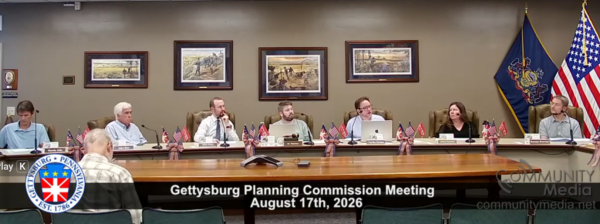
The Gettysburg Planning Commission continued its lengthy review of the proposed Gettysburg Station development Monday, focusing on traffic, public access to project documents and the commission’s role in evaluating the effects of the large mixed-use project on borough streets.
The Aug. 17 meeting also included acceptance of a land development application for the Adams County Historical Society’s Hopkins House project at 219 S. Washington St., discussion of an overhaul of the borough’s Subdivision and Land Development Ordinance, and a decision to move the commission’s September meeting because of Yom Kippur. The agenda listed Gettysburg Station, the Simrat LLC project at 351 E. Water St., Hopkins House and the ordinance update as the principal business.
Gettysburg Station traffic study
Much of the discussion centered on the traffic impact study for Gettysburg Station, the proposed development at 108 N. Stratton St.
Borough Engineer Chad Clabaugh said the traffic study has gone through six review cycles. An earlier version had shown an unacceptable level of service on Chambersburg Street at Lincoln Square, but officials subsequently discovered that traffic counts had been taken during the Remembrance Day parade, when two approaches to Lincoln Square were closed.
Clabaugh said the affected portion of the study was redone using traffic counts taken under normal conditions and the problem identified in the earlier analysis disappeared.
An Aug. 3 letter from C.S. Davidson, the borough’s engineering firm, says the most recent traffic impact study, dated June 12, has satisfactorily addressed all outstanding technical comments. The letter also notes that the current development plan proposes no bus traffic on Hazel Alley and recommends that, “when deemed appropriate,” the borough tell PennDOT it accepts the updated study.
Commission members questioned whether that letter should be sent yet, particularly because details of the project’s transit center have continued to evolve.
Clabaugh told the commission that the borough had received information that day indicating Rabbittransit plans to use a somewhat shorter bus that can negotiate the proposed transit center without using Hazel Alley or the neighboring SCCAP parking lot. He cautioned that the developer should formally present that information to the commission.
The commission did not take action Monday to send the acceptance letter to PennDOT.
Members also discussed the effects of the development on Stratton Street and other borough-controlled streets, separate from PennDOT’s review of state roads. Staff said Gettysburg’s SALDO encourages traffic analysis but does not necessarily require a developer-funded traffic impact study for local streets. Broader improvements could instead involve borough projects supported through state or federal funding.
The discussion included possible traffic-calming measures and the commission’s responsibility under the SALDO to consider public health, safety and welfare.
Access to traffic documents questioned
Public access to the various versions of the traffic study also became an issue.
During public comment, a community member questioned an earlier version of the study and asked about mitigation for traffic delays at Lincoln Square. The discussion revealed that the version the speaker had reviewed was not the latest one.
Commission members subsequently asked why updated versions of the study were not routinely available to commissioners and the public.
Planning Director John Whitmore said application materials are not necessarily posted online as they arrive, in part because some remain works in progress and some traffic-study material can contain proprietary or otherwise sensitive information. Borough officials said documents subject to Pennsylvania’s Right-to-Know Law can be requested through that process.
Clabaugh said later versions of the traffic study have removed sensitive crash information and indicated the developer’s traffic engineer has generally been willing to allow the studies to be distributed.
Commission members expressed interest in making the latest information more readily available as they continue reviewing the project.
The commission is expected to hear directly from the Gettysburg Station development team at its September meeting. Members were encouraged to submit questions and requests for additional information in advance so the developer has time to respond.
Among the additional information requested Monday were updated documentation from Rabbittransit, information about electric-vehicle fire-suppression requirements, a seasonal shadow analysis that had been discussed earlier in the review process, and consideration of how construction noise, hours, staging and truck routing would affect nearby residents.
The Adams County Office of Planning and Development, meanwhile, continues to support the Gettysburg Station project. In its Aug. 11 review, the county said most earlier comments had been addressed, although some relatively minor ordinance and site-design matters remained. The county said the location is appropriate for the proposed type and intensity of development and could provide additional housing and business opportunities.
Borough staff emphasized that the project is still some distance from final approval. Among other steps, it requires additional outside-agency reviews and ultimately a PennDOT Highway Occupancy Permit.
Hopkins House application accepted
The commission also formally accepted for review the Adams County Historical Society’s land development application for the Hopkins House at 219 S. Washington St.
The application describes a 0.12-acre property owned by the historical society. The project follows previously approved work removing later additions from the historic cabin and stabilizing the original structure.
Project documents call for a new two-story museum and support building behind the historic cabin, along with a new sidewalk on South Washington Street, parking near Warner Alley, patios and pocket parks, accessibility improvements, utilities and stormwater facilities. The historic Hopkins House dates to approximately the 1840s and is described in the project materials as one of Gettysburg’s oldest and most significant buildings associated with the town’s Black community.
After staff determined the submission was sufficiently complete to begin formal review, the commission unanimously voted to accept the application.
The Simrat LLC land development proposal at 351 E. Water St. remained tabled.
Borough considers major SALDO update
The commission also resumed discussion of updating Gettysburg’s Subdivision and Land Development Ordinance.
Whitmore said staff has recovered materials from an earlier attempt to revise the ordinance and is considering whether some subjects now included in the SALDO — including landscaping, lighting and sidewalks — might be better addressed through separate borough ordinances.
Sidewalks are a particular concern. Whitmore said the borough is considering placing a comprehensive SALDO and sidewalk review in its capital improvement program, potentially allowing the borough to hire an outside consultant. He said the borough faces pressure to improve sidewalk conditions while confronting the substantial cost of maintaining and replacing them.
Commission members also discussed Gettysburg’s unusual governmental structure, under which the Planning Commission itself has authority to approve land development plans. Solicitor Adam Boyer said that authority is more commonly retained by elected municipal governing bodies.
The SALDO discussion is expected to continue later this year.
September meeting moved
Finally, the commission voted unanimously to move its next meeting from Monday, Sept. 21, to Wednesday, Sept. 23, at 7 p.m. because the originally scheduled meeting falls on Yom Kippur.
The borough plans to advertise the change, notify applicants and post the revised meeting date on its website.