
The 1797 presidential transition, when George Washington handed the presidency to his vice president, John Adams, was a remarkable event simply because it happened. It was almost unknown for a person with government executive power to give it up voluntarily. Short or long, due to natural causes or assassination or death in battle, executive leadership tended to be a lifetime job.
But George Washington left the job voluntarily when he could have easily been re-elected . And he was replaced by a political ally. Yet to be determined was what would happen when a man who still wanted the job had to give it up – and to a political adversary. Both of those challenges happened in the 1800 election.
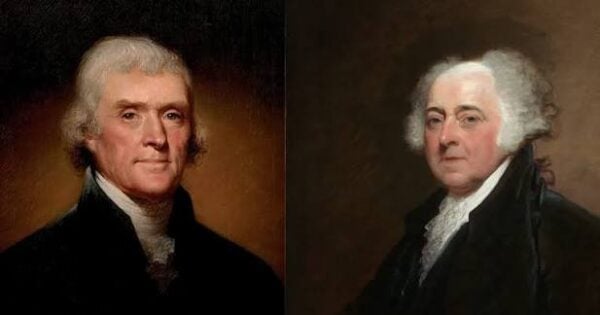
The 1796 election also demonstrated a structural problem with the way we elected presidents and vice presidents, but, like the answer to the question about contested elections, the solution to this problem would await the 1800 election. First, in 1796, the popular vote was basically irrelevant. In half the states, there was no popular vote at all and in the other eight (by now, Kentucky, Vermont, and Tennessee had been added to the original 13) the voters didn’t vote for a presidential candidate, but for electors. Each elector voted for two candidates and the second-place finisher was vice president. Political parties were beginning to predominate but didn’t yet have the party discipline to enforce rigid party line voting. While most electors voted for either Adams or Jefferson, the Adams voters split their second votes. Adams’s intended running mate, Thomas Pinckney of South Carolina finished third and Adams’s bitter rival, Thomas Jefferson, was elected vice president. Needless to say, this did not make for a smoothly functioning team.
This problem surfaced again in 1800, with even more serious potential consequences. This time, party-line discipline held, but that meant Jefferson and his vice-presidential candidate, Aaron Burr, wound up with the same number of votes. And Burr, who everybody understood was Jefferson’s intended vice president, declined to so inform the House of Representatives, which would decide the election. In the end, Jefferson only won because Alexander Hamilton despised Burr even more than he hated Jefferson and convinced Federalist Party voters to vote for Jefferson. That problem was solved by the 12th Amendment, which stipulated that presidential and vice-presidential candidates would run as a ticket and be voted on together.
That settled, the presidential transition came next. On March 4, 1801, Thomas Jefferson became the first president to walk to his inauguration, the first to be serenaded by the Marine Band, the first to be inaugurated in Washington, D.C. – and the first to take the reins of office from a political rival. It was immediately celebrated as a moment of unity and reconciliation after a bitter campaign, which Jefferson solidified by giving an inaugural address that stressed harmony and reconciliation. However, John Adams didn’t witness this moment: mortified by his loss and the recent death of his son, he left Washington early that morning.
The peaceful transfer of power has been one of the hallmarks of American politics. There have been many bitter presidential elections and a total of 11 (1800, Adams v. Jefferson; 1828 JQ Adams v. Jackson; 1840 Van Buren v. Harrison; 1888 Cleveland v. Harrison; 1892 Harrison v. Cleveland; 1912 Taft v. Wilson; 1932 Hoover v. FDR; 1976 Ford v. Carter; 1980 Carter v. Reagan; 1992 Bush v. Clinton; 2020 Trump v. Biden) where the incumbent lost. But most defeated incumbents welcomed their successor graciously and from 1800 through 2016, no defeated presidential candidate refused to concede the election.
