
Gabor S. Boritt, renowned author, scholar of Abraham Lincoln and the American Civil War, founder of the Civil War Institute at Gettysburg College, and co-founder of the Gilder-Lehrman Institute of American History and the Lincoln Prize, died on February 2, 2026. He was 86, having just entered his four score and seventh year.
Boritt spent his childhood in war-torn, fascist-controlled Hungary during World War II and the Soviet occupation. A participant in the 1956 Hungarian Revolution, he escaped the country after the Russian invasion and came to America as a refugee, ultimately settling on a historic farm near Gettysburg, Pennsylvania, where he spent the remaining 43 years of his life.
Ken Burns, documentarian: “Gabor Boritt was a towering figure in Civil War and Lincoln scholarship. He had a profound influence on my understanding of that period and that man, as well as my work. And he was a good friend—for decades. His loss is immeasurable.”
Karl Rove, former senior advisor to President George W. Bush: “Gabor Boritt was a great man and a symbol of the promise of our country. To have escaped Hungary, come to the shores of this country with nothing, and to have become one of America’s leading historians is such a wonderful story.”
Stephen Lang, actor: “As a scholar and historian Gabor Boritt was of the highest caliber. To be in his presence was to engage with not only a first-rate intellect but a raconteur of rare skill. Gabor was a serious man with a serious twinkle in his eye. I will cherish the memory of his kindness and his laughter.”
Harold Holzer, Jonathan F. Fanton Director of the Roosevelt House Public Policy Institute at Hunter College: “Gabor Boritt was that rarest of figures: a groundbreaking scholar, a brilliant teacher, a highly gifted writer, and a magnetic public historian who brought people together across generations to engage in the American saga. He revolutionized our view of Lincoln’s economic beliefs, produced highly influential landmark books, and over the years convened tens of thousands of college students, fellow historians, lifelong learners, and enthusiasts at special conferences. Gabor was all this, and a role model as a born-again American—a shining example of why immigration makes our country greater, and our collective story brighter.”
Dr. Ian Isherwood, associate professor of War and Memory Studies and director of the Civil War Institute at Gettysburg College: “Professor Boritt had a profound impact on the field of Civil War Era Studies and on the study of history at Gettysburg College. The founding of the Civil War Institute was a landmark moment in the field.”
Andrew Dalton, President & CEO of Gettysburg History: “Gabor was a tireless advocate for this place, not just as a scholar but as a citizen of Gettysburg in the deepest sense. He loved this town fiercely, and Gettysburg loved him right back. He will be sorely missed.”
Michael Birkner: Gabor’s vision and the energy he put behind it made Gettysburg College a real force in the national conversation about the American Civil War. His enthusiasm for learning rubbed off on his students, his friends, and young scholars in particular. Few scholars have had his impact, and we are better for it.
Gabor was born on January 26, 1940, in Budapest, Hungary, to Rozsa and Pal Roth-Szappanos (in the United States their surname would be changed to Boritt). Gabor was the youngest of three children in a Jewish family that included his brother Adam and sister Judy. For the first four years of his life, the family lived in a stone house in the wealthy Rózsadomb area in the hills of Buda as World War II engulfed Europe. In March 1944, Nazi forces took over Hungary and Hitler’s “Final Solution,” the aim of which was the systemic eradication of the Jewish people, began to be implemented across the country. Gabor’s grandfather’s family was deported from rural Transylvania and murdered at Auschwitz.
Gabor’s immediate family of five was forced from their home. They found refuge in the janitor’s closet of 44 Wesselényi utca, a school that had been converted into a makeshift hospital on the edge of the Budapest ghetto. Gabor’s father Pal helped lead resistance efforts against the Nazis by rescuing potential deportees from train platforms. While their father was away, the family was once threatened by a Nazi thug waving a pistol. It was an exceptionally cold winter, and the frozen bodies of the dead were stacked in the courtyard of the makeshift hospital, eventually reaching beyond the first floor windows. The Soviet army began a siege of Budapest in December of 1944. Allied planes dropped bombs on the city. Gabor recalled to his son a shell striking the floor of the building near where his family had been sitting.
By the end of the war, Budapest was in ruins and Hungary was firmly in Stalin’s grip. Soon thereafter, after Gabor’s mother died suddenly—an emotional wound he carried with him for the rest of his life—and his father and brother were imprisoned, he was sent to an orphanage. He remembered that it was a tough place and he was a small guy, but here he learned that when he got knocked down, he had to get back up.
In 1956, 16-year-old Gabor joined the Hungarian Revolution. He participated in protests on October 23. Riding on vehicles through the city, they shouted “Ruszkik, haza!”—“Russians, go home!” He joined a group that was attempting to pull down a massive statue of Jozef Stalin. Gabor helped fetch ropes and, by the time he returned, the statue had been toppled and the crowd had broken off pieces. Gabor took a piece of the statue as a memento. Later, he described the euphoria of the revolution in his son Jake’s documentary Budapest to Gettysburg: “We thought it was a whole new world. Anything was possible.”
Just days later, 3,000 Soviet tanks crushed those possibilities. Gabor’s father Pal had helped get supplies to the revolution but realized his family must flee. The family apartment building on Teréz körút was bombarded by Russian tanks while they sheltered in the basement. As the building partially collapsed, Gabor and his family escaped. While his elder brother, Adam, left immediately, their father told Gabor and his sister Judith to go to an English-speaking country. They headed for the Austrian border and, in darkness, hiked through wooded hills until they came to a no-man’s-land guarded by watchtowers and soldiers with machine guns. Freedom lay on the other side. Together, they started running.
Upon reaching Austria, Gabor got his first taste of free society. The first thing he wanted was the drink forbidden to him behind the iron curtain: Coca-Cola. When he finally tasted a Coke, he was disappointed. After spending months at an Austrian refugee camp, Gabor came to America—President Dwight Eisenhower had welcomed 40,000 Hungarian refugees to the United States—with just one dollar in his pocket, sent to him by his brother.
Gabor arrived in the “dirtiest city” he had ever seen: New York. He worked in a hat factory. Here he was told that America is “out west,” so he headed to South Dakota. Gabor wanted to learn English, so, in 1959, he picked up a free booklet of Abraham Lincoln’s writings. Captivated by Lincoln’s mastery of the language and his rise from poverty to the presidency, he began studying American history and obtained a Bachelor of Arts degree from Yankton College in 1962, followed by a master’s degree from the University of South Dakota the next year. Soon after, Gabor decided to continue his studies, eventually earning a Ph.D. from Boston University in 1968.
As an immigrant, he felt obliged to go to Vietnam, where he taught soldiers about the American Civil War in Phuket and Danang, as well as at other military bases in Asia.
In 1978, he published his first book, Lincoln and the Economics of the American Dream. The opening lines of the book read: “In the beginning were the land and the dream. The land, Robert Frost has written, was ‘vaguely realizing westward, but still unstoried, artless, unenhanced.’ The dream was as old as mankind, of the ‘city upon a hill,’ a light to the world, where men were endowed with the right to rise in life.” The book constituted an original and groundbreaking study of Lincoln’s beliefs and was nominated for the Pulitzer Prize. A survey of leading experts by Civil War Times lists the book among the ten most important books ever written about the 16th president.
Gabor loved teaching. A dedicated professor, Gabor had academic appointments at Harvard University, the University of Michigan, Washington University in St. Louis, and Memphis State, before arriving at Gettysburg College, mere blocks from where Lincoln had delivered his most famous address, in 1981.
As a professor at Gettysburg College, Gabor taught American history to students over many decades. He founded the Civil War Institute and, with the help of philanthropists Richard Gilder and Lewis Lehrman, established the $50,000 Lincoln Prize, which is widely considered the most coveted award for the study of American history. He also helped create the Gilder Lehrman Institute, a leader in improving the teaching of history in schools, and served on the board of the Gettysburg Foundation, helping to build a new visitor center for Gettysburg National Military Park.
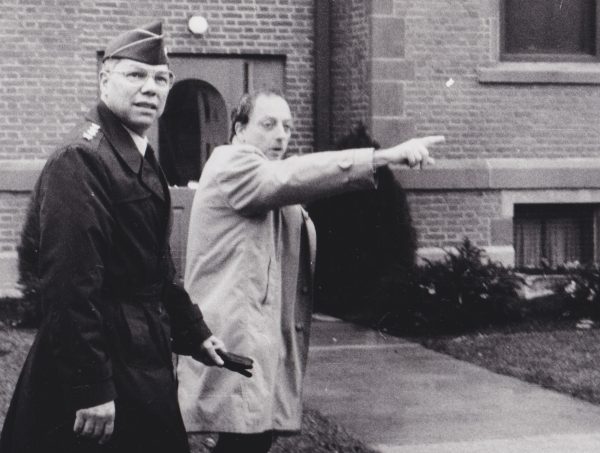
Beyond this, Gabor was a renowned and highly sought-after guide on the Gettysburg battlefield. He guided luminaires such as Supreme Court Justice Sandra Day O’Connor, actor Charlton Heston, author Elie Wiesel, and General Colin Powell, along with foreign leaders, including Colombian President Alvaro Uribe Velez and Israeli Chief of Defense Moshe Levy. In September 2008, Gabor gave a tour of the Gettysburg battlefield to President George W. Bush, Laura Bush, and a group that included White House Advisor Karl Rove, Former Attorney General Alberto Gonzalez, and Secretary of Education Margaret Spellings.
Among his other books are The Lincoln Image, The Confederate Image, The Gettysburg Nobody Knows, and The Lincoln Enigma.
In 2006, he published The Gettysburg Gospel: The Lincoln Speech Nobody Knows. It was featured on the cover of U.S. News and World Report and described as “fascinating” by The New York Times. Gabor wrote of the speech Lincoln delivered in the midst of the buried Union dead at Gettysburg: “Gettysburg, after the battle, is the site of the greatest man-made disaster in American history. This is where the president came to explain why a bloody war had to go on. ‘Gospel’ suggests spiritual rebirth. When Lincoln’s words are best understood, they bring that potential to Americans, indeed to people everywhere. His words pointing to rebirth went even deeper than the Christian message, if that was possible, reaching the primeval longing for a new birth that humankind has yearned for and celebrated with every spring since time immemorial.”
At the White House in 2008, President George W. Bush honored Gabor with the National Humanities Medal for a distinguished career of scholarship on Lincoln and the Civil War era, commenting, “His life’s work and his life’s story stand as testaments to our Nation’s precious legacy of liberty.”
The film Budapest to Gettysburg, a documentary by his son Jake Boritt, chronicles Gabor’s history in Hungary and his work on Lincoln and the Civil War. It follows Gabor’s return to Hungary to explore the epic history of his youth that he had heretofore refused to study, and how it had contributed to his important work on Lincoln, the Civil War, and American freedom.
Personal
As a graduate teaching assistant at Boston University, Gabor met Elizabeth Lincoln Norseen (Liz) in 1963 when she entered his class late and required after-class help. In 1968, they married on Elizabeth’s family farm in Bolton, Massachusetts. In 1983, they purchased an abandoned farm near Gettysburg on the banks of Marsh Creek and restored the circa 1799 stone house on the property themselves. It had once been the home of Basil Biggs, a free Black man who used the house as an Underground Railroad stop to help runaways escape enslavement. During the Battle of Gettysburg, the farm was used as a major field hospital by Confederate soldiers under William Barksdale (Mississippi) and Paul Jones Semmes (Georgia). At least 48 Confederate bodies were buried on the farm. It is likely the only Gettysburg home used as both an Underground Railroad stop and a Confederate field hospital. Gabor lived on the farm for exactly half of his life until his final days.
Gabor and Liz had three children: Beowulf Norseen Boritt (1970), a Tony Award-winning set designer living in New York City; Jake Boritt (1975), a documentary filmmaker and founder of the Gettysburg Film Festival; and Dan Boritt (1980), who serves as executive director of the Indiana Wildlife Federation.
After suffering some serious health issues, Gabor retired to live on his farm in Gettysburg with his wife. They were eventually joined by his son Jake and his family, which included three of his grandchildren, whom he enjoyed pushing in swings and chasing as “Tata Monster.” He enjoyed sitting on the porch by the creek singing favorite songs, including “Oh What a Beautiful Morning” and “Hava Nagila.”
Gabor is survived by his wife Liz; his son Beowulf; his son Dan, his wife Katie Moreau and their children, Henry and Leo; and his son Jake, his wife Heather Ross, and their children, Lincoln, Ellis, and Sadie Rozsa.
In lieu of flowers, please consider making a donation in Gabor’s memory to:
Gabor S. Boritt Endowed Fund Gettysburg College Civil War Institute 300 N. Washington Street, Gettysburg PA 17325 Gabor S. Boritt Endowed Fund https://www.gettysburg.edu/civil-war-institute/funding-priorities/


I am a ’91 History grad who took Civil War and the Lincoln Senior Seminar. Also, Professor Boritt was my advisor my final 3 years. I still cherish being his student and visitor to his home. God bless him and his family.
I am very honored to have known Gabor through my years attending the CWI. His vision and hard work brought the War to life. As a member of the 2nd South Carolina String Band we want to honor his memory and thank him for his support. We were lucky to have known him and he will be missed. Tom
So sorry to hear about Gabor’s passing. I first knew Gabor when he and I were both PhD candidates at Boston University under our mentor Professor Ken Bernard.
I also became a college teacher at Bridgewater State University specializing in the Lincoln Assassination. We continued to be friends over the decades and I spoke a number of times at the Gettysburg Institute and Gabor several times addressed the Lincoln Group of Boston.
A tremendous scholar, who had an enormous impact on the field of Lincoln studies, and a lifelong friend, he will be sorely missed.
I’m so deeply sorry for your loss and my condolences to the family and friends of Mr. Gabor Boritt