
Eric Williams, Rochester Institute of Technology; Payam Saeedi, Rochester Institute of Technology, and Stacey Watson, University of Waterloo
Think about the last smartphone, tablet or smartwatch you stopped using. Odds are it is not in a recycling bin or a new owner’s hands; it is sitting in a drawer.
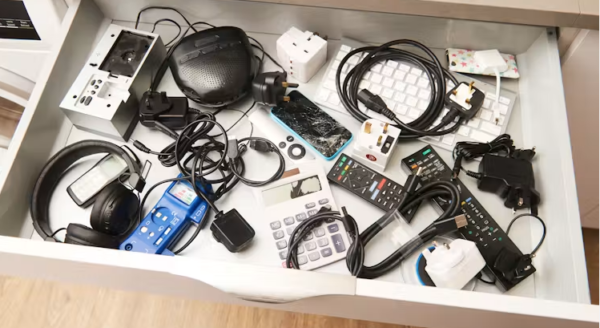
This look familiar? Peter Dazeley/Photodisc via Getty Images
From our survey of 4,000 American consumers, we found the single most common thing people did with a device they were finished with was nothing at all: 39% simply stored it. Recycling and reselling, outcomes better for the environment, each accounted for only about 1 in 10 devices. Throwing devices in the trash claimed another 9%.
Funded by the National Science Foundation, our multidisciplinary team blended our expertise in causal inference, sustainability and cybersecurity, to work on the tangled question of what people do with their consumer electronics when they’re done using them. We used statistical models to connect what people say – that is, their stated knowledge and attitudes – to what they actually did.
Why the drawer wins
Two main forces keep devices in the drawer. The first is anxiety about data. People who worried that recycling or reselling a device would compromise their data were 14% and 9% more likely to store it instead.
The second force is simply not knowing how to. People who did not know where to recycle were 10% more likely to hold onto a device, and many also kept old gadgets as a perceived data backup.
Recycling and reselling electronics are a lot easier than a lot of people think. In the U.S., the national chain Best Buy accepts devices for recycling; reselling online is convenient with vendors such as Back Market and Gazelle.
Just be sure to wipe data before parting with a phone or computer. Also, remove the device from your account, for instance with Apple or Android. Unless you do, the device stays locked to you, and no one else can use it.
We also compared what people intended to do with what they had actually done. This led to a telling detail: Data security worries led to people storing devices at a greater rate than they said they intended to.
In other words, the fear of leaking personal data kicks in only when someone is facing the real decision of whether to hand off their device to a recycler or secondhand buyer.
Getting at why people don’t recycle
Researchers have long studied why people do or don’t recycle electronics: Convenience, awareness and incentives showed up as affecting the decision. But prior work examined recycling as the only option.
Instead of considering the issue as a yes-or-no vote on recycling, we treat it as a comparison between different options: Storing, reselling, donating, trading in, recycling and throwing away the device in the trash. When modeling this way, trade-offs became visible.
Knowing where to recycle, for instance, made recycling 47% more likely, but it also pulled people away from reselling, which is often the more environmentally friendly choice. You can explore the survey results in our interactive dashboards. https://www.youtube.com/embed/HmEhTIMfZiI?wmode=transparent&start=44 Recycling your old devices is easier then you might think.
Getting people to let go
Storage is the worst of both worlds: A device sitting unused for years loses its resale value, and erasing its data only gets harder over time. The good news is that the main barriers – data concerns and not knowing where to turn – can be addressed with better information.
We are experimenting with information interventions that walk people through their options, including how to securely wipe their data. We are testing nudges with randomized, controlled trials to test what leads people to give their old electronics a second life.
It might be a good time to remember what old devices you’re holding onto and revisit your reasons for not letting go of them.
Eric Williams, Professor of Sustainability, Rochester Institute of Technology; Payam Saeedi, Ph.D. Candidate in Sustainability, Rochester Institute of Technology, and Stacey Watson, Assistant Professor of Computer Science, University of Waterloo
This article is republished from The Conversation under a Creative Commons license. Read the original article.

Each municipality in Adams County holds a covered device event twice a year, usually in April and September, to dispose of electronic devices including televisions. It’s a free event. You can visit http://www.adamscountypa.gov, search under the municipality you live in, and the dates of the events should be posted.
Good Will in Chambersberg accepts donations of electronic devices & even your big old CRT TV. Simple, fast – bins are in store rear. Pull up next to the bin, place your stuff into it & drive off. Hallelujah!
*No leaky, bursting batteries!
Is there a place in or near Gettysburg where we can recycle computers and cell phones?
Staples in Hanover does. I know it’s not in Gettysburg, but close. Check out their website for what they will accept.