
by Ian Karbal, Pennsylvania Capital-Star
Raina Yancey, founder of The Black Journey Philadelphia Walking Tour company, grew up around Independence National Historical Park.
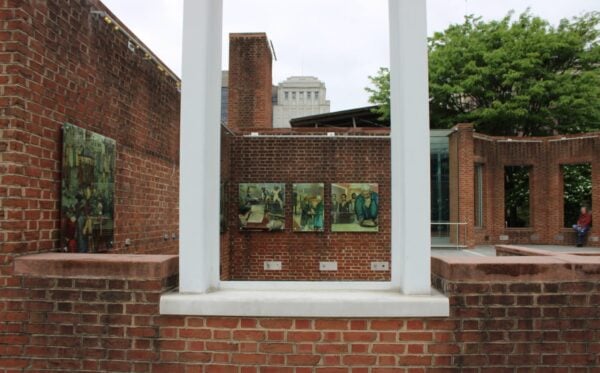
Exhibits at the President’s House in Philadelphia were replaced with signs experts say downplay the cruelty George Washington’s slaves experienced.
Her mother, Dr. Victoria Ward Yancey, was a park ranger at the federal historic district in Philadelphia where the Declaration of Independence and the U.S. Constitution were signed.
“There was not a lot of history or any mention of enslaved people, the role that people of African descent played in the revolution, or the role of African Americans in the early foundation of this country,” Yancey said about the site in the 1980’s and 1990’s.
But that changed in the 2000s when, while preparing to build a new Liberty Bell Center, archaeologists uncovered the foundation of the first presidential residence, and the slave quarters where at least nine people lived and served George and Martha Washington.
That led to the establishment of what is now the President’s House site, intended to be a monument to the enslaved people who served the nation’s first president during his time in office and a reminder of the paradox of freedom and slavery at America’s founding.
“I was so thankful and so proud in the early 2000s when the president’s house site and all of that history came to light,” Yancey said. “I felt included in the story and the narrative of the foundation of the country. I could connect to the young person Ona Judge [one of Washington’s slaves who escaped to freedom]. Representation matters.”
As a fight over the legacy of slavery brews in Pa., a historian tells how it shaped the commonwealth
Yancey, who is also a corporate lawyer, would go on to found the Black Journey with her mother in 2019. The group’s tour guides have given walking tours to thousands of people from around the world focused on Black history in Philadelphia during America’s foundational period.
Now, that group is central to the fight to ensure the history of Washington’s slaves and the role enslaved people played in the construction of the country can continue to be told at the President’s House site.
Earlier this year, after National Park Service workers removed exhibits on slavery from the President’s House site to comply with an executive order called “Restoring Truth and Sanity to American History,” The Black Journey joined the city of Philadelphia and an organization called Avenging the Ancestors Coalition in suing the Trump Administration to have the exhibits reinstalled.
A Circuit Court judge initially sided with the plaintiffs, ordering all exhibits reinstalled ahead of sesquicentennial celebrations in Philadelphia. But a panel of federal appeals court judges recently ruled the federal government should be allowed to replace the signs
In a conversation with the Capital-Star Wednesday — only hours after the exhibits were replaced with signs experts say downplay the cruelty Washington’s slaves experienced — Yancey discussed what it means to be part of keeping the site’s history alive.
Yancey remembers where she was in January, when she heard that the signage telling the story of Washington’s slaves had been taken down by NPS workers with little warning. She was at work, and then had to go to a dentist appointment before she could go home.
“I kept my composure, but I was extremely unhappy,” she said. “Then I went home and cried once I was alone and in private.
Yancey said she had a similar feeling Wednesday, when she learned that the signs had been replaced overnight with new panels that focus far less on the enslaved residents of the President’s House.
Only two of 11 new panels directly reference the enslaved people who lived there, and they provide far less information on the brutality American slaves regularly experienced. They also spend more space discussing Washington’s private opposition to the institution of slavery and how “slaves living in the President’s House experienced a greater modicum of autonomy than elsewhere in the South such as to explore the city and sometimes even attend the theater, with Washington buying the tickets.”
Yancey says she believes the new panels, while technically historically accurate, fail to convey just how central the institution of slavery was to the founding of the nation and the accumulation of wealth within it.
“This country became the wealthiest country in the history of the world because it benefited from exploiting trafficked people who were not paid, who were not able to create generational wealth” she said. “People were beaten and assaulted physically and sexually, were exploited, were separated from their family members. Babies were torn away from their parents.”
Moreover, Yancey said they gloss over the impacts the legacy of slavery still has on America today.
“It still has effects today through economics, through the criminal justice system, through housing and so many other ways like college attendance and employment,” she said.
A spokesperson for the Department of the Interior disputed Yancey’s characterization and said the new exhibits, “are full of historical context and highlight the momentous events that took place in the President’s House and the other sites at Independence National Historical Park.
“They acknowledge the evils of slavery, including its injustices and hypocrisies, and, by telling the stories of the nine slaves that Washington kept in the President’s House, remind us of their essential humanity.”
Even before the signs were replaced overnight between Tuesday and Wednesday, the Black Journey had already begun making changes to their tour scripts and audio guides in response to the actions of the Trump administration.
Tours, which have traditionally started at the President’s House, are also spending more time there now. And The Black Journey is now offering new tours
The Ona Judge tour tells the story of a young enslaved woman who escaped from the President’s House, whose history was previously documented in detail in the removed panels.
Another new tour makes a case for reparations. That’s in part by telling the story of Robert Morris, whose immense wealth built in part through participation in the slave trade helped fund the revolution.
The group’s legal battle continues as well. Yancey said there are still “a few paths forward” as the case continues, but did not provide details.
And the Black Journey will continue to provide tours, no matter where the case lands.
“People really do appreciate the full telling of history. They can handle it,” She said. “Even little kids. We have a lot of school groups come to the tour. A lot of families bring little ones, and we don’t shy away from talking about enslavement and the cruelty that entailed, though we tell it in a way they can understand.
“It’s a lot of history that was not necessarily told in a textbook or in school … People are hungry for this history. They want to know about it.”
Thank you for reading Ian’s story.
As the nation marks its 250th anniversary, it’s important to remember the role a free and independent press has played in its history.
Did you know the first paper to publish the Declaration of Independence on July 6, 1776 was in Philadelphia? People read the Founding Fathers’ words in the Pennsylvania Evening Post.
Every day, our team at the Pennsylvania Capital-Star works to live up to the ideals protected under the First Amendment. So if you believe that journalism is a cornerstone of a healthy democracy, invest in our newsroom today.
Please consider a one-time gift of $17.76 or $250 or “set it and forget it,” by making a monthly contribution between $17.76 and $50.
SUPPORT
Pennsylvania Capital-Star is part of States Newsroom, a nonprofit news network supported by grants and a coalition of donors as a 501c(3) public charity. Pennsylvania Capital-Star maintains editorial independence. Contact Editor Tim Lambert for questions: info@penncapital-star.com.
