
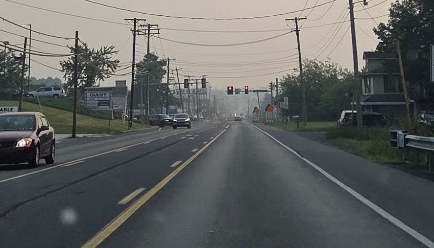
Smoke from massive Canadian wildfires continues to blanket Adams County, creating hazy skies, reducing visibility and prompting health officials to issue increasingly serious air quality warnings.
The Pennsylvania Department of Environmental Protection has declared a statewide Code Purple Air Quality Alert for tomorrow (Friday), meaning air pollution from fine particulate matter (PM2.5) is expected to reach “very unhealthy” levels. Under a Code Purple alert, everyone—not just people with asthma or other health conditions—is advised to avoid prolonged or strenuous outdoor activity.
Friday’s temperatures will reach 90 degrees.
The smoke originates from hundreds of active wildfires burning across Canada, particularly in Ontario, where winds have carried the smoke hundreds of miles into the northeastern United States. Stagnant weather has trapped much of the smoke near the ground, producing the milky skies and reduced visibility seen across Pennsylvania.
For many residents, the first sign has been the smell.
Wildfire smoke typically has a distinct campfire or wood-burning odor. People often describe it as smelling like a fireplace, burning leaves or fresh-cut firewood. As the smoke travels long distances, however, its chemistry changes. By the time it reaches Pennsylvania, the odor may become fainter, slightly sweet, musty, or stale.
Wildfire smoke may also smell like burned plastic, because, in addition to trees, wildfires burn houses, cars, furniture, appliances, and everything else in a neighborhood.
The primary health concern is not the odor itself but microscopic particles known as PM2.5. These particles are about 30 times smaller than the width of a human hair and are small enough to penetrate deep into the lungs and even enter the bloodstream. Because the nose detects gases rather than particles, smoke can sometimes smell strong when particle levels are only moderate—or have little odor even when unhealthy concentrations of PM2.5 remain in the air.
Even healthy people may experience irritated eyes, scratchy throats, coughing, headaches or shortness of breath during smoke events. Older adults, children, pregnant women and people with asthma, COPD or heart disease face the greatest risks and should limit outdoor exposure whenever air quality deteriorates.
The smoke is expected to linger through Friday, with temperatures climbing to about 95 degrees and unhealthy air quality continuing across much of Pennsylvania.
Relief may arrive Saturday as showers and thunderstorms move through the region. Besides bringing cooler temperatures, the rain and changing wind pattern are expected to wash some of the smoke from the atmosphere and improve air quality. Additional improvement is forecast for Sunday, although some lingering haze remains possible depending on changing winds and continued wildfire activity in Canada.
Health officials recommend keeping windows and doors closed, running air conditioning on the recirculate setting if available, avoiding strenuous outdoor exercise, and using a well-fitting N95 or KN95 mask if extended time outdoors cannot be avoided. Residents are also encouraged to monitor local air quality because conditions can change rapidly as smoke shifts with the wind.