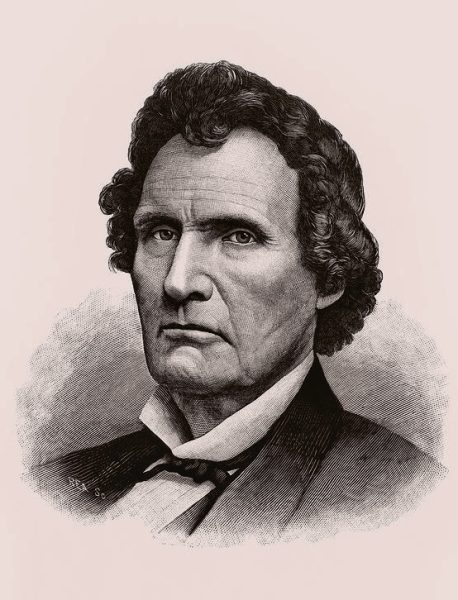
Besides his four decades-long crusade against slavery, Thaddeus Stevens was known as a wheeler dealer when it came to government financial matters. This was on full display when Stevens helped to rescue the Second Bank of the United States in 1836 and make it a state bank. The story was the last chapter in a decades long saga of the young country trying and failing to establish a stable banking system.
It started with the creation of the First Bank of the United States in 1791 by Secretary of the Treasury Alexander Hamilton. The bank was where federal taxes were deposited and loans made to the government and private interests. The bank was opposed by people like Thomas Jefferson and James Madison of Virginia, who would later become presidents. They contended that the bank was unconstitutional and primarily benefited northern business at the expense of southern agricultural interests.
But despite this opposition, the bank continued to operate until 1811 when Congress decided not to renew its charter. Then in 1816 Congress thought better of it’s earlier decision and took another whack at central banking with the creation of the Second Bank of the United States. Then in the 1830s anti-bank forces lead by President Andrew Jackson succeeded in blocking the rechartering of the bank and Jackson put federal funds into “pet” state banks.
This is when Stevens stepped in. In January 1836 he introduced a bill with the unwieldy name of, “An Act to Repeal the State Tax on Real and Personal Property and to Continue and Extend the Improvements of the State by Railroads and Canals, and to Charter a State Bank to be Called the United States Bank,”
In exchange for giving the bank a new life, the rechristened United States Bank would give the state $2 million, ($72 million in today’s dollars) and also loan it another $6 million ($216 million in current dollars) if the state needed it at very favorable interest rates. This staved off a possible state default and it also benefited two of Stevens’s favorite causes: public education and the construction of a railroad from Gettysburg to western Maryland, later known as the Tapeworm Railroad.
However, the windfall was short-lived. By 1837, the national economy tanked, partly due to scuttling the bank’s role in national finances. Coupled with malfeasance on the part of the it’s president Nicholas Biddle, the bank spiraled into insolvency by 1841. Stevens’s Tapeworm Railroad was abandoned in 1838 after he lost political power as a result of the Buckshot War where Democrats took political power in Harrisburg by force after a disputed election.
Yet the arrangement did have have the benefits of reducing personal property tax, creating public jobs and averting state bankruptcy, according to Bradley R. Hoch in his book, Thaddeus Stevens in Gettysburg: The Making of an Abolitionist.
It would not be the last time Stevens dabbled in government finances. He would go on to play a pivotal role in 1863 in the creation of the first federal paper currency, called “Greenbacks” and the creation of the national banking system, which endured until the creation of the Federal Reserve System in 1913.