
There’s lots of chatter about creating a meadow, or, more recently, a prairie pocket. A few questions may come to the forefront when hearing this:
What’s a meadow?
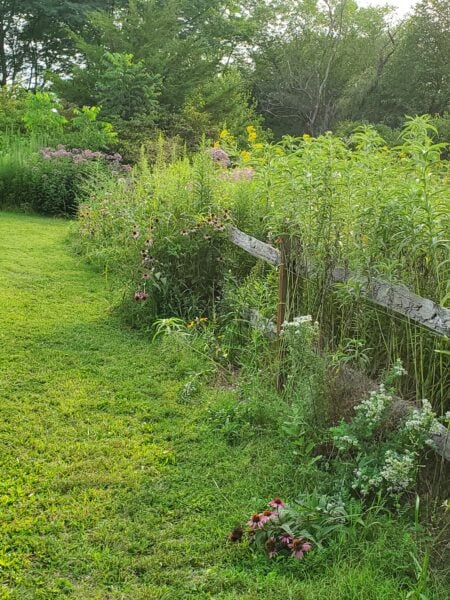
What’s the difference between a meadow and a prairie?
What’s a prairie pocket?
Why would anyone create one of these types of plantings?
Can it be done in my neighborhood?
Will it look weedy?
How difficult is it to maintain?
Will it cost a lot?
Let’s first define what a meadow and a prairie are.
A prairie is a space that also has grasses and flowering plants, annuals and perennials, but stays like that. Herbaceous plants will come and go, depending on what seeds are blown in or birds and animals carry in, but woody plants (shrubs and trees) do not encroach on a prairie. This is due to the type of soil that the plants are growing in, the fires that naturally happen on a prairie, and the acreage that they grow on. Prairies are typically large expanses of land that have 60% – 70% grasses growing with the rest covered with flowering plants. Maintenance of a prairie will look a little different than that of a meadow.
A meadow is a transitional space between a field and a forest. It’s an area that has grasses and flowering plants – annuals and perennials. As time goes on, shrubs, and then trees will encroach on a meadow, transitioning it into a forest. This is important to know as meadows do need maintenance, if for the simple reason of managing the woody plants that take root in the meadow. Also note that meadows are typically small patches of land that are surrounded by trees. Meadows may be defined as pockets of native flowering plants and grasses, with no woody plants (shrubs or trees). Meadows typically have less grasses and more flowering plants.
In the plant world on the east coast, we use the term meadow more frequently than prairie because our open spaces are more likely to develop into a forest if left untouched. Maintenance, such as managing invasive plants, and cutting the meadow once every one to three years, to keep the woody plants at bay.
Where does this newest term “prairie pocket” come into play? This is simply a term used to define an area in a typical suburban yard that has native perennials and grasses growing. It is intentional. Plants are selected for what they provide for the ecosystem. Often prairie and meadow are terms used interchangeably. The idea is simple: plant native perennials and grasses that will provide habitat for the native critters. This habitat consists of shelter all four seasons as well as food and water for every stage of growth for insects and mammals.
Meadows and prairie pockets can be re-created anywhere. A meadow can be as small as a 6-foot by 6-foot area where native grasses and perennials grow. These areas would be without any shrubs or trees, and invasive plants kept out of the area. In a suburban neighborhood, these meadows, or prairie pockets, can look intentional by having a fence, wall, or grass strip around them. And, if in a more public area, like the front yard, using shorter species of plants would be a good choice to reduce the wild and weedy look that native perennials often appear to the passerby.
Maintaining a meadow is relatively easy. It will take cutting the foliage down every one to three years in the spring and pulling any invasive plants. The bigger commitment is starting a meadow. The site must be prepared. Getting rid of all lawn and weeds is very important. And if it’s a small area, like a 6’x6’ space, that’s easy enough to either dig up or pull what’s there. If it’s a big area, then a bigger job.
There are a few options: covering the area with a dark tarp till the lawn and weeds die. Or, using cardboard or layers of newspaper to cover the area, then adding mulch, wood chips or organic matter like leaf clippings on top. And lastly, using an herbicide. When using herbicides, read the label for application rate, timing, and the target plants to be sure they’re used correctly.
After the weeds and lawn are gone, seeds can be spread or plants planted. In a small area, getting perennials from a nursery will give you instant results and the expense won’t be crazy. However, a larger area, seeds will be the economical choice. Evenly distributing the seeds isn’t easy as the seeds are very small, so adding some kind of course substance like sand will help distribute the seeds more evenly.
If seeding, spreading straw over the area, or a thin layer of compost is a good idea. This helps maintain moisture, as well as keeps the birds from eating the seed. Then, whether planting seeds or plants, watering until the seeds germinate, or the plants get established, is necessary. After establishment, watering stops.
The bottom line: the terms meadows and prairies, although different by definition, are terms used interchangeably. Prairie pockets, also could be called small meadows, are simply small areas where native grasses and perennials are planted and maintained. These can be created in large or small areas, can be sown with seeds, or planted with plants. After establishment, they are cut every 1 – 3 years, invasive plants are pulled, and the birds, butterflies, insects and rabbits will use these areas as a place to live, feed and nest.
If you are ready to change your part of the world for the better, the Adams County Conservation District has limited funding to help homeowners convert a portion of their lawn to a mini meadow by providing a native meadow seed mix and instructions for seed bed preparation and planting, or they can direct you to other funding sources for larger meadow projects.
If you are interested in learning more about the mini meadow program, please contact Vy Trinh at the Adams County Conservation District. She can be reached at 717-334-0636 or at vtrinh@adamscountypa.gov.
A workshop, Lawns to Meadows, will be held at the Adams County Agricultural and Natural Resources Center, 670 Old Harrisburg Road, Gettysburg on September 16, 2026 at 6:30 pm. To register, contact Vy Trinh at 717-334-0636 or at vtrinh@adamscountypa.gov.
