
Democratic Candidates for the U.S. Congress and the Pennsylvania House fielded questions about data centers, housing, education, gun laws, and constituent access during a Sept. 27 town hall at the Barn Resort in Gettysburg.
The candidates are seeking office in the Nov. 3 general election.
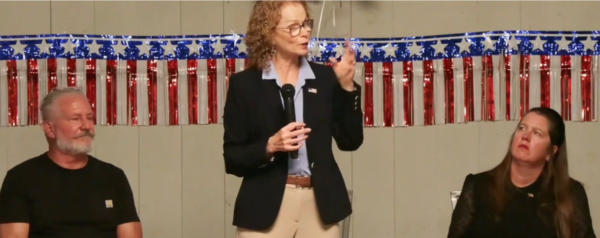
The People’s Town Hall Committee invited Democratic candidates Beth Farnham, Kathleen Pratt and Todd Crawley to answer written questions from residents. Farnham is running for the 13th Congressional District, Pratt for the 91st state House District, and Crawley for the 193rd.
The three Republican candidates were not at the event. Committee moderator Dick Shope said the group also invited U.S. Rep. John Joyce and state Reps. Dan Moul and Catherine Wallen. Shope said organizers repeatedly contacted Joyce’s office and campaign but received no reply, while Moul and Wallen declined.
Shope said People’s Town Hall committee members hold a range of political views, though most are Democrats. He said the committee believes candidates from both parties should answer questions from constituents.
Before the forum, Pennsylvania Democratic Party Chair Eugene DePasquale addressed the audience by video. DePasquale said Democrats are preparing to help voters access the ballot and ensure legally cast votes are counted. He also outlined priorities for a possible Democratic legislative majority, including raising the minimum wage, protecting abortion rights and making child care and housing more affordable. On data centers, he backed stronger local zoning and review, limits on nondisclosure agreements, and requirements for facilities to provide their own water and power. “Every vote that was legally cast gets counted,” he said.
Data centers drew extended discussion. Farnham said she supports a federal moratorium while officials assess their effects. “We don’t know all of the impacts,” she said, citing concerns about water use and energy costs.
Pratt said the state should protect residents from data centers’ effects on water, electricity prices and the environment. She called them “greedy neighbors,” and said she would work with environmental groups to protect clean air and drinking water.
Crawley said he wants stricter oversight of data centers and other technology, including automated license plate reader cameras. He proposed limits on how long camera data could be retained and who could access it. He also suggested using revenue from data centers to support job training, saying that electricians, carpenters and plumbers “are not going to get taken away by AI.”
The candidates also outlined different approaches to housing affordability. Crawley described meeting a working mother who was staying in a shelter with her daughter and struggling to afford an apartment. He proposed limiting rental application fees and increasing state funding for housing rehabilitation.
Pratt said she would seek changes to state programs that she believes make it difficult for landlords to rent to lower-income tenants. She also argued that raising the minimum wage would help workers meet housing costs.
Farnham said she did not have a fully developed housing plan, but cited raising the federal minimum wage and restoring housing programs as steps she would support.
On education funding, Pratt proposed taxing skill-game machines and directing some revenue to public schools, with the goal of easing pressure on property taxpayers. She opposed proposals to replace property taxes with higher sales taxes, saying the increase could weigh heavily on lower-income residents. Farnham argued that public education should rely more on state and federal funding than local property taxes.
The candidates also addressed gun policy. Pratt supported background checks and scrutiny of “ghost guns.” Farnham backed safe-storage requirements, universal background checks, reporting lost or stolen guns and extreme-risk protection orders. Crawley said he would support background checks and red-flag laws, and proposed limiting the sale of ammunition magazines holding more than 10 rounds.
Asked whether they would hold town halls if elected, all three said they would. Pratt pledged to hold them every six months, using technology to include people who could not attend in person. Farnham said she would hold public meetings and support legislation requiring members of Congress to hold in-person town halls. Crawley said he had held several town halls while campaigning and would continue listening to constituents.
Farnham called the event “not just an event, it’s my job interview.”