
By Dr. Daun van Ee
Dwight Eisenhower had an expansive view of what he called “psychological warfare.” It was more than mere propaganda. Psywar could include anything “from the singing of a beautiful hymn up to the most extraordinary kind of physical sabotage”—what today we might call covert operations (letter to J.F. Dulles, Oct. 24, 1953). He had approved the requirements for such a program while he was still setting up NATO’s European headquarters: “(a) money no object; (b) no holds barred; (c) no questions asked” (letter, C.D. Jackson to C.M. Spofford, Feb. 16, 1951, quoted in _The Papers of Dwight David Eisenhower_ vol. 13, p. 1149, n. 2).
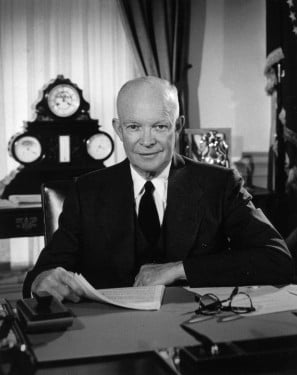
Iran was a likely target. In 1951 its prime minister, Mohammed Mossadegh, had nationalized the holdings of the Anglo Iranian Oil Company, leading to a serious disruption in the world’s supply of petroleum. British leaders, including Winston Churchill, had prevailed upon Eisenhower to send an extraordinary letter to Washington urging support for any measures the United Kingdom might take to reverse Mosaddegh’s actions. Eisenhower, a military leader constantly aware of the big picture, knew that strengthening the economies of NATO’s European nations was crucial for Western defense, and that an adequate supply of oil from Iranian and other Middle Eastern sources was necessary for economic growth: “All of us must look upon that area with the greatest concern, and all of us must certainly hope that we can weld the people of that region into a solidly supporting block. . .. The stakes are high” (letter to W.A. Harriman, July 9. 1951). President Truman, while backing British economic countermeasures, decided instead to try to mediate the Anglo-Iranian dispute in the hopes of arriving at a settlement. He was not successful, and the problem remained for the incoming Eisenhower Administration in 1953.
There was more involved than the loss of British property and prestige. There were fears that Mossadegh’s government could be subverted by a strong Iranian communist party, or—even worse—that America’s dangerous Cold War rival, the Soviet Union, could dominate or even absorb the entire country. Eisenhower opted for more aggressive measures, while eschewing overt military actions. Using the Central Intelligence Agency, in cooperation with the British, he arranged for the Iranian military, working with anti-Mossadegh street mobs, to overthrow the government. Friendly leaders, including Iran’s Shah, Mohammed Reza Pahlavi, took power. Ike recounted these events in a diary entry that was not completely declassified until 2010: “The things we did were ‘covert.’ If knowledge of them became public, we would not only be embarrassed in that region, but our chances to do anything of like nature in the future would almost totally disappear.” He marveled that “in the first hours of the attempted coup” the American plans had been discovered and all had seemed lost, but the CIA had persevered until they “reversed the entire situation” (diary entry, Oct. 8, 1953).
Eisenhower’s Iranian success paved the way for future CIA operations during his two terms in office. Some of these were successful, some not. The Shah remained in power for over a quarter of a century. Many Iranians, however, apparently never forgot the intervention into their affairs, perhaps leading to the tensions that have characterized US-Iranian relations for the last 47 years.
Author Dr. Daun van Ee is an historian and editor for the Eisenhower Papers Project at Johns Hopkins University and a Trustee of the Dwight D. Eisenhower Society. The Eisenhower Society is dedicated to promoting the memory and legacy of leadership of Dwight D. Eisenhower through educational programs, scholarships, grants, and special events. Learn more at dwightdeisenhowersociety.org.