
Filmmaker Jake Boritt was shooting footage of writer Jeff Shaara on the Gettysburg Battlefield for the documentary, The Gettysburg Book: A Father, Son and The Killer Angels, when “the floodgates just opened up,” said Boritt.
Jeff, the son of Michael Shaara, the Pulitzer Prize-winning author of the groundbreaking Civil War novel The Killer Angels, began describing the abuse he suffered from his father while growing up.
“He was talking about his father throwing him to the ground and kicking him in the stomach,” Boritt said. “I thought to myself, ‘What should I do? Should I put down the camera and go over and give him a hug? Or should I just keep filming?’”
He kept filming.
The Gettysburg Book, which is currently airing nationwide on PBS, is the story of how The Killer Angels came to be. The film also tells the story of how Michael’s struggles with mental illness took a toll not only on him but also on his children, Jeff and daughter Lila.
“When it was bad with my father, it was very bad,” said Jeff, himself a New York Times bestselling author who recently sat down with Gettysburg Connection to talk about the film and his relationship with his father. “But when it was good, it was The Killer Angels.”
The impact of the book was powerful. It helped inspire a young documentarian, Ken Burns, to create his masterpiece film, The Civil War. The book would also be turned into a much-loved movie, Gettysburg, directed by Ron Maxwell and produced by media mogul Ted Turner. Both Burns and Maxwell appear in the documentary.
“I find it remarkable that the book is so strong and enduring given the pain that he experienced in creating it,” said the documentary’s co-director Gordon Beittenmiller.
The son of Italian immigrants, Michael was a paratrooper, boxer and merchant seaman. But most of all he was a writer, although at times a frustrated one.
“My mother would hide rejection letters from him,” Jeff said. Perhaps rightly so, as a rejection letter could result in Michael spiraling into a deep depression. “He would go into the bedroom, and we wouldn’t see him for days.”
“He was brilliant, but he just got triggered so easily and could either fly into a rage or plunge into a depression,” said Michael’s daughter Lila, who also appears in the documentary.
Early on, Michael wrote in genres including science fiction. But it was the story of the Battle of Gettysburg that would solidify his reputation as a great writer. In writing about the battle, he took a distinctively different approach. He told the story through the eyes of those who fought it – Gen. Robert E. Lee, Col. Joshua Lawrence Chamberlain, Brig. Gen. John Buford, Lt. Gen. James Longstreet and Maj. Gen. George E. Pickett.
“You can hear them all talking in Killer Angels,” said actor Jeff Daniels in the documentary. Daniels played the role of Chamberlain in Gettysburg.
“It had a reality I had never, ever felt,” said actor Martin Sheen, who played the role of Robert E. Lee in Gettysburg and also appears in the documentary.
“People who don’t even care about history will read this book, because it’s a great read,” said Boritt. “It has great characters. It’s a great story.”
The novel covers a four-day period during the Battle of Gettysburg, a turning point in the Civil War. Stephen Lang, who played Pickett in Gettysburg, narrates the film. The documentary also uses family photos and newly discovered 8 mm family films to tell the story.
It was a family visit to Gettysburg and the battlefield that would inspire The Killer Angels. “It wasn’t even an intended trip,” said Jeff, who was 12 years old at the time. “Just sort of a stop on the way to somewhere else.” The family, who lived in Tallahassee, Fla., was traveling to the New York World’s Fair in 1964.
During that stop, Jeff walked the battlefield with his father. Michael began to talk about the friendship between Brig. Gen. Lewis Armistead, who fought for the Confederacy, and Maj. Gen. Winfield Scott Hancock, who fought for the Union. The two men were both injured during the battle, and Armistead died two days later. As he told the story to his son, Michael began to weep. “That is how Killer Angels began,” Jeff said.
The book would be published in 1974 and win the Pulitzer Prize in 1975. Today it has sold millions of copies, despite first being rejected by 15 publishers.
Jeff said he remembers that visit to Gettysburg as time spent with his father and “climbing up on the monuments, which I probably shouldn’t have done.”
But the good times with his father were few and far between. “He told me that when I was born, he went out in the woods with his pistol,” said Jeff. “He was going to end it because he couldn’t stand the idea of having a child. Then he saw a pheasant take off. He shot the pheasant instead.”
Throughout his life, Michael battled not only mental health issues but also physical issues. At 36, he suffered a major heart attack. And in 1972 he had a nearly fatal motorcycle crash, suffering a traumatic brain injury.
“He recovered enough that he could drive and talk to people,” said Lila. “He travelled around a lot. Kind of aimlessly. It was as if he was looking for something.”
Like Jeff, Lila was impacted by her father’s anger and sudden mood shifts. “I became very good at not triggering him,” she said. “He wanted to be attached to his kids. He wanted his kids to know him. That doesn’t mean he was always a good dad.”
Early on, Lila knew that her home life was different, with Michael’s issues and her parents engaging in what she described as a “toxic dance.” “I remember thinking when I was 13 or 14 that this is not normal. I’m going to have to deal with this at some point,” she said.
Both Lila and Jeff sought therapy to grapple with their difficult childhoods. Today, Lila is an adjunct professor of anthropology and is married with two children, one of whom composed music for the documentary. “I’m much more comfortable now remembering good things about him,” she said of her father. “That was very hard for a long time, for a lot of reasons. But enough time has passed, and I’ve done enough work. Those bruises have faded now.”
Jeff decided not to have children and has been married five times. As a young man, he chose to remove himself from his father, and the two didn’t speak for years. “I left on Christmas Eve,” he said. “He’d been haranguing me for two hours. And he says to my new wife, ‘Well, you’re not very pretty and you’re not very smart, but you’ll probably be a good match for him.’”
Jeff took his wife by the hand, turned around and walked out of the house forever. “We go out to the car, and I’ll never forget that feeling of the weight of the world just leaving me,” he said.
In the documentary, Jeff recalled that a Washington Post reporter told him his father had said he was dead.
The two men never reconciled before Michael’s death from a heart attack in 1988 at 59. At that time, the movie Gettysburg was in the works, but Michael would never live to see its completion or release in 1993. “I took a tape recorder to his grave and played the music from the film for him,” said Jeff.
Despite poor book sales upon its initial release, the movie Gettysburg greatly increased the popularity of The Killer Angels, making it a cultural milestone. “It’s sad that he did not see the full reach of the book’s legacy,” said Beittenmiller.
Ironically, Jeff would step in to continue the legacy his father had begun while creating his own. Following the release of Gettysburg, Maxwell told Jeff that Turner wanted to make more movies, which would cover the time periods before and after Killer Angels. Jeff decided to take on the task himself. “I called Ron and said, ‘I think this is something I want to try to do,’” he recalled, to which Maxwell replied, “I’ve been waiting for your call.”
“Before that moment, I never considered becoming a writer,” said Jeff, who was a rare coins dealer. “Why would I? I saw what my father went through.”
He would go on to write Gods and Generals, the prequel to The Killer Angels, which was then made into a film. He also wrote The Last Full Measure, which was a sequel to The Killer Angels and Gods and Generals. Today, Jeff is the author of over 20 books, including the just-released The Unfinished Work: A Novel of Abraham Lincoln.
When Boritt, the son of historian Gabor Boritt and an award-winning documentary filmmaker whose works include The Gettysburg Story, approached Jeff about the documentary The Gettysburg Book, Jeff made a decision. “If we were going to talk about my father, then let’s really talk about my father,” he said.
Boritt said the documentary tries to balance both Michael’s talent and the family’s trauma. “Michael is not here to speak for himself,” he said.
Boritt was encouraged to include the family’s trauma by Beittenmiller, who has experienced mental health issues in his own family.
“After seeing early interviews with Jeff and Lila” is the context for Beittenmiller’s remarks. “I recognized right away that there was a whole other story here – the story of a father and son and the trauma of creating the book,” Beittenmiller said. “That fascinated me. I felt that this is a documentary that should be made. This is a human story.”
The film has also given Jeff an outlet for voicing his own mental health struggles. Following the movie’s premiere last summer in Gettysburg, Jeff revealed to the audience that he had been diagnosed as bipolar.
“People came up to me afterward and some of them were in tears,” he said. “They were saying to me, ‘Thank you for talking about this.’ That told me right there that sharing this is a good thing.”
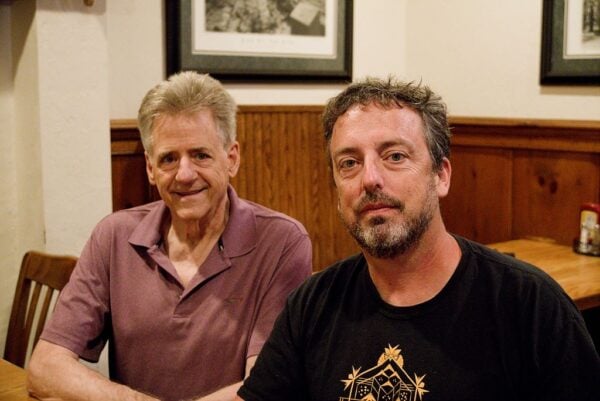
Featured image caption: Shaara and Boritt [Rick Gregory]
