
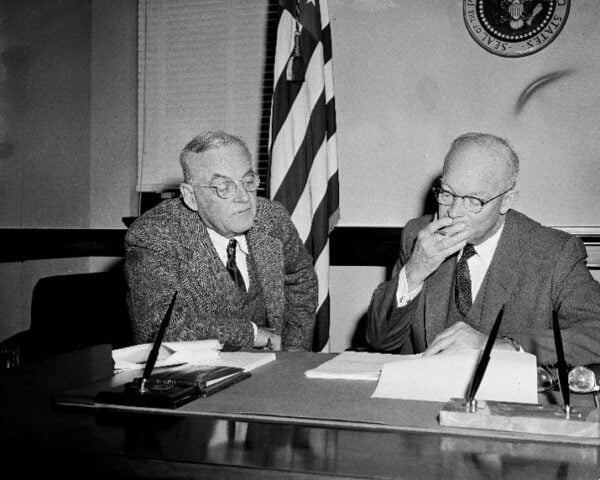
Convalescing in Gettysburg following a serious heart attack suffered while vacationing in Denver, Colorado in September 1955, Dwight Eisenhower gradually returned to the business of governing. By Thanksgiving he was meeting periodically with key aides in his recently remodeled Gettysburg home or his public office at the post office on Baltimore Street and signing legislation in his tiny office on the farm. Doctors even allowed Ike to practice his putting on the green just east of the family’s Florida room, as long as he did not overdo it. Reading and painting were part of the recuperation menu along with ample rest time.
That winter Ike had to consider his future. With the national economy humming, the nation at peace, and a 70% favorable standing in the polls, Eisenhower knew that if his health was not a problem, he would be strongly favored for re-election. His party overwhelmingly wanted him to run. But did Ike want or need to run again? That was not an entirely fixed notion.
Eisenhower knew that Mamie was eager to live in Gettysburg full time. He also felt that he had accomplished much of what he had promised to do as president. Maybe it was time to pass the baton?
Scholars generally agree that Eisenhower did not want to give the appearance of needing to be president. On the other hand, they also agree that his self-regard was such that he was unconvinced the GOP had anyone more qualified—and more likely to win the ’56 election—than he was.
What to do? In meetings with associates Ike frequently speculated on possible Republican alternatives if he chose not to run again. Some he praised but found unelectable. Others, like Senate Minority Leader William Knowland, Eisenhower believed incompetent. As for Vice President Richard Nixon, Ike felt he needed more seasoning – perhaps a switch to a major cabinet position would be in order, to set him up for 1960?
Ike’s decision to run for a second term proved contingent on securing a clean bill of health from his doctors. Tests at Walter Reed hospital confirmed he was recovering well and could serve. On February 29, in a rather back-handed way, the president announced that he would stand again. It was a big relief to Wall Street and Republicans nationwide and a blow to Democrats’ hopes of retaking the White House.
This was not quite the end of the story, or of Gettysburg’s role in 1956.
On June 7, the president suffered a severe stomach attack—soon diagnosed by doctors as ileitis, specifically caused by a piece of celery trapped in his intestines. Surgery ensued on the 9th. It was tricky but went well. But the issue of Ike’s candidacy was resurrected. Would he be healthy enough to campaign for re-election and to serve if he won? In fact, Eisenhower proved resilient. But absent a formal statement that he was ready to serve for another four years, media speculation was rampant for the next month.
Uncertainty about the popular president’s plans was finally put to rest based on a conference Eisenhower convened with Republican legislative leaders on July 10 in Glatfelter Hall on the Gettysburg College campus. As they discussed prospects for specific legislation, Ike casually mentioned that he intended to “take up these issues in our campaign this fall.”
Those words were golden for Ike’s companions that day. The session with the legislators concluded at 10:30. Ike posed for pictures as he departed and the press then assembled in the president’s office. There, Senator Knowland broke the news.
Moments later, as Professor of History Robert Bloom was strolling past Glatfelter Hall, minding his own business, he was surrounded by reporters. Bloom heard one of them shout, “Anyone here local?” As soon as Bloom answered that he was, he was asked for directions to the telegraph office. “I’ll not only show you,” he replied. “I’ll take you there.”
Thus was launched Dwight Eisenhower’s campaign for a second term as the nation’s 34th president.
Author Michael J. Birkner is Professor of History at Gettysburg College and a Trustee of the Dwight D. Eisenhower Society. The Eisenhower Society is dedicated to promoting the memory and legacy of leadership of Dwight D. Eisenhower through educational programs, scholarships, grants, and special events. Learn more at dwightdeisenhowersociety.org.
Photo: Most members of the Eisenhower cabinet made it to Gettysburg at least once during the Gettysburg sojourn. Here Eisenhower confers with Secretary of State John Foster Dulles in the president’s office at the Post Office, November 18, 1955. (Courtesy of AP 168707788826.)