
May is National Preservation Month — and every year at its annual dinner, Historic Gettysburg Adams County (HGAC) presents its Barn Preservation and Historic House Preservation Awards to recognize barn and building owners for the restoration and preservation work they have accomplished.
This year HGAC’s 19th Annual Barn Preservation Award goes to the Double B Barn, located in Latimore Township and owned by Barry Bechtel. HGAC’s 151st Historic House Award goes to Matthew and Lori Altier for their magnificent and majestic buildings that they affectionately call their homestead, located at 314 West King Street in East Berlin.
The Double B Barn is a circa 1790 double log-crib, extended Schweizer Pennsylvania Barn, which has been expertly maintained and carefully cared for by Barry Bechtel since 1993. HGAC Preservation Committee Chair Curt Musselman said the barn was first visited by HGAC Barn Preservation Project Surveyors in August of 2016 when it became barn number 244 on the HGAC Historic Barn Register. Measuring 65 by 40 feet, the barn has a fully cantilevered forebay that extends seven feet beyond the front wall.
Inside the upper level of the barn is a single granary and two massive log-cribs separated by the threshing floor. Log-cribs at the core of the barn are a sure sign that the barn is one of the older barns in Adams County. “HGAC is thrilled to honor this barn that has survived since the 18th century, much like the United States of America has,” Musselman said .
HGAC’s House Preservation Award Committee members felt that the Matthew and Lori Altier Homestead is a spectacular historic preservation and reconstruction project that synthesized an existing 1760s era log home with a new 2023 addition constructed from various other reclaimed log buildings dating from the 1700s to the 1820s. The reuse of very old building materials flows seamlessly through the entire floor plan in a masterful example of how to bring new life and purpose to treasured historical materials.
The Altiers recounted their preservation project for HGAC:
Circa 1760 Our two-story log home, built by the early settlers of Berlin Pennsylvania (which later became East Berlin), was constructed of logs that came from the American Chestnut, a tree now extinct. All the logs were hand hewn using early axes of their time. There were no sawmills back then. We lovingly restored the home exposing all the original logs which were covered by decades of lath and plaster which, in the mid 1800s, was all the rave. The plaster with 1800s wallpaper was used to cover the logs because a log home at that time was considered a poor man’s home. Then in the 1960s the plaster walls were covered with another layer of drywall and paint. After tearing down the drywall and the earlier plaster we discovered the beautiful logs you see now.
Between the logs was the original chinking which consisted of mud mixed with goat hair and small rocks we believe came from the Conewago Creek a few hundred yards from here. The reason goat hair was used as a mud binder instead of horsehair (which is longer and stronger than goat hair), is because the family who built this was probably too poor at the time to own horses, so they used what they had available.
During our renovation, the original floorboards were decayed beyond repair and removed, and the cabin was taken down to the dirt floor. All of the original chinking had to be removed, the house base foundation reinforced, and new chinking installed after the logs were cleaned up. We found some interesting artifacts while renovating including “spirit bags” that were tucked inside holes drilled into the logs, one downstairs and one upstairs. A spirit bag was a piece of cloth with rock salt wrapped inside and tied with string. For those early settlers and their belief system the spirit bags kept bad spirits from entering the house. We did not throw those away, just in case….
The foyer area was added as an addition to the original cabin probably in the mid 1800’s and you can see what would have been the original outside of the cabin, with the whitewashed logs from the foyer. The original two-story cabin with an attic was tall for its time as many log homes in that era were one story with a loft (one and a half stories). The attic of this home was used for smoking and storing meat. The footprint of this original home was 16’x20’ which is what was called for in the town ordinances when Berlin was first established. The original stairs to the 2nd floor were probably located in the area where the modern gas stove in the kitchen now sits.
A separate smoke house was added later (again sometime in the early 1800’s) to the back of the cabin which is now used as a spare room and laundry. The space in between the smoke house and cabin was enclosed in the 1940’s or 50’s and became what is now the downstairs bathroom, which was also renovated and rebuilt during our project.
To make this historic home comfortable, we installed all the modern conveniences of central air conditioning and heating, full kitchen, Wi-Fi, etc. with some added twists. The kitchen counter tops for example are live edge wood slabs of sinker cypress trees excavated from the bogs (bayous) of Louisiana and transported here (in our SUV). These slabs are between 5,000 and 10,000 years old and were perfectly preserved in the mud at the bottom of the swamps. You can see where all the small seashells and “swamp critters” borrowed into the live edges on each slab.
Log Home Addition
The large log home attached to the back of the original Circa 1760 log home was designed and constructed in 2023. In order to construct it with historical context, three early American (from Pennsylvania) log homes dating from the late 1700’s to the 1820’s were saved from demolition, dismantled, labeled and brought to this site to build the home you see. In order to have enough hand hewn logs from the time period, additional logs were added that came from two fallen 1800’s barns, one from Adams County Pennsylvania and an old tobacco barn from the Asheville area of North Carolina.
The logs and beams that make up this home came from white oak, chestnut oak, American chestnut, and heart pine trees, all native to the areas where the original log homes were constructed. One of the log homes saved and brought here we believe had been built by the family of Governor Snyder, the 2nd governor of the state of Pennsylvania. It came from Snyder County.
The home was carefully crafted to reflect the original log home construction style, but designed to have modern conveniences. Almost everything in the house was salvaged from the three-state area and reused and built into the home such as the wrought iron railings surrounding the stair wells and spanning the 2nd floor balcony overlooking the great room. These railings came from a 200 year old cemetery near Scranton PA and a 150 year old school yard near State College PA.
Other items worth noting include the crow’s nest balcony railing located in the great room which was crafted from long scythe handles purchased at auctions and antique stores in the area, the crystal stone wall made from quartz crystal clusters, geodes and amethyst built into the downstairs bathroom wall. The small shower in that bathroom has a base that came from an antique water fountain discovered in New Jersey and a shower curtain rail made from an old wagon wheel.
On the opposite side of that stone wall (under the stairs and behind the live edge bar) is a wall made up of fossils, dinosaur teeth, arrow heads and minerals. Some of the fossils date to the Jurassic period from 125- 200 million years ago.
The 30 foot high hand-crafted stone fireplace is made from granite and quartz rocks that were salvaged from an old crumbling barn foundation just outside of Hagerstown MD.
The base of the fireplace (the two end towers) are petrified wood dating to 500 million years ago. On display on several walls you will find Civil War era muskets and swords, prehistoric megalodon teeth embedded into some timbers, a door from 1600’s medieval France, etc.
The original log home (Circa 1760) is used as an Airbnb and the log home addition serves as the owners’ residence.
You can read about the Altier homestead at: https://www.hgaconline.org/2026-historic-house-award
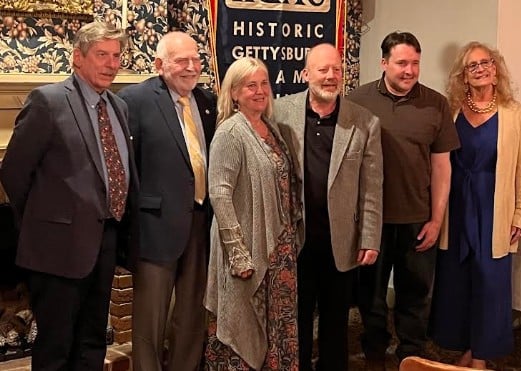
Featured image caption: The HGAC Historic House Committee members with 2026 Historic House Award winners Mathew and Lori Altier, center.