
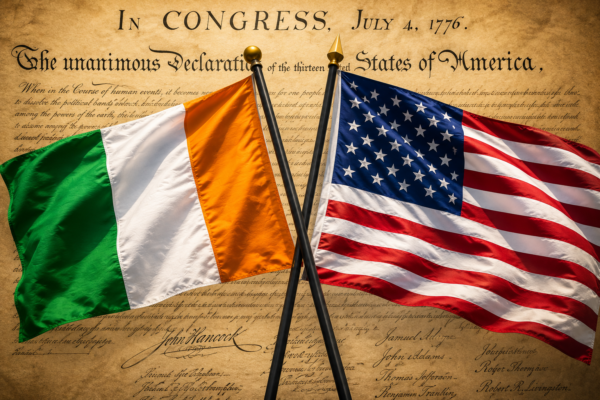
Not only did the Declaration of Independence set out a vision and set of principles for an independent America, it also became the inspiration for many nations seeking independence. Crucially, it inspired the leaders of the French Revolution and those who fought for Irish independence. Four signatories of the Declaration were Irish American members of the Continental Congress from Pennsylvania. One Pennsylvanian Irishman was the printer of the Declaration and two were senior figures in the War of Independence. Four Irish signatories had settled in other colonies.
The Irish Signatories of the Declaration
George Taylor, born in Co. Antrim in 1716, emigrated to Pennsylvania in 1736. Formerly an indentured servant, he became an ironmaster in Pennsylvania providing cannon balls to the Revolutionary Army. He lived variously in Chester, Bucks and Northampton Counties during his life. He became a member of the Continental Congress in 1776 and briefly served in Congress.
The second Irish signatory from Pennsylvania was James Smith from Cavan in Ireland. Smith’s family was forced to emigrate by abusive landlords, eventually settling in Pennsylvania in the 1720s. Smith became a lawyer, settled in York and became a member of the Continental Congress from 1775 and in 1776, a Colonel in the Pennsylvania Militia. Smith’s contribution to the drafting process of the Declaration was evident in the final document.
The third, Thomas McKean was born in New London, Pennsylvania in 1734. McKean’s father was an innkeeper from Co. Antrim who emigrated to Pennsylvania in 1720. McKean, a lawyer and a politician, became President and Chief Justice of Delaware and Governor of Pennsylvania. He led a group of insurgents, the ‘Pennsylvania Associators’ and was one of the leading players in the 1776 process representing Delaware.
The fourth was George Read, the son of a Dubliner who emigrated first to Maryland and then Delaware. George was born in 1733, becoming Attorney General in Pennsylvania and a member of the Continental Congress from 1774.
Several other Irish figures merit mention. The first is John Dunlap of Strabane, Co. Tyrone, the official printer of the Declaration. Dunlap was born in 1747 and at the age of ten was sent to Philadelphia to work with his uncle, William Dunlap, a printer and bookseller. He saw action with George Washington at the battles of Trenton and Princeton, thus establishing his patriot credentials. In 1776, Dunlap won the contract to print the Declaration and in 1787 was commissioned to print the US Constitution.
Charles Thomson, the Secretary of the Continental Congress, was born in Maghera, Co. Derry in 1729 and emigrated to New Castle, Delaware with his father and siblings in 1739. Settling in Philadelphia, he was appointed Secretary of the Congress for 15 years and his signature appears on the Declaration. Close to Benjamin Franklin and second President, John Adams, Thomson was delegated in 1787 to travel to the George Washington’s Virginia home to inform him of his election by Congress as the United States’ First President. Thomson was also responsible for devising the Great Seal of the United States, still used to this day.
Two further Irish people made significant contributions to American independence.
The first is Stephen Moylan. Born in Cork in 1739, Moylan was to become one of the most senior military leaders in the War of Independence. Settling in Philadelphia in 1768, he was the first president of the fraternal ‘Friendly Sons of St. Patrick’ there and in 1775 joined the forces of the American Revolution. He is said to have been the first to use the term, ‘the United States of America.’
Another important figure was Commodore John Barry known as ‘father of the US Navy’ for his exploits during the War. He was born in Wexford in 1745, emigrating to Philadelphia in 1766 where he worked aboard ships. He bought several boats which he put at the service of the patriot cause from 1776. He was the first to capture a British ship, playing a critical role throughout the War. In recognition of his service, Washington appointed him, Commodore. Barry died in 1803 and a statue to him in his native Wexford was unveiled in 1962 by former US President, Dwight D. Eisenhower.
The state of Pennsylvania was the crucible of American political steps towards independence. Irishmen, Taylor, Smith, McKean, Read, Thomson, Dunlap, Moylan and Barry who all settled in Pennsylvania, made significant contributions to that process. When the time came for Irish independence, Irish people in turn, looked to the United States’ example of independence and nation-building.
