
The Majestic Theater opened its 2026-27 season with a return to Gettysburg as the Pennsylvania-based Paragon Ragtime Orchestra celebrated its 41st season performing music from early American theater, silent film and vintage dance.
One year ago, PRO launched the Majestic’s Centennial Season with its world premiere of the underscore to “The Gold Rush” (an iconic silent film starring the legendary Charlie Chaplin) to a standing ovation.
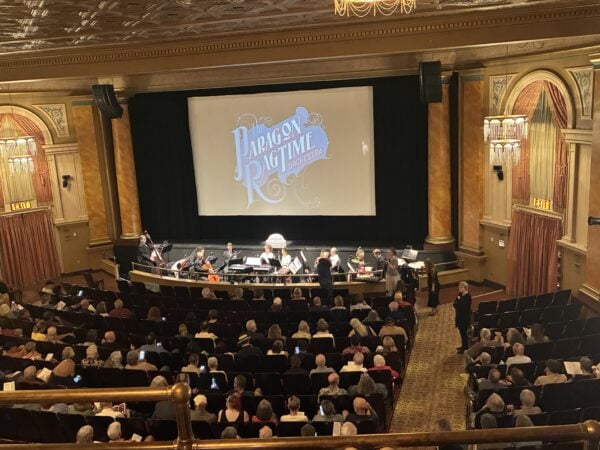
This year on Sept. 17, PRO underscored another silent film masterpiece in the restored historic Vaudeville theater, and audience members were equally enchanted as “Safety Last!” — the career-defining romantic comedy that set actor Harold Lloyd’s footprint in silent film history — was shown in a single performance in the Majestic’s lush main auditorium.
At a pre-show reception, Majestic Theater Executive Director Brett W. Messenger welcomed attendees to its 26-27 season and introduced PRO’s founder, artistic director and conductor, Maestro Rick Benjamin.
Benjamin said he founded PRO as a vehicle to explore American Music from the 19th-early 20th centuries, inspired by his discovery of lost orchestral scores by hundreds of American composers in the archives of a 20th century recording company while studying at Juilliard in the mid 1980s.
Today the nonprofit PRO has a unique music library of 20,000 stories with a collection of about 900 orchestral scores. And the Paragon Ragtime Orchestra has performed more than 750 times and across 48 states and seven countries.
A frequent guest on NPR, Benjamin has lectured at more than 100 universities and shared a brief glimpse of film history in a short talk at the Majestic reception.
Highlights of his talk included an interesting look at the beginning of silent films, which were only about 30 seconds long; he said that all people needed then to go and see something move for 10 seconds was “an astonishing earth-shattering spectacle.”
The earliest motion film projectors (marketed by Thomas Edison in the U.S.) sounded like threshing machines. Many theaters had no electricity, and some Victorian audiences felt uneasy sitting in the dark with strangers. Benjamin said there was emotional discord in musical underscores that were added to soften the mechanical noise until about 1913, when studios started creating thematic cue sheets to match the music to the action onscreen.
At the Majestic Theater, in PRO’s 787th performance, the Gettysburg audience was once again enthralled by a smooth and fully integrated experience.
Messenger said he was thrilled to welcome everyone back to a century past to experience what the Majestic Theater was built for: “for people like us to come together and experience the cinema arts as a community … I hope this will be the start of an annual tradition, a Silent in September, if you will.”
A beautiful musical intro — “Prelude to Modern Picture Comedy” (1918) by composer Mel B. Kaufman — started the magic rolling, after which Benjamin briefly welcomed the full house before the film appeared onscreen. Easily charming everyone from his first step on stage, he invited all to practice “boos” and “awws” in anticipation of participating fully in the adventure.
As Act 1 of “Safety Last!” began, Lloyd’s artistry melded like magic with the film’s original score performed live by PRO.
The film’s story begins in a fictionalized small town where a young man (Lloyd as The Boy) leaves home to make his fortune in a big city, planning to send for and marry his sweetheart (Mildred Davis as The Girl). Once there, he works as a low paid salesclerk in a department store, foregoing food to send expensive gifts home and pretending to be thriving.
When The Girl makes a surprise visit to the city, The Boy goes to great and comical lengths to preserve his façade by pretending to be the store manager.
Some of Lloyd’s funniest slapstick moments occur when he gets tangled in bolts of silk and fabric while trying to navigate a mob of extremely demanding female customers, in the great lengths The Boy goes to hide his actual situation from The Girl, and in his desperate and acrobatic attempts to avoid getting caught by his landlord and bosses.
When the real store manager offers a $1,000 prize to anyone who can draw a massive crowd, Harold sees a solution to his money problems and convinces his friend (Bill Strother as The Pal) — who climbs buildings for a living — to join in a publicity stunt for half the prize.
Their plan is to draw a massive crowd by announcing that a “human fly” (The Pal) will scale the 12-story department store building.
But in Act 2, on the day of the climb, their plan goes awry. A police officer (Noah Young as The Law) with a grudge spots the climber he’s been pursuing. To avoid getting caught and arrested, The Pal convinces The Boy to start the climb in his stead, planning to switch places with The Boy after the first story. But at every level, The Pal is chased away until The Boy ends up scaling the entire skyscraper through endless, hysterical obstacles.
One of the most famous images in silent film history features The Boy dangling precariously from the hand of a massive clock high above the ground (filmed using optical illusions and rooftop sets in downtown Los Angeles).
Ending on a final “aww” from the audience, the performance drew to a close with Edmund Braham’s “Exit Music –The Majestic March” (1925).
According to Benjamin, “until you’re in a historical cinema like this (the Majestic Theater) with a live orchestra…you haven’t actually seen the picture. If you were here last year, you might have experienced that.” He said he prefers performing in historical venues because they sound better (the Orchestra does not work with microphones) and PRO loves working at the Majestic Theater.
Both Gettysburg audiences to date appeared to love PRO, too.
Met with lively enthusiasm when he polled the audience about PRO returning next September, Benjamin suggested that after Charlie Chaplin and Harold Lloyd, Kingsley Benedict (who appeared in more than 50 silent films) could be up next.
Artist credits: Arthur Moeller (1st Violin and Concertmaster), John Vaida (2nd Violin), Amy Vaida (Viola), Jonathan Dexter (Cello), Michael Kuennen (Bass), Leslie Cullen (Flute and Piccolo), Yasmina Spiegelberg (Clarinet), Michael Blutman (Cornet), Steven Marx (Cornet), Rebecca Ciabattari (Trombone), Taylor A. Goodson (Drums and Mallets)
The show was made possible by the Majestic Theater Centennial Endowment Fund.
Paragon Ragtime Orchestra albums and souvenirs were on sale in the lobby. Explore more at www.paragonragtime.com.
For the Calendar of upcoming Majestic Theater events, see https://www.gettysburgmajestic.org/calendar/.
