
Dear Readers,
I’m using this issue of The Conceptual Frame to showcase Chris Lauer and his work. Lauer is a local artist and founder of Waldo’s & Company, the nonprofit art studio, exhibition space, and coffeehouse on the Gettysburg Square.
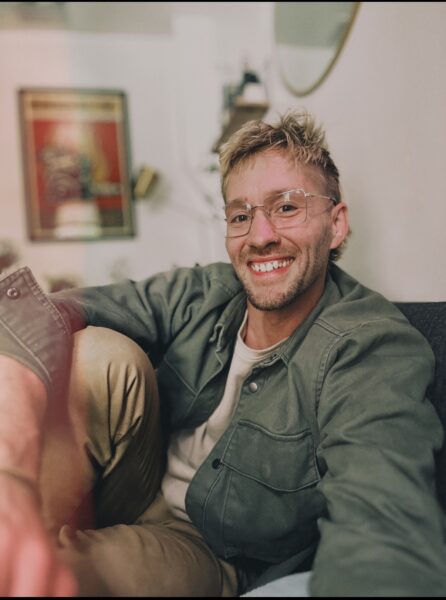
Lauer is originally from Minnesota. He studied studio art at the University of Minnesota and later walked across the country, passing through Gettysburg on his way to Philadelphia. After travelling for a few years after that, he returned to Gettysburg. .
Lauer works in a variety of media, including murals, portraiture, sculpture and printmaking. His work has appeared in Adams County Arts Council exhibitions and Gettysburg College’s juried exhibitions.
____
SJ: Chris, I’ve really been enjoying your detailed screen prints based on photographs in Waldo’s and Co.’s gallery this month. They remind me of the kind of scenes I encounter when I’m fully engaged in an activity and I freeze, visually if not physically, when I see something that strikes me. It’s like, “Time out! I must look at this!” Some of your images are looking down at the ground, some up at the sky, indoors, outdoors, and yet there’s an “in the moment” vibe to all of them. How did you come to create and choose these images?
CL: These images come from some of my time abroad in Morocco and Ecuador, but also some shots from around Gettysburg. I’m struck by images that feel like an intrusion to an intimate moment, things that would have gone unnoticed. The method of screen printing has a way of adding craft and depth encouraging the viewer to reimagine how we perceive photos especially as we casually consume thousands of images every day.
SJ: My favorite thing about these is that they seem to depict moments of leisure, looking up at puffy clouds, down at an empty beer can on a lawn, at a patron in a café. Were you hoping to evoke a particular feeling or feelings in the viewer?
CL: There is a stage in infant development where a child simply points to say ‘see’ to say, ‘let’s both look at that.’ In some ways, I feel that the imagery that I choose is simply that. Just a moment to say ‘look, isn’t that neat’. I’d love to say that there is more to it than that, but also, I don’t feel like there needs to be any more than a welcoming into some captured moment.
SJ: What is the method? These look so much more realistic than the kind of block printing I’m used to seeing with silk screen.
CL: This method of screen printing just pushes the common commercial level to its highest potential quality. We commonly encounter screen printing in tee shirts and posters, dragging ink across a permeable screen to create images where there are more large blocks of color overlayed onto each other. But if we take this method and merge it with the offset printing method that allows newspapers to print in full color using only 4 ink channels, then you get an incredible detailed full color and resolution image reconstructed with ink on paper. If you look closely, you will notice the tiny dots of each color layered to trick the eye into seeing the full spectrum.
SJ: You’re also one of the co-founders of Waldo’s and Co. Arts Center and Café. Is screen printing something that a person could try there? (Full-disclosure to readers: I’m on the board at Waldo’s.)
CL: Yes, I am very lucky to be able to work at Waldo’s and Company. I am one of the founders along with a lot of other very creative people. And we put together public art studios that we all felt like we were missing after high school or college. Our studios cover many mediums, including darkroom photography, ceramics, and printmaking. I have been able to learn so many new mediums as we have built out our studios there and all of these prints were made using both darkroom and printing equipment that is available to the public through Waldo’s Tradeshop Membership.
SJ: You also have a great gallery at Waldo’s, where your prints are currently on display. Over the past few years you’ve shown a lot of interesting artists. Last month you showed Kerry Mott’s layered collages made with duct tape. The surfaces resembled topographic maps. You’ve also shown the work of sculptors, painters, installation artists, all kinds! How do you choose the artists you exhibit?
CL: Luckily we have a great community full of artists to draw from and we are able to feature our studio holders, tradeshop members, and other creatives in our community. But we also source artists from applicants through our website and are always excited to feature new artists from outside the community too. There is such a wide spectrum of creativity and Waldo’s hopes to expand the variety of the arts represented in this area by highlighting emerging artists and mediums that don’t get enough attention.
SJ: I’m assuming that as a small-town non-profit arts space, Waldo’s is just overflowing with cash-money and doesn’t need donations. No?
CL: I would love to say yes, but of course we thrive with community support. We have worked hard to build in funding mechanisms like the coffee bar to subsidize the space, but community donors really help to make our mission happen. Waldo’s is always present at the Adams County Community Foundation Giving Spree and we also accept regular and one-time donors through our website at waldosandco.com.


