
Women’s Important Role in Independence. Although the idea of formal participation of women in politics or the “Rosie the Riveter” idea of women replacing men in factories were well in the future, women played an indispensable role in our national struggle for independence. This started long before the outbreak of hostilities. The “Daughters of Liberty” were formed in 1765 in response to the much-hated Stamp Act. As the primary purchasers and consumers of household goods, women exercised considerable economic power. Their boycott movements on tea and other British products had a strong influence on imports (and profits) for British merchants and their “homespun movement” organized largescale community spinning bees and reduced imported clothing and other textiles to a trickle.
Once the war started, women raised money to support the colonial cause and sewed shirts for the Colonial army.
Although the employment of women in arms production didn’t come anywhere near even the levels of the industrial revolution a few decades later, women were an important source of industrial labor. There were, indeed, some trades, such as making cartridges (pre-packaged units containing bullet and powder), where women were considered superior to men. Sixty percent of the workers in the cartridge operation at the Philadelphia Arsenal were women, with one woman, Catherine Friend, producing 211,300 cartridges in the 17 months for which records are available.
And, of course, with so many men away in army service, women took on traditional male roles to keep farms, shops, and communities operating.
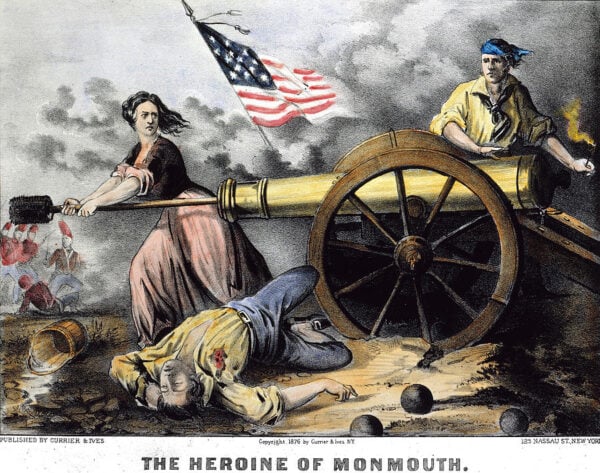
Many women traveled with the army, often serving as seamstresses, cooks, and nurses. Mary Ludwig Hays (“Molly Pitcher”), who replaced her wounded husband and serviced a cannon at the 1778 Battle of Monmouth Courthouse, is the best-known combatant but other women either filled in openly for their husbands or served in the ranks while disguising their sex. Another woman, Margaret Corbin was severely wounded during the British assault on Fort Washington in November 1776. She lived, though her wounds left her permanently disabled; she was the first American female to receive a soldier’s lifetime pension after the war.
Many women also took advantage of the privileges accorded their sex to serve as spies, scouts, or messengers.
Some women more directly affected policy and gained a measure of fame. Abigail Adams famously corresponded voluminously with her husband, John Adams, and exercised a strong influence on his thinking – though he did not follow her warning that the founders should “remember the ladies” if they didn’t wish to face a revolution of their own.
Mercy Otis Warren was a prolific writer, not only recording her thoughts about the confluence of events swirling around Boston but also dabbling in playwriting. She was a fierce devotee to the patriot cause, writing in December 1774, four months before the war broke out at Lexington and Concord, “America stands armed with resolution and virtue, but she still recoils at the idea of drawing the sword against the nation from whence she derived her origin.” In 1805 she published History of the Rise, Progress, and Termination of the American Revolution.
Phyllis Wheatley, an enslaved African American living in Boston, wrote poetry and became one of the first published female authors in America and the first African American woman to be published. Her 1773 collection Poems on Various Subjects, Religious and Moral was popular on both sides of the Atlantic. Her poems focused on patriotism and human virtues. She even wrote a poem about George Washington. “To His Excellency, George Washington” in 1775.
