

Alliance With France. On February 6, 1778, following the shocking surrender of General John Burgoyne’s English army at Saratoga, an American diplomatic team led by Ben Franklin signed a treaty of alliance with France. French King Louis XVI had no love for the American cause. But he had been itching for payback from England since 1763, when the treaty concluding The Seven Years War (which we call the French and Indian War) had deprived France of her North American possessions. He wanted revenge, but he didn’t want to back a loser. Why provoke England unless the punch hurts?
Franklin earlier had been able to secure a secret loan and some covert military assistance, but all talk of an alliance was rejected by the French as the British piled up victory after victory in 1776 and 1777. However, the victory at Saratoga finally convinced the French king that the American cause might be viable.
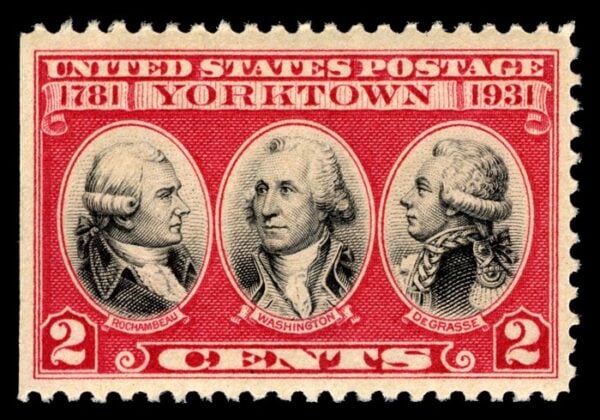
The resulting alliance consisted of a Treaty of Amity and Commerce (which provided trade relations with France and helped the young country gain some foreign exchange) and the Treaty of Alliance (military support). This meant many things to the colonists. What had been an occasional under the table shipment of arms and gunpowder, often substandard or obsolete weapons, now became a steady flow of first-rate equipment. And it meant the commitment of French troops and ships; the two countries agreed to fight together if England declared war on France, which of course they immediately did.
The French sent a small army of 7000 troops under the command of the Comte de Rochambeau, with orders to cooperate with Washington. His arrival in 1780 gave George Washington a military job much like Dwight Eisenhower’s job in WWII: Washington now, in effect, was theater commander of a multinational force in a worldwide coalition war.
And Washington learned, as Churchill observed some 160 years later, that “the only thing worse than fighting with allies is fighting without them.” Rochambeau professed to be under Washington’s command, but he spent a prolonged time in Rhode Island protecting a French fleet instead of joining General Washington near New York City. And the main French fleet under Admiral DeGrasse, seemed (and was) more interested in rumbling with the British fleet in the Caribbean than directly helping Washington.
Finally, in 1781, French support converged to decisive effect. Rochambeau joined up with Washington and Admiral deGrasse sent a message that his fleet would be available to cooperate with the Americans for a short time. After briefly considering and rejecting an assault on New York City, Washington selected British General Lord Cornwallis – dithering in Yorktown – as his target. He took the gutsy move of abandoning the trenches in New York – which would have left an energetic British commander free to commit mayhem. But General Henry Clinton, the British commander in New York, was the furthest thing from energetic. The French fleet got to Yorktown first and drove off the British fleet coming to rescue Cornwallis, Washington and Rochambeau arrived shortly thereafter and surrounded the army commanded by Cornwallis, and the world was soon “turned upside down” with the second surrender of a British army to the “colonial rabble.”
Comte de Rochambeau performed one last service. At the surrender ceremony, the British commander offered his sword to Rochambeau as a final face-saving gesture – in effect saying we’re not surrendering to this colonial riff-raff, we’re at least surrendering to another superpower. But the French general politely informed the British that their offer was misdirected and pointed to the real victor: George Washington.

Leon
Thank you for your informative article on the history of the American Revolution. It helped fill in a few gaps in my own knowledge.
I have written for the Gettysburg Connection too, mainly on Irish-American history and visited the battle site many years ago which was quite an experience.
Best regards
Paul McElhinney