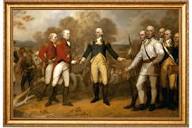
250th: Saratoga, the Turning Point

0 27

After Washington’s victories at Trenton and Princeton at the end of 1776, the British abandoned all their outposts in southern New Jersey. This meant thy started the 1777 campaigning season precisely where they had been the previous autumn. Having failed to take Philadelphia the previous year by marching through New Jersey, British commander Sir William

Leading the Army

march to trenton

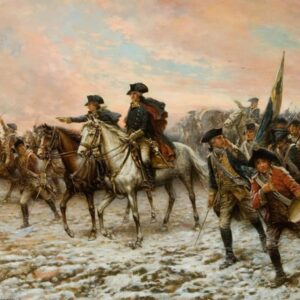
George Washington was the furthest thing from a “share the campfire with the boys” leader.  Often traveling by carriage, he typically stayed in a comfortable farmhouse near the military encampment and usually dined with his aides or generals. But after his Christmas-time 1776-1777 victories at Trenton and Princeton, his soldiers became extraordinarily devoted to their

Foreign help for the Revolution

lafayette

The most prominent statue in Lafayette Park, directly behind the White House, is the famous Andrew Jackson equestrian statue. But in each corner of the park, visitors will find statues of the Marquis de Lafayette, Baron von Steuben, the Comte de Rochambeau, and Tadeusz Kościuszko. Two Frenchmen, one Prussian, and one Pole, they represent an

Cowpens: Best Day ever for the U.S. Army?

0 44

 January 1781 didn’t seem like a promising time for the U.S. Army in South Carolina. In the previous year, the army of 5000 men defending Charleston had surrendered and another army had basically been destroyed at the Battle of Camden. For a time, guerrilla forces commanded by Francis “Swamp Fox” Marion and a few others

Payback is delightful/Paoli and Stony Point

0 35

By comparison to later wars, the battles of the Revolutionary War tended to involve a small number of troops and took place over a small area. But the fighting was no less intense. The fights at Paoli, PA, and Stony Point, NY, illustrate the brutality of these fights. The “Paoli Massacre” took place on the

Supplying Washington’s Army

0 3

Supplying an 18th century army was not as complex as it was during WWII, but still Washington’s army needed supplies. Besides commercially available items like food and uniforms, the main needs of the army were: muskets and rifles, powder, lead for bullets, cannon, and ammunition for cannon. The mercantilist policy prevalent in the 18th century

York in the Revolution

0 1

Yorktown (VA) the town where British general Charles, Lord Cornwallis surrendered his army and in effect brought an end to the war, is the most famous York in the Revolutionary War. But the city of the same name in south central Pennsylvania deserves mention. Most notably, York, Pennsylvania, was the Capital of the United States

Paul Revere 2: The Ride and the Result

0 3

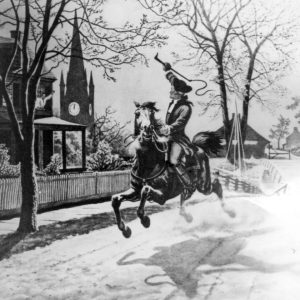
Paul Revere #2: The Ride and its consequences By mid-April 1775, the British army’s “secret” preparations for a mission to the Boston countryside were on sight for everyone to see. The scouting parties had largely finished their work. Soldiers and sailors were mending and replacing equipment, breaking out field equipment, and conducting maneuvers west of

A President’s Day Appreciation

0 2 scaled

In my lifetime, George Washington’s reputation has been transformed several times, from the pious jerk of the Parson Weems tales to the profiteer of Gore Vidal’s “An Evening With Richard Nixon” and “George Washington’s Expense Account” to a wooden figurehead who was neither a competent general nor an especially impressive president. In fact, the standards

Paul Revere #1: Propagandist and Communicator

Paul Reveres ride

Everybody knows the story of Paul Revere’s ride – or thinks they do: the lonely rider, galloping through a town, shouting “The Redcoats Are Coming!” In the broad scheme of the Revolution, Revere has been reduced to a bit part, his importance diminished by comments such as, “He didn’t even finish the ride, Samuel Prescott

America 250: The Growth of Resistance

america 250

For more than a century, from 1640 to 1763, England was consumed with Civil War, dynastic turbulence, and superpower land wars in Europe. During this time, England’s new American colonies enjoyed substantial autonomy. In 1763, at the end of what we call the French and Indian War, England found itself in possession of its own

>