

After fighting well but losing at Brandywine in September 1777 and again at Germantown in October, George Washington faced the inevitable that the British army would spend the winter in comfort in Philadelphia and that his troops would spend another winter in makeshift quarters. On December 19, 1777, he established a winter camp at Valley Forge, close enough to keep an eye on the British but far enough to be safe from surprise attack.
The first order of business for the troops was to build quarters, and Washington turned his attention to supplies. Fortunately, the winter wasn’t as cold as a few others during the war. But it was a tough winter for the American soldiers. Crops were plentiful that year, but many farmers wouldn’t sell to Washington’s army because Continental money was essentially worthless. Smallpox also was rampant in th camp until Washington had th mn inoculated.
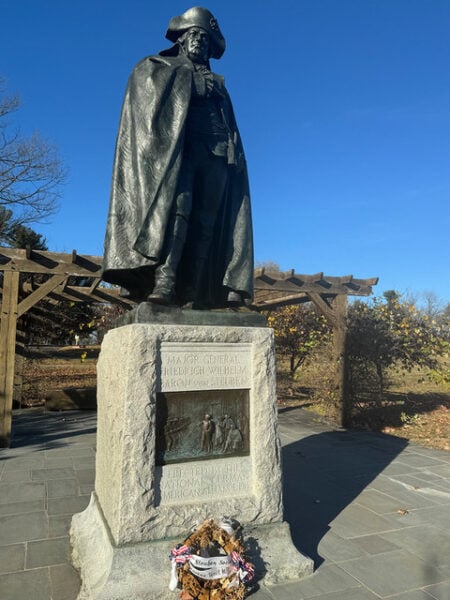
But, despite the suffering, the army’s winter at Valley Forge was perhaps the most valuable time of the whole war and in some senses marked the birth of the American army. This was due to the presence of Baron Friedrich von Steuben, a veteran of the Prussian army who had been discharged due to the peacetime state of affairs in Europe, the machinations of a rival, and veiled accusations of homosexual behavior. He came to the attention of American diplomats in Paris, who recommended him – and exaggerated his experience – to Washington. Impressed with his knowledge of military drill and tactics, Washington appointed him Inspector General of the Army.
Steuben was horrified at the army’s lack of discipline and undertook to turn “the rabble” into soldiers. He barely spoke English and was a strict taskmaster but delighted the Americans with his colorful outbursts in German, French, and other languages.
Besides drill, Steuben taught the soldiers military skills such as firing by volley and use of the bayonet. He also taught survival skills such as military protocol, saluting, hygiene, how to set up an efficient camp, how to set out sentries, and rudimentary first aid.
By the end of the winter at Valley Forge, the roles had reversed. Washington believed his army was now at least as good as the Redcoats and he no longer avoided battle; he was now the hunter. And the British, learning they were now at war with France as a result of the new American treaty with France, ordered their forces in North America to retrench. Holding Philadelphia had done them no good and they now wanted nothing more than to get safely back to New York.
Washington’s army caught the retreating British on June 28, 1778, and fought the Battle of Monmouth Courthouse, a day-long slugfest that resulted in a clear-cut American victory. There would be no more sneak attacks at dawn or night-time marches to attack a small rear-guard. Washington’s army took on the main British army in head-to-head combat – and came out ahead.

Great and informative article. Thank you Leon
Another excellent piece about the Revolution by Leon Reed. Many thanks.
I’ve been saving them, but I’m not sure i got them all, so far. Is it possible to find them on past issues of Gettysburg Connection?
yes! they’re here: https://gettysburgconnection.org/author/lreed-250/