

The colonies immediately recognized the importance of naval warfare. Although the 13 colonies had no real naval force, they did have a shipbuilding industry, many merchant vessels that were engaged in domestic and foreign trade, and many captains and sailors who were familiar with the open sea and with warfare. In fact, the colonies did have one major naval advantage: for years, the Royal Navy had depended on the forests of New England for the tall, straight trees needed for the masts of their warships.
On October 13,1775, the Continental Congress authorized the creation of the Continental Navy and followed with the U.S. Marine Corps a month later. Through construction and purchases, the colonies had 27 warships by 1776, far short of the Royal British Navy‘s 270 warships.
The U.S. Navy never came close to matching the Royal Navy. But it had some successes. In February 1776, a fleet commanded by Essex Hopkins executed the first amphibious assault by U.S. Marines and sailors. Their attack on the British colony in the Bahamas, captured a large supply of guns and ammunition.
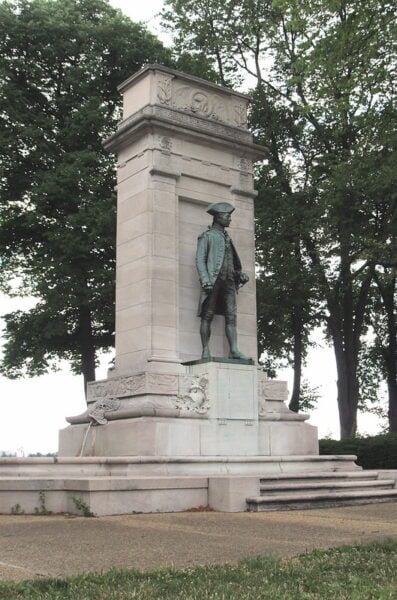
The best-known American sea captain was John Paul Jones, who remarked upon being given command, “I wish to have no connection with any ship that does not sail fast; for I intend to go in harm’s way.” He captured several British warships, including the HMS Serapis in a battle in which, after being asked by the British captain if he was ready to surrender his badly damaged vessel, famously shouted, “I have not yet begun to fight!”
One crucial weakness was that the U.S. Navy never was used to provide mobility or firepower for the army. On several occasions, notably the 1776 campaign for New York City and the 1777 British move via Chesapeake Bay to attack Philadelphia, Washington’s army was left guessing where the British would strike next. In a 1780 letter, Washington noted “the facility with which the enemy by the help of their fleet can unite their force at any point where they find us weak.” It wasn’t until the post-treaty arrival of the French fleet under Comte de Grasse that the British fleet faced a real challenge.
American privateers – privately-owned ships licensed to attack British ships – also did considerable damage to British shipping. It is estimated that American privateers seized approximately 1,500 British ships over the course of the war. This caused British marine insurance rates to skyrocket; the combination of losses and higher costs eventually caused British merchants to call for an end to hostilities.
The nature of the war at sea changed considerably when France entered the war in 1778 and Spain and the Netherlands joined over the following two years. Britain still managed to maintain naval superiority along the North American coast for most of 1779 and 1780, which allowed them to pursue land campaigns in the Carolinas. But their forces were now distracted by fights at Gibraltar, in Asia, in North American possessions outside the 13 colonies, and in the Caribbean.
From the American viewpoint, the climax of the naval war occurred in September 1781, when de Grasse’s French fleet drove off a British fleet commanded by Admiral Samuel Hood in the Battle of Virginia Capes. This prevented the evacuation of Lord Cornwallis’s army at Yorktown; the subsequent surrender of this army to American and French forces commanded by Washington ended major hostilities in the 13 colonies, although fighting in the Caribbean and elsewhere continued until the 1783 Treaty of Paris ended all fighting.
