

After Washington’s victories at Trenton and Princeton at the end of 1776, the British abandoned all their outposts in southern New Jersey. This meant thy started the 1777 campaigning season precisely where they had been the previous autumn. Having failed to take Philadelphia the previous year by marching through New Jersey, British commander Sir William Howe decided to come up the Chesapeake Bay, giving his army a much shorter march (and hopefully less fighting) to get to Philadelphia. Washington’s army fought well at Brandywine, Germantown, and other battles, but the result was that Howe’s forces spent the winter in comfort in their foe’s capital city while Washington’s army shivered at Valley Forge.
But in pursuing this campaign, Howe may have done more than any other military leader to lose the colonies for Britain. Instead of going to Philadelphia, Howe was under orders to proceed up the Hudson River to cooperate with another British commander, John “Gentleman Johnny” Burgoyne.
Burgoyne’s plan was to come down Lake Champlain and the Hudson River from Canada, cutting New England off from the rest of the colonies. At first the mission went well. He captured Fort Ticonderoga and Fort Edward and a separate column advancing across the Mohawk Valley made good progress. But the Mohawk Valley force was turned back and a detachment from Burgoyne’s army was defeated at Bennington, VT, by Vermont militia forces. This was a serious setback. Not only did the battle cause losses that couldn’t be made up, but the expedition also failed to capture the much-needed supplies it had been sent to get.
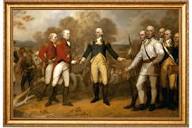
Finally, in September and October 1777, Burgoyne’s depleted army fought two battles near the village of Saratoga, NY. The fighting on both battles was sharp but American forces prevailed. Two of the major American heroes were Daniel Morgan, whose Virginia riflemen did much to thin the British officer ranks, and Benedict Arnold, whose future treason was at least in part because of his belief that he hadn’t been given enough credit for the victory at Saratoga. Surrounded and running out of food and ammunition, Burgoyne surrendered his army of 6000+ British and Hessian soldiers on October 17, 1777.
The surrender of an entire British field army to “colonial rabble” sent shock waves through the British public and Parliament, causing many to lose faith in the war effort. However, the greatest impact of the victory was felt in Versailles, at the French court. Ben Franklin had been representing U.S. interests in France and was popular at Court and with the French public. There was no love lost between the French and English kings and French King Louis XVI would be happy for a chance to knock England down a notch. But he didn’t want to incur England’s wrath by backing a loser.
The victory at Saratoga convinced France that the colonists had a real chance and Franklin was able to secure a treaty of alliance. This immediately meant aid – arms and money – but it also brought the powerful French Navy and Army in on our side.
Suddenly, England wasn’t fighting 13 rebellious colonies; she was in a world war, fighting the other great superpower. And her truly valuable possessions, the sugar islands in the Caribbean, were at risk.
At this point, Britain’s days ruling the North American colonies were numbered. If they couldn’t persuade enough Loyalists to take up arms or trap and destroy Washington’s army, the end was inevitable. The British prolonged the agony for four more years and in that time the colonists had many bad days. But the direction was clear; Saratoga truly was the turning point.
Featured image: Surrender at Saratoga (Morgan in white)
