
If it’s still feeling dark to you in the mornings and evenings these days, you’re not imagining it. Since the winter solstice on December 21,the daylight has been increasing, but through January the change is barely perceptible, and doesn’t occur evenly in the morning and evening.
Around the solstices, the Sun’s apparent path along the horizon changes very little from day to day, much like a car easing through a tight turn on a road. As Earth moves farther from the solstice, the Sun’s path steepens, and sunrise and sunset times begin to change more quickly. This is why day length barely budges in January but increases rapidly by March.
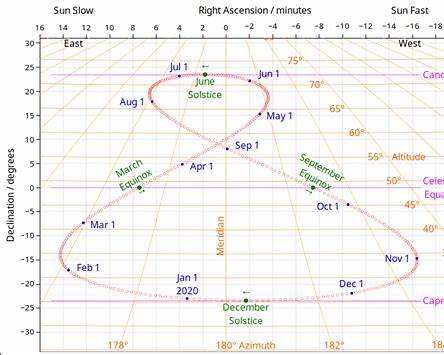
January’s small amount of added daylight also does not arrive evenly. While the sun is above the horizon slightly longer each day, almost all of that extra light is added after sunset, not before sunrise. In early January, Earth’s tilted axis and slightly elliptical orbit cause solar noon — the moment the Sun is highest in the sky — to drift later each day. That drift offsets what would otherwise make sunrise noticeably later, effectively freezing morning light in place while sunsets inch later.
This behavior is illustrated in the featured image to this article, a diagram known as an analemma, which traces the Sun’s position at the same clock time throughout the year. The tightly curved section representing December and January shows how little the Sun’s apparent position changes during midwinter, while the wider loops reflect faster changes later in the year.
Right now, in Adams County, sunrise is stuck at about 7:30 a.m. and won’t change much for the next few weeks. But sunset is slowly creeping later. On January 1, sunset occurred around 4:55 p.m., giving us roughly 9 hours and 24 minutes of daylight. Only today will we reach a small but psychologically important milestone: the first 5:00 p.m. sunset of the year.
But be ready! Things are going to change quickly over the next few weeks as we approach February, when sunrise will start to be noticeably earlier.

A very interesting and informative piece. Now we wait for the daffodils, tulips and other spring bulbs to wake up.