
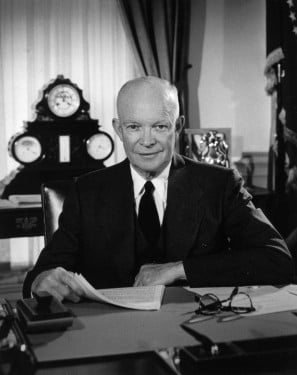
Most visits by US Presidents to Ireland have been ‘Irish vote’-related or homecoming trips to ancestral roots. Trips by Kennedy, Reagan, Obama, Clinton and Biden are cases in point. The visit in late August 1962 of Gettysburg’s most famous resident, former President, Dwight D. Eisenhower, was of another hue altogether.
Eisenhower visited the town of Wexford on Ireland’s southeast coast to lay a wreath at the statue of Commodore William Barry, ‘the father of the US Navy’. The bronze statue was a gift from the American people and was transported to Ireland on the USS Charles S. Sperry. In a further nod to the historic setting, a couple of hundred yards down the quays from the site of the Barry statue, is the bridge over the river Slaney constructed in 1793 and a key factor in quelling the 1798 Irish rebellion against British rule.
Barry was born in 1745 in the village of Ballysampson, Tacumshane in the county of Wexford. As a young man with an interest in the sea, he emigrated to Pennsylvania where he became a shipmaster at the age of 21 in Philadelphia – a major port of entry for Irish emigrants of the era. Barry offered his services to the Continental Army at the outbreak of the War of Independence and offered his ship, the Alfred to the Continental Navy as its first ship. It was the first ship to capture a British one in the war, for which Barry received a note of gratitude from General Washington.
At the foundation of the US Navy in 1794, Barry as the senior captain of the naval service, was awarded the honorary title of commodore in honor of his huge contribution to its founding and development. As a military man who also headed a vital US military serice, Eisenhower would have been keenly aware of the magnitude and impact of Barry’s service.
Although perhaps stretching the connection with Gettysburg a little, it is worth mentioning the mid-1990s Stephen Spielberg film, ‘Saving Private Ryan’ about the D-Day Normandy Landings of 1944. Spielberg chose Wexford’s nearby beach, Curracloe, as the location for the famous events due to its close similarity to Omaha Beach, one of the US forces’ D-Day landing points. The film provided huge interest and some well-received local employment during its filming. To this day, a pub/bar named ‘Omaha Beach’ remains near the shore.
The fact that the Supreme Allied Commander of the invasion had visited the nearby town of Wexford some thirty years before the making of the film, was not lost locally or farther afield. Interestingly, Eisenhower’s visit to Ireland took place in 1962, two years after his own presidency had ended and during the presidency of John F. Kennedy. Eisenhower’s presence in Wexford was a huge honor and spectacle for its local citizens.
Kennedy himself was to visit Ireland including Wexford in the following year. This cemented further the links with Wexford as Kennedy’s family roots were in the village of Dunganstown also in county Wexford and a small number of miles from where the statue to Commodore Barry was erected.
JFK’s 1963 visit to Ireland took place a mere five months before his assassination. In his address to both houses of the Irish parliament that year, the President formally announced the return to the Irish people of the battle flag of the famous ‘Fighting 69th’ Irish Brigade which fought so bravely at Gettysburg and other Civil War battles. Scarred by a bitter civil war only forty years previously, Irish people could feel the full intimacy and poignancy of the gesture.
Pennsylvania and Ireland have had strong links since the 17th and 18th centuries. These have been well-documented. Those between Gettysburg and Wexford are less so, but on deeper exploration, significant.
The visit of an illustrious statesman and Gettysburg resident to honor a US hero with Irish antecedence, established direct links with an ancient Viking/Norman town that had sent many of its people to live in Pennsylvania and its fellow US states. Not insignificant.
