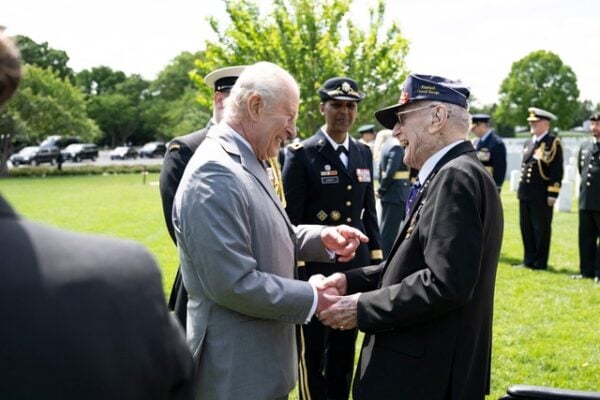
York County resident Harry Miller had the honor of representing all American WWII veterans to greet King Charles during his recent visit to Arlington Cemetery. Harry, 98, chatted briefly with the King at the cemetery’s Canadian Cross. “He was very nice,” said Harry. “He asked if I really enlisted at age 15 and when I said yes, he asked me why I did it. I told him, ‘well, there was a war to win and I thought I could help.’ He said, “Well, you certainly did a good job.’”
Harry served in the 740th Tank Battalion and fought in the Battle of the Bulge and later battles through V-E Day. The 740th compiled an enviable record after a tough start. “We were originally assigned a classified mission and had special Sherman tanks with intense lights instead of a turret,” Harry explained. We were supposed to light the way for our boys in a night attack or blind the Germans if they attacked.” But the mission was cancelled, their modified Shermans were taken away, and they arrived on the mainland of Europe shortly after D-Day without tanks. “The beachmaster was a Navy guy and he said, ‘I don’t know anything about tanks, you’ll have to get them from First Army,’” Harry said. “But wherever we went they didn’t have tanks.”
Finally, by December, they were in Belgium, still with no tanks, working as MPs. The front wave of the German attack in the Battle of the Bulge was approaching and the battalion was ordered to go to the village of Stoumont. “Col. Peiper’s tanks were going to get there in the morning and there was only infantry to hold them. “The colonel said, ‘We don’t have any tanks,’ and they said, ‘No problem, you can go to the depot and draw whatever you like.’ We thought ‘Oh boy, new Shermans,’ but it turned out to be a bunch of junk. Battle damaged, cannibalized, there were no gunsights, no radios,” said Harry. “But the boys spent the night welding and scrounging and by daylight, we had two more or less functioning Shermans and one M36 tank destroyer.”
As they arrived in the village, Peiper’s vanguard was coming in from the other direction. “Our first Sherman got off one shot and set the lead Tiger on fire. His gun jammed so the second Sherman pulled up, fired one shot, and hit a second Tiger. The tank destroyer had one of the best gunners in the battalion; he got off three quick shots and set a third Tiger on fire.” With three burning Tigers blocking the way, Peiper had to draw back and divert to the village of LaGlaize, where he was finally blocked and gave up, telling his men to abandon their vehicles and try to walk back to Germany. “After that, we were pretty popular,” chuckles Harry. “We spent most of the rest of the war working with the 82nd Airborne. They were great guys, We had a lot of laughs.”
Harry made a career of the Army, retiring in the mid-1960s. He recently moved to York County. He is active in the Battle of the Bulge Association, speaks regularly on his experiences in WWII and Korea, and volunteers regularly at the WWII American Experience museum in Gettysburg.