Discussions of allied support in the Revolution tend to focus on the support the new country received from France. And there is no doubt that the French arms and military support were instrumental in the American victory. But focusing on French support, important as it was, tends to obscure the important support received from the Spanish, the Dutch, and other European countries.
The alliance with France turned the colonial rebellion into a world war. Britain’s overwhelming 1763 victory in the Seven Years War didn’t just leave her nearly bankrupt and begin her alienation from the North American colonies; Britain’s rise to power also terrified or angered other European powers, who feared Britain’s power or longed for the return of lost territories. When England declared war on France, she found that she was friendless in Europe: both traditional adversaries and allies were eager to see England humbled. Spain, still angry about the loss of Florida to Britain in the settlement of the Seven Years War (though they had gained French Louisiana), quickly joined the alliance against England.
Spanish and French forces threatened the British base at Gibraltar. Although the attack ultimately failed, they forced Britain to reinforce the garrison with troops who otherwise might have been available for services in North America.
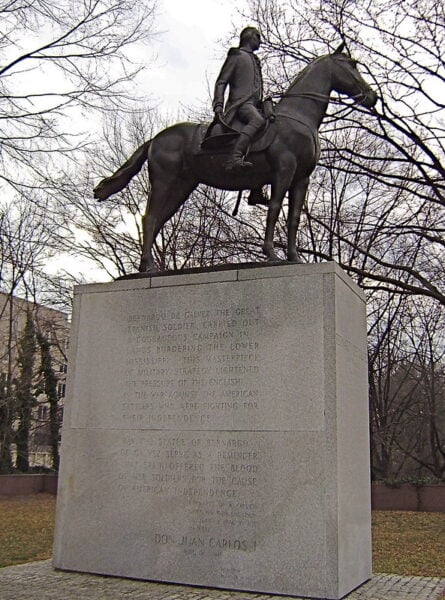
Bernardo de Gálvez, governor of Spanish Louisiana, provided arms to the Americans and conducted an active military campaign, defeating British forces at Baton Rouge and Natchez in 1779 and Mobile in 1780. In 1781, he took Pensacola, capital of West Florida, leaving the British with no Gulf bases. This secured Florida for Spain and distracted British troops that otherwise might have supported Cornwallis in the Carolinas. And, in the subsequent peace negotiations, these Spanish victories did much to negate British land claims between the Appalachians and the Mississippi River. A statue to Gálvez stands in Washington, D.C. among a collection of statues of Latin American liberation leaders: Bolivar, Juarez, etc. He is also one of only eight people granted honorary American citizenship, together with fellow Revolutionary War heroes Lafayette and Casimir Pulaski, Sir Winston Churchill, Raoul Wallenberg, and other luminaries.
Dutch support. Although maintaining an official show of neutrality, Dutch merchants and the Dutch government provided important assistance – gunpowder, muskets, loans and other financial support – to the rebellious colonies from the outset. Much of this support flowed through the Caribbean port of Sint Eustatius, where, in 1776, the Dutch port commander ordered his fortresses to return a salute from an American ship entering port and thus became the first nation to extend a form of recognition to the new United States. In 1782, they became the second country, after France, to extend formal diplomatic recognition.
Frustrated with Dutch supportive actions, such as shielding Admiral John Paul Jones after his famed “I have not yet begun to fight” victory over the British warship Serapis, the British declared war on the Netherlands and now was embroiled with another naval power in the Caribbean.
Other countries. Prussia and Russia, sometime allies of England, refused to support her in this war. In fact, Catherine the Great’s refusal to provide hired soldiers in 1775 delayed British actions while they made other arrangements with German princes such as Hesse, Brunswick, and Hanover. While neutral, Prussia and Russia helped America when they formed a League of Armed Neutrality, insisting that Britain not interfere with neutral shipping. Finally, Austria stayed out of it, but merchants in the Austrian Netherlands (present day Belgium) traded with and provided aid to America.
Although not directly bolstering Washington’s army in North America, all these military, diplomatic, and economic actions buttressed the American economy and army and forced the British to spread their army and naval forces more thinly. Britain learned the difficulty of fighting alone and the Americans learned the benefits of having allies.