
The Founders read and debated the works of Enlightenment political philosophers such as John Locke, Montesquieu, Voltaire, and Rousseau and applied many of their ideas in arguing for independence and establishing our government. They also looked for inspiration to the Classical era, particularly the Roman Republic. Mistrusting pure democracy, as practiced in Golden Age Athens, the Founding Fathers admired the Roman Republic, which lasted more than 500 years and invented such concepts as separation of powers and limited tenure in office. Frequent references were made to political and military figures such as Cicero, Cato, Brutus, Marc Antony, Scipio Africanus, Fabius Maximus … and Cincinnatus.
Day-in-and-day-out, the Senate ruled the Roman Republic. Each year, the Senate selected two consuls who jointly “reigned” for a year. The consuls had extensive administrative, legislative, and judicial authorities and the appointment of two to share the power was intended to ensure that each consul would act as a “check” on the other; each could veto the decisions of the other.
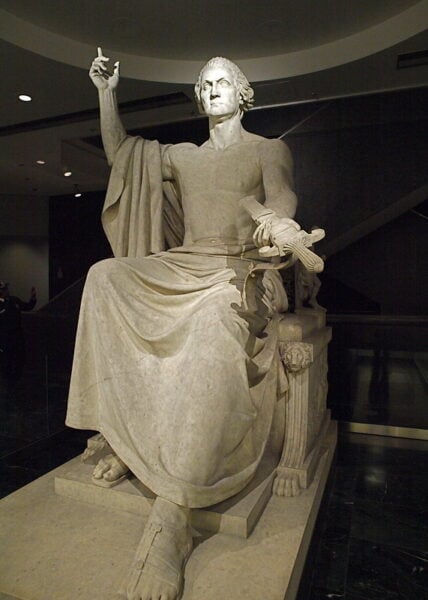
During an emergency, the Senate could appoint a dictator. These were temporary appointments who had total civil and military power, even the power to execute without trial.
Under Roman law, the dictator relinquished power once the emergency had passed. Of course, the Founders recognized the risk in this system – the end of the Republic came when Julius Caesar was appointed dictator and made the office permanent. The central challenge James Madison perceived when he wrote the Constitution was how to give the Chief Executive enough power to be effective while avoiding the risk of a Caesar.
The Roman most admired by the Founders was the first famous dictator, Lucius Quinctius Cincinnatus. Cincinnatus was a Roman farmer and a senator in the mid-5th century BCE.
According to the story told in Livy’s History of Rome, he had retired from public life and was plowing his field in 458 BCE when notified that he had been appointed dictator to rescue a surrounded army.
Cincinnatus took the field and defeated the enemy in just sixteen days. He then stepped down from his post and returned to the countryside.
Cincinnatus was considered a model of civic virtue by the founders and was perhaps the most widely admired man from classical times. Washington had a bust of Cincinnatus in his study and was often referred to as “The American Cincinnatus.” He first showed his recognition of this role when, at the end of December 1776, Congress granted Washington what amounted to near-dictatorial powers for 6 months. Washington’s carefully word reply stressed his understanding that the civil authority remained supreme and that he was eager for the opportunity to relinquish the power..
When the time came for the army to disband, Washington’s officers named their veterans’ association “the Cincinnati” in reference to their abandonment of the tools of war and return to civilian life.
Washington Declines Total Power. Early in his life, George Washington may have been one of the least likely people to stand as a model of rejecting power within his grasp. Born into middling circumstances and acquiring wealth through inheritance and marriage, he was stiff, formal, somewhat vain, and hungry for land and a position in society.
Even his support of the Colonial cause came with a grasp for power. He attended the meetings of the Second Continental Congress, convened shortly after the start of hostilities in Lexington and Concord, wearing his Virginia militia officer’s uniform – just in case anyone happened to be looking for someone to lead the army.
But Washington came to understand that HE was the face of the rebellion: not Congress, not the capital city, not some abstract writings by Thomas Jefferson, Thomas Paine, George Mason and other thinkers. But he applied this knowledge thoughtfully: rather than a grasping “l’ etat, ce moi,” he understood that every move he made was being watched and that every action he took was setting a precedent.
He had his first chance at total power in 1776, when Congress granted him temporary dictatorial powers:
Congress: Resolve, That General Washington shall be, and he is hereby, vested with full, ample, and complete powers [raise troops …]; to displace and appoint all officers under the rank of brigadier general, and to fill up all vacancies in every other department in the American armies; to take, wherever he may be, whatever he may want for the use of the army, if the inhabitants will not sell it, allowing a reasonable price for the same; to arrest and confine persons who refuse to take the continental currency, or are otherwise disaffected to the American cause; and return to the states of which they are citizens, their names, and the nature of their offences, together with the witnesses to prove them: That the foregoing powers be vested in General Washington, for and during the term of six months from the date hereof, unless sooner determined by Congress.
Washington’s careful reply would have reassured people who might have feared Congress was approving an American Caesar:
“Instead of thinking myself free’d from all civil Obligations, by this mark of their Confidence, I shall constantly bear in Mind, that as the Sword was the last Resort for the preservation of our Liberties, so it ought to be the first thing laid aside, when those Liberties are firmly established.”
Regardless of his frustrations with the chronic inability of Congress to pay and supply his army and the constant intrigues and meddling, Washington insisted that Congress was the ultimate authority. He corresponded regularly with Congress, giving detailed reports on campaigns and the status of the army, acknowledging their questions and instructions. Frustrated by the inability of the colonies and existing industries to provide enough and the right kind of arms, he had his chief of artillery, Henry Knox, work with Congress to create a Commissary General of Military Stores.
He was given similar dictatorial powers temporarily again in late 1777, when Congress was fleeing the British army approaching Philadelphia. Once again, he continued to defer to Congress, temporarily meeting in York while the army wintered at Valley Forge. He never used the extraordinary powers beyond the military sphere and once again surrendered them promptly.
And when his chief rival, Horatio Gates, was appointed Chair of the Board of War (more or less the Secretary of Defense and in effect Washington’s superior), Washington dutifully complied with instructions and communicated with Gates on war and supply matters.
This does not suggest Washington was a humble man or one who lacked ambition. Rather, he understood his importance as a symbol of the rebellion and that they were trying to build a durable institution that would last beyond his lifetime. And, as his rival Gates came to understand, Washington knew when to be patient with his critics and when to make his move.