
On November 25, 1783, after the British army evacuated, George Washington entered New York City for the first time in seven years. This was the scene of his greatest humiliation – getting routed, chased out, and hounded the length of New Jersey in 1776 – and Washington undoubtedly felt a deep sense of satisfaction. Fe would have questioned if he had turned his re-entry into a pageant of praise for the conquering hero. But this was no Roman triumph: Washington rode quietly in on a horse, accompanied by Governor George Clinton to show his deference to civilian authority: two public officials entering the city to make sure all was well and to restore civil government.
On December 4, he hosted his officers in a farewell banquet at Fraunces Tavern. He told them, “With a heart full of love and gratitude, I now take leave of you. I most devoutly wish that your latter days may be as prosperous and happy as your former ones have been glorious and honorable.”
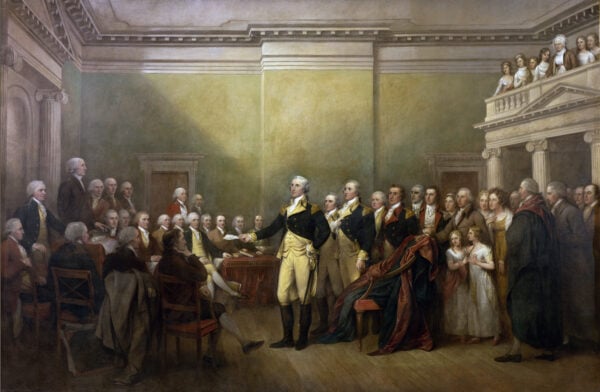
He made an even more dramatic gesture a month later, when he appeared before Congress to surrender his commission. Arriving in Annapolis, where Congress was meeting, on December 19, he was honored by Congress with a banquet three days later.
The next day, in a carefully scripted ceremony, Washington reported to Congress that he had accomplished the mission Congress had given him (defeat the British) and requested permission to step down and return home.
Mr. President: The great events on which my resignation depended having at length taken place; I have now the honor of offering my sincere Congratulations to Congress and of presenting myself before them to surrender into their hands the trust committed to me, and to claim the indulgence of retiring from the Service of my Country. …
Having now finished the work assigned me, I retire from the great theatre of Action; and bidding an Affectionate farewell to this August body under whose orders I have so long acted, I here offer my Commission and take my leave of all the employments of public life.
Ironically, Thomas Mifflin of the Conway Conspiracy was the presiding officer to whom Washington surrendered his commission and his frequent challenger, Horatio Gates, was the man given the honor of greeting him and presenting him to Congress. That itself is revealing. Think of the people much closer to Washington who would have loved this honor: his “sons,” Alexander Hamilton or Marquis de Lafayette, or loyal generals like Nathanael Greene or Henry Knox. But protocol said the honor belonged to Gates, so Gates it was.
Thomas Jefferson, present that day, understood the enormity of what he had witnessed: “The moderation and character of a single man has probably prevented the revolution from being closed, as most others have been, by a subversion of the liberty it was intended to establish.”