Recovery is Possible. Compassion is the Cure.
Approximately thirty Adams County community members participated in Gettysburg’s Eighth Annual Overdose Awareness Walk and Vigil on Monday, Aug. 31, kicking off the September Recovery Month Campaign for the Adams County Coalition for Overdose Awareness & Recovery.
Observed in August every year across the nation, International Overdose Awareness Day (OIAD) seeks to create a better understanding of overdose, reduce the stigma of drug-related deaths and create changes that reduce the harms associated with drug use.
Presented by Andrea Dolges, Executive Director, Center for Youth & Community Development (CFYCD) and Aaron Zipp, Director, Youth Coalition and COAR, and accompanied by Borough Mayor Alison Lintal and Gettysburg Police Chief Dave Snyder, the group walked the route from the Adams County Court House on Baltimore Street and ended at the Gettysburg Rec Park on Long Lane. Adams County Commissioner Randy Phiel, Gettysburg Council Chair Matt Moon, and Beth Farnham, Candidate for Congress, also joined the walkers.
On the way, the group stopped at the Mercy House, Gettysburg’s drop-in recovery support center to leave personal messages and sign the “Why I Walk” banner. Mercy House Executive Director Colin Kerrigan, addressed the walkers, expressed pride in the community, commended the families who refuse to give up, those who are working on their recovery, and all who are helping to support the cause. He mentioned that overdose fatalities are on the decrease, “but one is too many, so let’s keep this going”.
At the GARA Sterner Building, the group gathered in a circle to listen to opening remarks by Andrea Dolges, Aaron Zipp and Mayor Lintal. The Mayor mentioned that this event brought close to home that we are not talking about statistics, but about our own community, neighbors, friends, and children. She wanted to recognize not only those affected by overdose deaths, but also those currently in recovery in the community.
Lintal then read an official declaration proclaiming August 31 Gettysburg’s International Overdose Awareness Day. She encouraged the Gettysburg community to learn about signs of overdose; to have access to resources to help in case of being faced with an overdose; to remember those whose lives have been lost; and “to support those in recovery with dignity and understanding”.
Families then were encouraged to share their personal stories of loss.
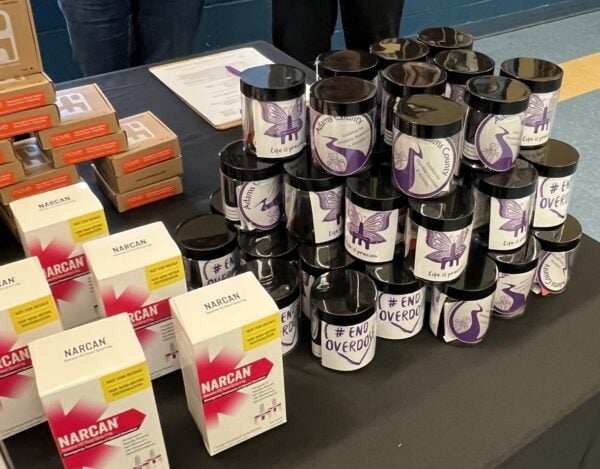
The gathering concluded with a vigil, with attendees lighting purple candles and paying respect to community members lost to overdose, their portraits exhibited along the walls of the meeting room. The event presented an opportunity for attendees to connect, gather educational materials, and pick up naloxone medication and accessories.
According to preliminary data released by the Centers for Disease Control and Prevention (CDC), approximately 70,000 Americans died from drug overdoses in 2025. This represents a decrease in deaths by nearly 14% from 81,313 deaths in 2024 and marks the third year in a row that overdose numbers have dropped nationally (with the exception of a few individual states).
Experts say that the decrease in drug overdose deaths is driven by a combination of public health interventions, changes in drug use behavior, widespread access to naloxone (Narcan), and better access to addiction treatment medications. In addition, increased federal funding for treatment access, as well as settlement monies stemming from national opioid lawsuit settlements are now reaching state and local communities, funding local treatment clinics, education and prevention resources. 1)
Enter the Adams County Coalition for Overdose Awareness and Recovery (COAR), a grassroots organization right here in Gettysburg that was formed in 2016 as an initiative to meet the specific needs of Adams Countians in treatment and recovery; to continue to prevent overdose deaths; and to reduce stigma while supporting families who have lost loved ones or been impacted by addiction.
The goal of the organization is to empower the community to help people struggling with substance use, “which is a symptom or result of other issues affecting our neighbors”. “A person isn’t an addiction and people can move on and be productive members of our community,” their mission statement says. 2)
The stigma of drug or alcohol addiction is one of the most considerable obstacles that many folks with substance dependence face on a daily basis when trying to overcome their disease. Stigma often also afflicts undeserved pain on the loved ones of addicts, many of whom did everything to raise their children right or support other loved ones. And stigma is one of the main reasons that some agencies or community members shy away from reaching out to help.
But overdoses do not only happen to regular users or addicts. Erika S. lost two sons to substance abuse after an extended struggle with mental health issues and addiction. On contrast, Scott’s son never drank or used drugs in his life but ended up dying from an overdose when taking one single pill handed to him by a fellow college student, which ended up being laced with Fentanyl.
Overdose doesn’t discriminate.
How You can Observe and Act 3):
• Carry naloxone, the medication that reverses an overdose. It is an effective way to save lives, preventing death in 75-100% of drug overdoses.
Keep a naloxone kit on hand (in your purse, your car), learn how to use it and show others how simple it is to save a life.
• Familiarize yourself with the resources your community offers and help guide someone in crisis to the help they need.
• Reach out to your elected officials to ask for support policies that expand treatment access, fund overdose prevention programs and support stigma reduction.
Citations:
1) DPA Fact Sheet : https://drugpolicy.org/resource/fact-sheet-health-harm-reduction-approaches-pivotal-to-decrease-in-national-drug-overdose-deaths/
2) COAR: https://www.overdosefreeadams.org/ and https://www.cfygettysburg.com/about-us
3) Learn more at: https://www.advocacyincubator.org/overdose-prevention