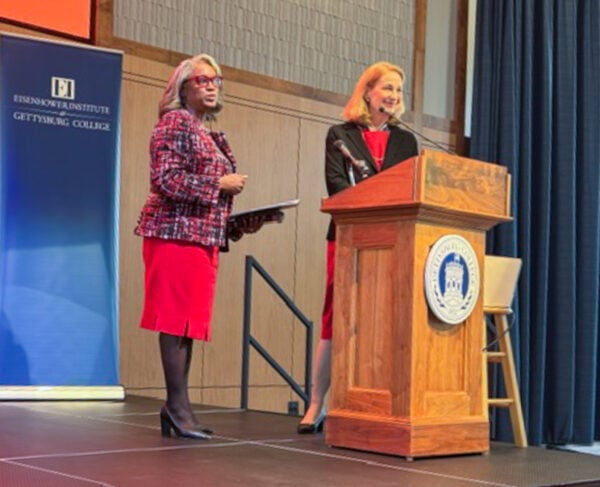
Tracie Potts, executive director of the Eisenhower Institute at Gettysburg College, kicked off the Institute’s 5th annual “Democracy Week” by introducing Institute founder Susan Eisenhower for a major address: “From a World at War to Civil Rights: How WWII Transformed America.”
Eisenhower noted that WWII was not her grandfather’s first experience with extraordinary command responsibility. During WWI, Ike had 10,000 soldiers under his command at Gettysburg’s Camp Colt, the first U.S. tank training school. In this command, he was one of the first to deal with the Spanish flu. After dealing with the local emergency, his medical staff was sent to Washington, D.C., to educate the Army medical staff about dealing with the pandemic.
Eisenhower noted that after WWII, “Europe was in chaos,” with the aftereffects of 72 million killed. She observed that for years Ike had to “deal with the challenge of sending so many inro harm’s way.” He had a particularly harrowing experience on April 12, 1945, when, after visiting the salt mines where looted art and gold were stored, he toured Ohrdruf, the first camp liberated by western armies. That day, he insisted on seeing everything so that he could be a witness when others denied it had happened. He wrote Gen. Marshall urging him to send “everyone” and required that both nearby villagers and American GIs tour the camp. “Imagine having the forethought to think 50 years into the future, to see the problems that might arise. This is called accountability.” And that night, while still processing what he had seen at Ohrdruf, he learned that the president who had led America through the Depression and WWII had died.
“The war left us an extraordinary range of challenges, including rebuilding Europe and the Cold War. U.S. society was in turmoil. African Americans came home after serving in the military to a brutal system of segregation. Women who had left their homes and helped win the war were expected to step backwards.”
She added, “And for the first and only time, we truly were the world’s only superpower. As a result of the war, we had an enormous amount of goodwill.”
“And General Eisenhower was left to modernize America in the 1950s.” She noted that that the Republican party had been out of power for 20 years and was blamed for the Great Depression. “He modernized the party and he was the first president of the hydrogen bomb and space eras. He ended the Korean War in 1953 and took us off a war footing, expanded social security, and built the interstate highway system and other large projects like the St. Lawrence Seaway.”
She noted that President Eisenhower was responsible for the first civil rights legislation since the Civil War era, desegregated the District of Columbia, and made the key Supreme Court appointments that led to the landmark decisions expanding rights. “He established a beachhead and didn’t get too far ahead of his supply line. Everything he controlled he fixed: the District of Columbia, federal agencies, federal contracting.”
He was a real “national security” president who often described national security of a three-legged stool, made up of military strength, the economy, and “our moral force in the world.”
Eisenhower observed that Ike’s ability to master himself helped him handle difficult problems and people. He understood the importance of relationships and had empathy for the other’s viewpoint. She noted that he said the death of his son Icky convinced him that “I had to learn acceptance or go crazy.”