
Now that the Constitutional Convention had approved the Constitution, it required the ratification of nine states to take effect. And there was powerful opposition, even in Washington’s home state, where Patriot firebrand Patrick Henry and Virginia Declaration of Rights author George Mason were counted among the opponents.
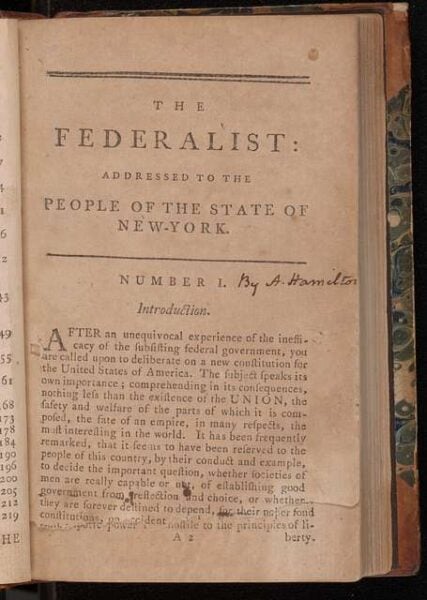
To support the ratification, the two Framers perhaps best known for their original thinking as well as having a “ready pen,” James Madison and Alexander Hamilton, undertook one of the most impressive political writing projects ever: the creation and publication of “The Federalist Papers.” Aimed at readers in New York, the series eventually totaled 85 essays. They were published under the pen name “Publius” and addressed a wide range of arguments in favor of ratification: weaknesses of the current Confederation, protection from foreign countries, how the Constitution protects against faction, safeguards against tyranny, arguments in favor of the structure of the House of Representatives, etc. Hamilton was most prolific, writing 51 of the essays; Madison wrote 29, and John Jay, 5. Although each paper addressed an important issue, five are generally considered to be the crucial foundations of thinking on the Constitution, No. 39, 10, 51, 70, and 78. These defined the basic structure of government and described how they intended to avoid the rise of tyranny.
In Federalist No. 39, James Madison defines “Federalism.” It explains the balance of power between the national government and the states. Madison argued against the alternatives of a confederation (what we had been living under since 1778) or a strictly national government. He argued for “a political system in which at least two territorial levels of government share sovereign constitutional authority over their respective division and joint share of law-making powers; differently put, neither the federal government nor the relevant federative entities may unilaterally alter one another’s powers without a process of constitutional amendment in which both levels of government participate.”
In Federalist No. 10, Madison further argued that a large, commercial republic with a wide range of interests is the best defense against the “mischiefs of faction” and minority oppression. Besides the example of the Roman Republic, Madison’s ideas about the structure of government owed much to the writings of the French Enlightenment philosopher, Baron de Montesquieu. Madison introduced the theme of separation of powers in Federalist 47, where he quoted Montesquieu, agreeing that liberty is lost when the power to make, execute, and interpret laws is held by the same person or group.
He followed up with Federalist No. 51, which is widely considered the most important of the Federalist Papers. Madison explains the foundational system of checks and balances, and the separation of powers, the crucial mechanisms he adapted from the Roman Republic to guard against tyranny. Madison argued that the only practical way to check the growth of excessive power was by contriving the interior structure of the government in a way that its constituent parts could keep each other from accumulating too much power. He observed that, “If men were angels, no government would be necessary. If angels were to govern men [no controls] would be necessary. In framing a government which is to be administered by men over men … you must first enable the government to control the governed; and in the next place oblige it to control itself.”
He noted that power is first divided between two distinct levels of government (state and federal). Then, within each level, the people could rely on “opposite and rival interests” to compensate for “the defect of better motives” by dividing and arranging power so that “each may be a check on the other that the private interest of every individual may be a sentinel over the public rights. …Ambition must be made to counteract ambition.”
Alexander Hamilton’s Federalist No. 70 argued that a single, energetic executive rather than a committee or leadership council, is essential to secure liberty. He based his argument on two themes: energy, the ability to act quickly and decisively; and accountability, the focus of public attention on the actions of a single person
In Federalist No. 78, Hamilton argues for an independent judiciary and lays the groundwork for the doctrine of judicial review.
Besides providing examples of some of the most brilliant writing ever on politics and government, the Federalist Papers remain highly relevant today. They are the best documentation of the Framers’ original intent and provide a guidepost to allow contemporary citizens to judge the direction in which the country is headed and the extent to which it continues to follow Constitutional principles.