
Alexander Hamilton and Thomas Jefferson were the dominant figures in George Washington’s original Cabinet and represented opposite visions of government and how society should be organized. They were the prime movers behind the emergence of political parties and the heads of the two opposing political parties.
Their differences were profound. Jefferson believed the Constitution meant exactly what it said and nothing more. In particular, he believed the federal government had no powers except those specifically mentioned in the Constitution. Hamilton believed that words like “necessary and proper legislation” and “regulate interstate and foreign commerce” allowed for a certain degree of flexibility and interpretation
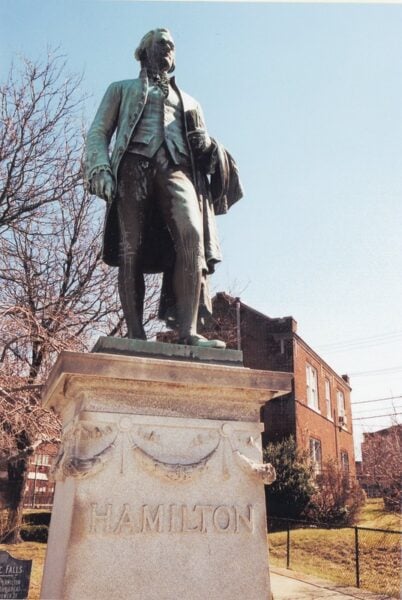
Jefferson believed that political strength lay with the people while Hamilton mistrusted the people and thought decisions should be made by “the best and the brightest.” Jefferson admired the French Revolution in its early stages while Hamilton abhorred the violence of the French Revolution and considered Britain a more advantageous partner due to common heritage, institutions, and trade possibilities.
Eventually, they each came to believe that the other was betraying the Revolution. Jefferson believed that Hamilton’s admiration for England would inevitably lead to restored monarchy while Hamilton believed Jefferson’s admiration for France was leading to the same anarchy and mob excesses seen in the later stages of the French Revolution.
Jefferson favored an agrarian society made up of small farmers and was suspicious of any centralized economic or political power, while Hamilton advocated a strong central government and a strong manufacturing and commercial base to provide prosperity and economic and military security.
Hamilton laid out his views on government in The Report on Manufactures and three reports on debt, credit, and banking. His economic reports called for establishing a national bank to issue currency and stabilize the economy (something like today’s Federal Reserve), and for the federal government to assume responsibility for state debts incurred during the Revolution. This wasn’t just an idea to relieve financially distressed states. Hamilton also reasoned that a national debt would give the bondholders who purchased this debt a stake in the stability and success of the new government and would require the other institutions of national stability such as a national bank and other means to secure the credit.
The Report on Manufactures advocated a policy of encouraging manufacturing by offering subsidies to industry and regulating trade with moderate tariffs (which would both discourage imports and raise revenue to support manufacturing by subsidies). Hamilton argued that these policies would also provide more employment opportunities, promote immigration, and expand the applications of technology throughout the economy, including agriculture. Hamilton attempted to demonstrate Amrica’s industrial future with the Society for Useful Manufactures, a planned manufacturing community at the Great Falls of the Passaic River in Paterson, NJ.
Washington had advocated a similar view in his January 1790 “First Annual Address, to Both Houses of Congress” (in effect, the first State of the Union message). “A free people ought not only to be armed but disciplined; to which end a uniform and well-digested plan is requisite; and their safety and interest require that they should promote such manufactories as tend to render them independent of others for essential, particularly military, supplies.”
Jefferson’s disagreement about the national bank was finally settled in a compromise where Jefferson and Madison allowed the national bank while Hamilton agreed to allow the nation’s capital to be located in the south.
This conflict has largely dominated American politics to this day. The argument about Constitutional interpretation and the expansiveness of the federal government still continues, though now even conservatives practice overwhelming federal authority and wholesale reinterpretations of the Constitution. And, while maintaining a romantic attachment to Jefferson’s view of a pastoral society, the country largely adopted Hamilton’s vision of an urban society based on industry.
