
The new country was relatively weak militarily, had few alliances, and had growing but increasingly restless settlements on the western frontier.
Indian wars. Following the disastrous November 1791 defeat (85% casualties) of an American army by a multitribal confederacy primarily made up of the Miami, Shawnee, and Delaware at the Battle of the Wabash, the U.S. completely revised its military force. Secretary of War Henry Knox created the Legion of the United States, foreshadowing modern day combat teams that integrate infantry, artillery, and other combat arms in a single fighting force. Revolutionary War hero Anthony Wayne was given command of the Legion and won a series of victories, culminating in the 1794 Battle of Fallen Timbers, near present-day Toledo.
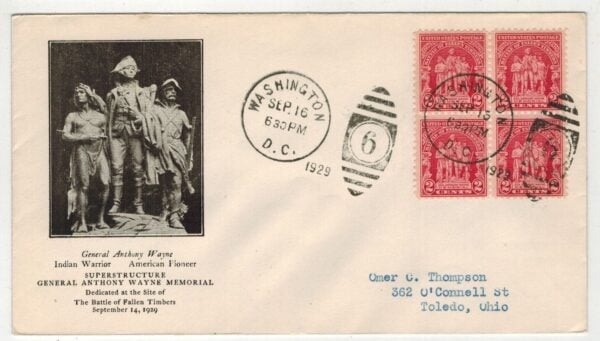
The resulting Treaty of Greenville set the modern-day Ohio-Indiana boundary, extinguishing Indian claims east of that line and promising that the land to the west would forever be theirs. This opened the Ohio territory fully to white settlement (it became the 17th state less than a decade later) and set the pattern for subsequent negotiations and land grabs.
Whiskey Rebellion. Alexander Hamilton’s economic plan called for a tax on distilled spirits and a few other domestic goods to boost revenue. He thought that a “sin tax” on spirits would be a relatively uncontroversial way to make money, not realizing that many farmers distilled their crops into whiskey simply because it was easier to transport on the virtually non-existent roads in the west. His new tax set off the Whiskey Rebellion,, which highlighted the increased stratification into social classes, as small farmers in western Pennsylvania fought against the government.
In 1794, Washington decided on a maximum show of force, calling up and personally leading a military force drawn from the Pennsylvania, Maryland, New Jersey, and Virginia militias. This army, larger than the Continental army at many points in the Revolutionary War, quickly intimidated the rebels, who dispersed before the army could engage with them.
As the rebellion collapsed, 150 men were arrested. Only two were convicted of treason and Washington granted clemency to both. Eventually, the tax was repealed, but the incident demonstrated emphatically the government’s willingness and ability to suppress violent resistance to its laws. The heavy-handed Federal response alarmed many people and accelerated the move toward the formation of political parties.
French-Barbary pirates. The Navy had been disbanded at the end of the Revolutionary War and Congress ignored Hamilton’s argument in Federalist 11 that a national government was needed to negotiate trade agreements and standardize tariffs as well as a Navy to protect this commerce. “Let Americans disdain to be the instruments of European greatness! Let the thirteen States, bound together in a strict and indissoluble Union, concur in erecting one great American system, superior to the control of all transatlantic force or influence, and able to dictate the terms of the connection between the old and the new world!”
But the new country quickly found that it faced challenges at sea from France, which began seizing our ships in their anger after we signed a trade treaty with England, and from pirates operating out of Mediterranean ports in Tunis, Tripoli, and Algiers, who targeted shipping and held crews for ransom or enslavement.
These threats forced Congress to reconsider the Navy. The debates foreshadowed the ultimate divide that would create parties. Federalists considered foreign trade to be essential and a navy necessary to protect that trade, while anti-Federalists believed an agrarian, small town society didn’t need foreign trade and shouldn’t incur the expenditures (and debt) to build and operate a navy.
President George Washington signed the Act to Provide a Naval Armament on March 27, 1794. It authorized the construction of six heavy frigates, including the USS Constitution (Old Ironsides) and had them built in six separate yards (four in the Federalist north), officially giving birth to the permanent U.S. Navy (and the first industrial base policy).
The Navy’s first serious action occurred in the Quasi War with France (1798-1801). President John Adams authorized the new frigates to take on the French and after several victories against French warships and the seizure of many French privateers, the French and Americans ended the conflict. But by the end of Adams’s term, the Navy had 50 warships.
The pirates were tougher to handle. Regularly seizing American ships for hostage ransom, the pirates demanded higher and higher tribute from the American government. In May 1801, Jefferson dispatched much of the fleet to fight the Barbary states on their home turf. After several victories, the U.S. settled with the pirate states and established a position in trade and naval power.
Aaron Burr’s plot. After his 1804 duel with Alexander Hamilton, Aaron Burr realized that his political career was finished. He traveled to the west and developed a plan to … do something. Some believe he planned to organize some western territories (which included the newly acquired Louisiana territory) into a breakaway nation; others believe he planned to invade Mexico (which still included Texas and much of the current Southwest) to create a nation out of that territory. Perhaps the ever-flexible Burr was ready to do both. He was never that clear about his plans and, once the conspiracy collapsed, other participants quickly erased their tracks.
What is clear is that “the west” wasn’t as firmly fixed to “the Union” as it became a few years later. Thinly settled with almost no connections to the eastern states, they still faced occasional Indian problems and were in the midst of occasionally sharp-elbowed jostling between European powers. Their communications and trade were via the vast Mississippi River watershed to New Orleans. Most had moved west to get away from debts or crowds in “the East” and ambitious men were always ready to listen to someone’s new idea. Burr met with many leaders, including future president Andrew Jackson and had the questionably useful support of U.S. general in chief (and first governor of the Louisiana Territory) James Wilkinson. Wilkinson, one of the great scoundrels in U.S. history, plotted with Burr. But when its failure became evident, Wilkinson revealed the plot to President Jefferson and became the foremost witness against Burr. (At the same time, he was also a paid agent for the King of Spain, completing a trifecta of betrayal.) Burr was charged with treason but in a lengthy trial presided over by Chief Justice John Marshall, he was acquitted.
