
In the 1950s and 1960s, I grew up in Ohio, in a country with widespread prosperity and limitless opportunity. I grew up in a town where the country club neighborhood was populated by the usual run of doctors, county seat lawyers, and executives from “the mills:” Republic Steel, Copperweld, Ohio Lamp, Trumbull Lamp, American Welding, and a seemingly endless list.
But most important, we were a headquarters town: there was a vast number of senior executives of what amounted to a Fortune 500 company: Packard Electric, captive supplier of every cable, wire, and harness that went in any GM vehicle.
On the other side of town, we had thousands of well paid union workers at Republic (7000+), Packard (12,000+), eventually Lordstown (10,000+). The rules for every high school kid were plain: stay out of trouble, get your diploma, give Uncle Sam his two years if the Greetings arrive, and you will have the good life. You won’t love your job, but you can own a house, have a motorboat at the lake, and put your kids through college.
That world is as far removed as fin de siècle Europe. Those executive jobs didn’t move to Alabama – or Mexico. They were obliterated. Those union jobs were replaced by jobs driving for Doordash or working in an Amazon warehouse.
Now, the financial reality in Trumbull County – and much of the rest of the country – is stark. Almost 20% of county residents live below the absurdly low federal poverty level and 42% are below the United Way ALICE cutoff, a far more realistic measure of financial distress.
The cold-hearted injunction to anyone experiencing hard times, “get a job,” at least had some basis in reality in the 1960s. Now, it’s a silly comment. ALICE describes the reality:
In 2024 in Ohio, 69% of people in the labor force worked full-time (35+ hours per week, for 50+ weeks). Yet only about 40% of employed people (age 16+) had the security of a salaried, full-time job. The rest relied on non-standard work arrangements — typically hourly paid work from one or multiple jobs (including part-time and gig work). Hourly and part-time workers are more likely to have fluctuations in income due to schedule changes and variable hours and they are less likely to receive benefits, such as health insurance, paid time off, family leave, or retirement plans.
A full 33% of fulltime workers in Ohio do not earn enough to afford the basic necessities. The financial reality is that the “good life” is no longer available to the average American. The world lived in by the privileged classes – government employees, university professors, retired military – with secure careers and lifetime pensions, is the equivalent of the Versailles Court to the average American. And even that world is shrinking.
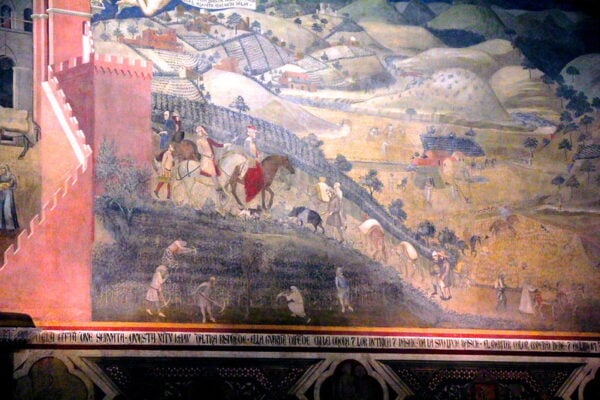
Renaissance Florence was a vast improvement over the preceding Middle Ages. Merchants were beginning to flourish. Trade was resuming. Municipal government was beginning to replace the iron secular rule of the church. But the rule was by a few wealthy landed or banking families. The small middle class were the retainers to the wealthy: painters, doctors, tutors, and suppliers of luxury items. The vast majority lived little better than their serf grandparents.
We’re seeing this. Fifty percent of U.S. consumer spending now is made by the top 10%. This is up from 35% just a few years ago. The luxury travel market, which encompasses “high-end accommodations, luxurious transportation, curated activities and bespoke services designed to offer comfort, privacy and unique cultural engagements,” already a $1.5 trillion annual market, is expected to nearly double in five years. In air travel, the Gided Age “premium and steerage” sections are emerging, with premium seating accounting for half of airline revenue while taking up only a third of seating capacity.
