
The British recognized American slaves as an important resource that could help the Rebels – or be turned to help them. In November 1775, Lord Dunmore, the royal governor of Virginia, issued a proclamation declaring martial law in the colony and offering freedom to any enslaved people or indentured servants belonging to Patriot rebels, who were willing to bear arms for the British. “I do hereby farther declare all indented servants, Negroes, or others (appertaining to rebels) free, that are able and willing to bear arms, they joining his Majesty’s troops, as soon as may be, for the more speedily reducing this colony to a proper sense of their duty, to his Majesty’s crown and dignity.”
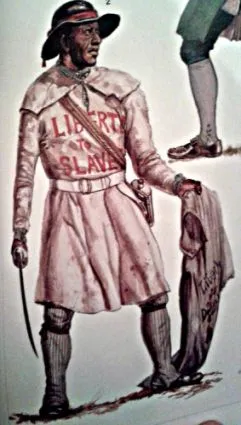
Dunmore organized the Ethiopian Regiment, made up of roughly 800 self-emancipated Black men who had reached British lines. Many of these soldiers fought wearing uniforms bearing the motto “Liberty to Slaves.” The unit fought in several early battles in Virginia, including Kemp’s Landing and Great Bridge, but it never recovered from a 1776 smallpox and typhus outbreak.
The promise of freedom to enslaved people who left their Patriot masters to side with the British was issued on a wider basis. In New York City, which the British occupied, thousands of refugee enslaved people migrated there to gain freedom. The British created a registry of people who had escaped slavery, called the The Book of Negroes. It included details of their enslavement, escape, and service to the British. If accepted, the former enslaved person received a certificate entitling transport out of New York. By the time the Book of Negroes was closed, it had the names of 1,336 men, 914 women, and 750 children.
While Dunmore’s proclamation and other announcements helped spur black support, the initiative also backfired. The British southern strategy relied first and foremost on getting Loyalists to rally to the King’s standard and join military units. Many plantation owners who were otherwise inclined to support the King were angered by the threat to their slaves.
But many slaves escaped to the British – perhaps as many as 50,000-100,000. And the British more or less kept their word. On July 21, 1781, as the final British ship left Savannah, more than 5,000 enslaved African Americans were transported with their Loyalist masters for Jamaica or St. Augustine.
In December 1782, the British evacuated many Loyalists and more than 5,000 Black men from Charleston. More than half of these were enslaved by the Loyalists and were taken by their masters for resettlement in their new plantations in the West Indies. The British also settled freed African Americans in Jamaica and other West Indian islands, eventually granting them land.
At the end of the war, about 200 formerly enslaved people were taken to London with British forces as free people. About 3,500 Black Loyalists, most from the South, were evacuated to Nova Scotia and New Brunswick, where many faced severe discrimination, harsh economic realities, and cold weather. Many of those evacuated to Canada moved on from there to present day Sierra Leone, where they stablished Freetown. Their descendants today are known as the Krio people.
