
The exhibit “Stories Told” at the Phoenix Art Museum featured 40 large-scale figurative paintings by Eric Fischl from the late 1970’s to the present. Near the end of a tour this spring I ignored the cranky buzz of my continuous glucose monitor. The alert was for sinking blood sugar. I waited to hear the docent’s final remarks. When she was done, I thanked her and looked immediately for the grab-and-go part of a café. Not to be found. At this museum there is only a very swanky, mid-century modern restaurant (named for architect Alden B. Dow). It would have to do.
That’s how I ended up at the Alden’s otherwise empty bar – a woman with a leather purse drinking a Sprite in the middle of the afternoon. The bartender looked like he’d stepped straight out of an Eric Fischl painting, so did the particular pitch of sunshine through the windows. I sipped and waited for my blood sugar to rise into range.
Doesn’t sound like an emergency, does it? I didn’t want to deplete the small bottle of apple juice and Halloween-sized Twix bar I had with me. After the museum, I’d be in a car with other people, with other plans. If I strolled out to the patio and drank the juice now, it wouldn’t be there if I needed it on the freeway.
Every type 1 diabetic has their own personal catalog of lows (hypoglycemia near misses). Some are easily handled. Others involve creative triage to remain conscious. Emergencies averted. That takes constant preparation. When you are 100% responsible for managing something your body no longer does on autopilot, you don’t have the luxury of only thinking about the moment.
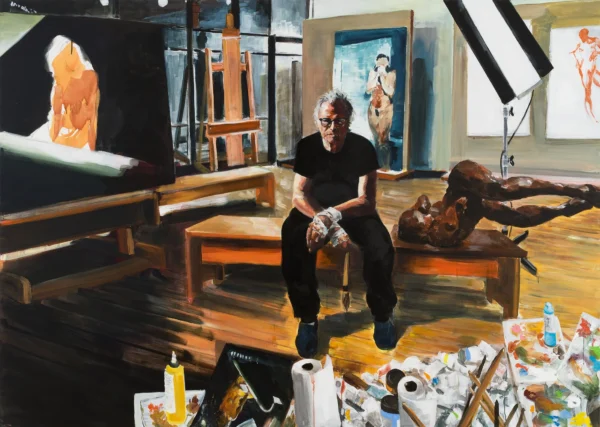
The first time I saw an Eric Fischl painting was in art history class. It was from slides and a book, not the work itself. This was before I was diagnosed with type 1 diabetes, before continuous glucose monitors, before I learned about the Social Determinants of Health (SDOH), before drug prices started “skyrocketing” in earnest, before every local and international event that has unfolded in the meantime. The artist has more miles on him as well. His self-portrait in acrylic, Broken Hallelujah, (2023), offers an introspective moment with him in his studio. Moving through this exhibit I noticed, to my surprise, public health issues subtly present in the scenes. I realized many more stories were implied in each figure in each piece. Fischl’s work is known for leaving viewers with open questions. Visit www.ericfischl.com.
I want to express my respect for all people with chronic illness, and all of those connected to them (family members, clinicians, patient advocates, researchers and voters who understand the importance of access to healthcare and access to essential medicines). Prevention and maintenance of conditions is exponentially less expensive than treating complications.
I’m particularly thinking of diabetes since November is National Diabetes Month in the U.S. And this Saturday, November 14, is World Diabetes Day. Around the globe 1 in 9 adults live with diabetes. That includes people you know and love whether they live in Romania, Nigeria, Taiwan, New Zealand, Arizona, or Adams County, Pennsylvania. You’re hard pressed to be alive anywhere and not know at least one diabetic.
Diabetes includes type 2 (affecting over 90% of diabetics), type 1, gestational, LADA, MODY and cystic fibrosis-related. World Diabetes Day was launched by the International Diabetes Federation and the World Health Organization in 1991.
November 14 is the birthday of Sir Frederick Banting, the Canadian physician-researcher and co-discoverer of insulin. It takes a village, of course – it always does for such discoveries – but Banting’s birthday is a fitting time to commemorate World Diabetes Day.
If you’re curious about the discovery of insulin I recommend the book Breakthrough: “Elizabeth Hughes, the Discovery of Insulin and the Making of a Medical Miracle,” by Thea Cooper and Arthur Ainsberg.
An organization effectively putting stories and data into action on behalf of diabetics is T1International. This nonprofit seeks access to insulin and essential supplies for diabetics around the world. T1International does not accept funding from the pharmaceutical industry. Learn about their current focus on public pharma at www.t1international.com/about/
Katy Giebenhain is a member of the Gettysburg Area DFA Healthcare Task Force.
Featured image caption: Eric Fischl, Broken Hallelujah, 2023, acrylic on linen, 68″ × 96″.
