

After an unsuccessful 1776 siege of Charleston, S.C., and an American victory at Moore’s Creek Bridge, N.C., the British largely left the southern colonies alone for several years as they concentrated their actions in the northern colonies. This does not mean that things were peaceful in the South. The civil war that took place throughout the 13 colonies was especially bitter in the Deep South colonies. Loyalist support was strong throughout the area and the war fought between Patriots and Loyalists was nasty and bloody. As early as 1776, partisan leaders such as Francis “the Swamp Fox” Marion, Andrew Pickens, and Thomas Sumter raised small armies which they used to harass British and Loyalists alike. The war in the Carolinas was a nasty affair involving ambushes of British patrols, burning homes, and taking people who sympathized with the wrong side from their homes. On the frontier, the Cherokee provided an added dimension. The British encouraged the Cherokee to attack Patriot settlements and in regions, the war became basically another white settler-Indian war.
In 1778, British commander Sir Henry Clinton brought much of his force to the South from New York after the Ministry in London ordered him to retrench in the north and seek Loyalist support (and fighters) in the presumably friendlier southern colonies/states. Now that France had entered the war, England faced a worldwide war on land and at sea and needed to conserve its forces in North America.
The transfer of the main British effort to the South began with the December 29, 1778, capture of Savannah.
1780 seemed like a good year for the English. Charleston fell and a 6000-man American army surrendered in May after a six-week siege. In August, another army commanded by Horatio Gates was thrashed at the Battle of Camden. With the fort at Ninety-Six and its network of supporting forts, they even seemed to control South Carolina’s interior. Until the December 1780 arrival of Nathanael Greene with another small force, there was no organized American resistance in the Carolinas except for a swarm of guerrilla leaders.
But the British control was always tenuous. They never received enough Loyalist support, partly because of Patriot intimidation, partly because the British treated them poorly, and partly because the British promise to free slaves who joined them angered many slaveowners who otherwise would have been inclined to support the King.
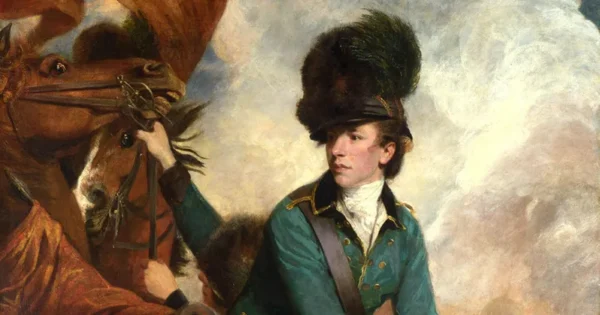
Colonel Banastre Tarleton was one of the most effective British leaders in this campaign. He led The British Legion, a mixed infantry dragoon unit equally known for its rapid movements and its ruthlessness in battle. Tarleton won victories against militia at Monck’s Corner (April 1780), captured several ships at Wando River (April), defeated American cavalry at Lenud’s Ferry (May), Continentals at Waxhaw’s (May), burned homes at Kingstree (August), and defeated American cavalry and militia forces retreating after Camden at Rugeley’s Mill and Fishing Creek (August). Despite his unqustioned abilities as a commander, Tarlton was condemned for his harsh tactics, especially after Waxhaws, where it was reported that his men bayoneted many Americans after they attempted to surrender. From then on, he was known as “Bloody” or “Butcher” Tarleton and the term “Tarleton’s Quarter” came to mean “No Prisoners.” His impulsive tactics were used against him at Cowpens, where he was lured into a premature attack and his command was all but destroyed. When Washington hosted the customary banquet for British officers after the surrender at Yorktown, the Americans refused to invite Tarleton because of his tactics.
A group of militia from across the mountains (present-day Tennessee) defeated a large force of Loyalists at King’s Mountain in October 1780 and any patrol or foraging party straying far from the forts as likely to be ambushed. After Nathanal Greene dealt with the main British armies at Guilford Courthouse and Hobkirk’s Hill, the partisan forces along with Lighthorse Harry Lee’s Legion went after the interior forts. Eventually, the British evacuated even Ninety-Six, abandoning all of South Carolina except for Charleston.
Next week: African-Americans in the Revolution
