
The 81st anniversary of the end of the war in Europe is/was May 8. For the American GI, it was a major goal accomplished. The last month had involved intermittent combat, discovering concentration camps, miles driving in trucks, the surrender of many German soldiers, and the growing desire “not to be the last GI to die in Europe.”
For many soldiers, the concentration camps remained their most haunting memory. 740th Tank Battalion veteran Harry Miller, 98, a frequent volunteer at Gettysburg’s WWII American Experience museum, didn’t particularly have dreams after the war about combat, but the camps continued to haunt him for years. “I would wake up and wonder how the smell of the camps had gotten in my room. I had those thoughts until about five years ago,” he said. Two other frequent speakers at Gettysburg’s WWII museum agreed. Both Joe Landry and Ben Berry, both 102, agreed that the smell was their most haunting memory.
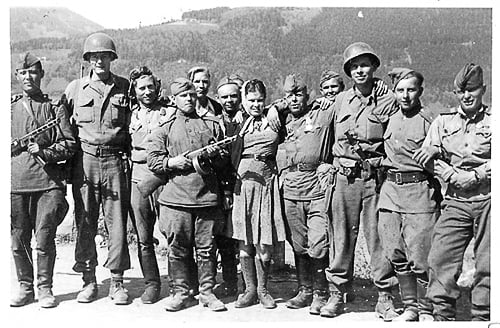
First Lieutenant Walter Carr of the 318th Infantry Regiment, 80th Division, remembered the V-E Day celebration with Russian troops at Liezen, Austria. “We made sure all the boys understood what we were doing here. A ceremony, not a celebration. We did our part in the ceremony, and then the party started. A lot of vodka was consumed and a good bit of whiskey as well. As the party went on, I had a chance to think. My main thought was ‘I sure am tired.’ Second was ‘It looks like I’ll make it home.’ I had a sense of accomplishment, but a small sense of loss too. Being a combat rifleman can be terrifying, but there is no doubt what your purpose in life is. I knew I’d never have another day in my life where my goals were so clear.”
Second Lieutenant Frank Lembo, 305th Combat Engineers, also of the 80th Division, recalled that, if anything, the engineers got even busier after VE Day. First, they had enclosures to build to house thousands of German POWs. The rule was you were a captive of the army whose territory you were in at the appointed ceasefire hour and the Germans in Russian territory were desperate to get across the Enns River to American territory: an estimated 102,000 Germans fled into 80th Division custody in the war’s last few days.
Lieutenant Carr’s company was assigned to move the 6th Panzer Army, their opponents six months earlier in the Battle of the Bulge, to POW camps. “Day after day, directing traffic, mostly marching soldiers but vehicles too. Unsnarling traffic jams, disarming those still carrying arms, getting those stricken by heat or injury to an aid station. Most were happy to be in American hands and fairly cooperative, but there were occasional hotheads – on both sides. Everyone was appreciative that we didn’t need to listen for incoming mortar rounds, but it still made for long days,” he recalled.
He also commented, “In some ways, it’s easier to manage a military organization in combat than one at peace, but I think we did a good job of giving the boys a little slack while still maintaining necessary discipline.” The biggest challenges, he recalled, were drunkenness, the futile efforts to enforce “non-fraternization” rules, and making sure soldiers understood German civilians and POWs were not to be abused. “Almost everyone understood they were still soldiers,” Carr recalled, “but some were ready for a month-long carouse.”
The other challenge was “displaced persons” (DPs): concentration camp inmates, POWs and deserters from every army in the world, Germans who had been bombed out of their homes or fled the approaching Russians, slave laborers, concentration camp guards and other Nazis trying to blend in … The priority was to separate the wolves from the sheep, get them healthy, and get them home. Lieutenant Lembo operated a branch railroad line transporting DPs for several weeks.
And for all, there was the desire to return home. Eligibility was based on points, awarded for months of service, months in Europe, medals earned, and dependents waiting at home. Of the soldiers mentioned in this story, Carr and Miller made careers of the Army while Lembo, Landry, and Berry returned home and built successful businesses.
