
For years, Gettysburg residents have been told that developer Timothy Harrison intends to “move” or “relocate” the Gettysburg Transit Center at 103 Carlisle Street as part of his proposed Gettysburg Station development. That description is profoundly misleading. Harrison isn’t planning to move the transit center. He is planning to destroy it. Harrison owns approximately 2.4 acres of adjacent vacant land, the former REDDI property, where he proposes to construct three large buildings and a parking garage. He does not own the adjacent .38-acre parcel where the existing transit station is located.
Make no mistake: The Gettysburg Transit Center is no ordinary bus station. Built in 2012 with $1.5 million in taxpayer funds, it was carefully designed to complement the historic Lincoln Train Station and is an architectural asset in its own right. Step inside and look around. Exposed timber roof trusses, soaring ceilings, attractive masonry walls and expansive windows give the building the character of a beautifully designed civic facility. Its spacious, climate-controlled waiting area offers comfortable seating, vending machines and accessible public restrooms. Even many larger communities lack comparable passenger amenities. This is not merely a place to catch a bus. It is a welcoming public facility serving residents, senior citizens, students, people with disabilities and the millions of visitors who come to Gettysburg. Why destroy it?
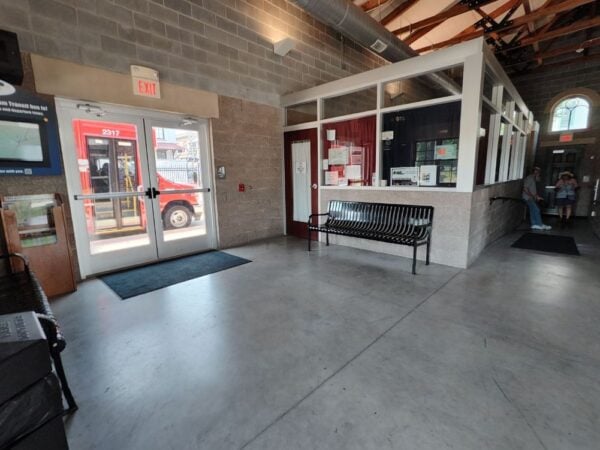
Harrison’s own words tell us why. In a 2019 interview with the Gettysburg Times, Harrison explained that one of his development’s challenges was that “there’s not a lot of frontage on Carlisle Street.” When he approached prospective commercial tenants, Harrison said, frontage “immediately was the objection I encountered.” The article then explained that, to address this problem, he would tear down the existing transit station.
There it is. Harrison’s prospective commercial tenants want their businesses directly on Carlisle Street, where they can be seen by the thousands of people who travel through downtown Gettysburg. They want storefronts facing Carlisle Street, not businesses located behind the transit center on Harrison’s land. And Harrison wants to give them that frontage. But the beautiful, taxpayer-funded transit center stands in the way. His solution is to destroy it and replace it with a canopied platform and bathrooms, but no indoor waiting room, on a very small lot on North Stratton Street.
Here’s the thing: Harrison can develop his 2.4 acres without acquiring or demolishing the transit center. It might require a different configuration, fewer buildings, or a smaller project. But destroying the transit center is not a prerequisite to developing his land. It is not landlocked and is readily accessible from North Stratton Street. His land development plan presently before the Planning Commission includes an entrance and exit from North Stratton. Destroying the transit station is not necessary to develop his property. It is necessary only to accommodate the particular development he has chosen to propose. An arrangement to share an existing Carlisle Street driveway might allow the development and transit center to coexist.
Even more disturbing is the Borough’s role in making this possible. Gettysburg Borough actually created a zoning incentive that rewards a private developer with an additional 12 feet of building height for arranging the destruction of this functional public building.
Save Historic Gettysburg supports responsible redevelopment of the former REDDI property, consistent with the community’s historic character and the capacity of its streets and infrastructure. But the Gettysburg Transit Center belongs to the public. Its future should be determined by what best serves transit riders, taxpayers and the community.
Everyone in Gettysburg should be grateful to RabbitTransit and the Susquehanna Regional Transportation Authority (SRTA) for operating and maintaining this remarkable facility. We recognize that maintaining a building of this quality involves expense, and Save Historic Gettysburg stands ready to work with SRTA and other community organizations to explore ways to share those expenses while preserving the transit center for public use.
We appeal directly to the members of SRTA’s Board of Directors: Please do not agree to the destruction of the Gettysburg Transit Center. You are the stewards of an exceptional public facility built with taxpayer funds to serve the traveling public. Neither the Borough’s zoning decisions nor Harrison’s development plans obligate SRTA to surrender this property. SRTA’s responsibility is to the traveling public, not to the commercial interests of a private developer.
The proposed replacement would leave passengers exposed to heat, cold and rain. Equally troubling is its proposed location on North Stratton Street, which is considerably narrower than Carlisle Street, has a significant grade and runs immediately alongside active railroad tracks. The proposed driveways raise serious questions about how buses would safely enter and exit the property, particularly given the street’s width, slope and proximity to the railroad crossing. These safety and operational concerns deserve careful, independent evaluation before any decision is made.
We ask the Board to consider alternatives that would allow the existing transit center and Harrison’s development to coexist. The convenience and profitability of a private development are not sufficient reasons to destroy a public transportation asset.
Harrison should develop the substantial property he already owns and leave the Gettysburg Transit Center alone.
