
When her contractions hit at dawn, Wendys Martinez eased down the steep-pitched stairs of her rowhome and called a stranger instead of 911.
Her four young children, two boys and two girls, were still asleep. She didn’t wake them; it was too early. But she left a note reminding them of instructions she had given them many times before: “Don’t open the door, not to anyone, even if they’re trying to break it down.”

She’d be back soon with their new baby brother.
The stranger, a nurse hired by a local immigrant aid organization, picked Martinez up and drove her to the hospital. The nurse stayed as long as she could but left before Martinez gave birth.
Martinez’s husband, Carlos Moreno, the father of her newborn son, was nearly 200 miles away.
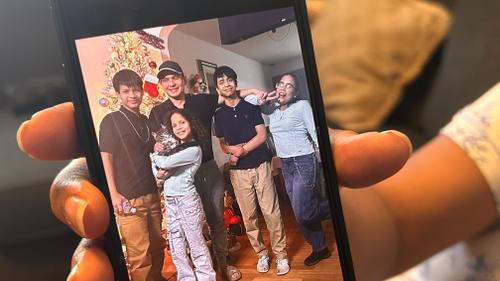
Martinez and Moreno have been together for 12 years. They fled war-torn Colombia, walked through a dense and dangerous jungle, and took a leap toward a better life in a new country together.
But as their child was about to be born, they were apart: Martinez in her hospital room and Moreno in a rural Pennsylvania jail, waiting for the moment the government would send him back to his native country, Venezuela, without ever meeting his son.
Moreno has hearing loss and is legally blind. He has no criminal history, save a noise complaint a neighbor called into the Pottsville police department in January.
Nevertheless, federal agents arrested Moreno in March as he left court after paying the $277 fine.
He would spend almost six months in the Cambria County Prison — one of a handful of county jails in Pennsylvania that have partnered with the federal government to detain immigrants in exchange for payment.
A new Spotlight PA review of data and documents shows the county took more than $1.5 million in nine months as part of that arrangement.
As President Donald Trump’s mass deportation campaign continues, these Pennsylvania jails have seen significant increases in the number of people they hold for immigration violations. Local jails receive compensation for each detainee each day they are held. Between 2024 and 2025, county jails have collectively made at least $21 million.
These longstanding agreements have become increasingly central to the federal government’s deportation efforts, providing a place to hold the growing number of people detained by ICE, especially as attempts to build new detention facilities break down.
Defenders of these agreements point to the revenue they generate in rural jurisdictions with smaller tax bases. County residents have argued partnerships with local facilities can prevent loved ones from being sent farther away. Local officials have said they trust their wardens, who are accountable to county commissioners and lawmakers, who are in turn accountable to the public.
But Moreno’s experience reveals the limitations of a county jail’s ability to meet the needs of an influx of immigrant detainees in a criminal setting, even as these facilities receive high ratings by national detention standards.
After nearly six months in Cambria, the federal government moved Moreno out of state — first to Louisiana, and then a few days later to a vast detention center in Texas, a former Japanese-American internment camp where he awaits deportation to Venezuela.
In conversations with Spotlight PA, Moreno described his hardship in the Cambria County jail. While in detention, his hearing aids regularly ran out of battery and often failed. His cane was broken and could not support his weight. He spent the majority of his time trying to receive replacements for both. His meals consisted mostly of potato and bread, he said, and he didn’t move much throughout the day because navigating the detention facility was difficult without assistance — support Moreno says he didn’t have.
Those hardships were exacerbated by his difficulties understanding the jail’s procedures. He is not fluent in English and often needed to bring another detainee with him to translate when he met with jail staff.
“I feel like life here just deteriorates faster, because you don’t move, you don’t get around,” Moreno said while detained in Cambria. “I just go from the bed to the bathroom. I feel like that’s more draining. With my condition, if I can’t get around, I can’t run, I can’t jog, then it becomes harder for me.”
The federal standards that dictate detainees’ quality of life in Cambria are broad. But the standards say that detainees who don’t speak English should be provided with translation services, and that detainees with disabilities or illnesses should receive healthcare.
Kurt Wolford, warden of Cambria County Prison, said Moreno received such care, but declined to give details, citing privacy and “security procedures.”
“There’s not a situation where we are not going to help someone in need, as long as we can manage it through medical and security,” Wolford told Spotlight PA in August.
But Moreno described life in the county jail as untenable. Pushed to the brink, the father of five considered giving up his asylum case rather than appealing his order of removal and staying detained at Cambria indefinitely.
Moreno’s appeal deadline passed, and three days later, Martinez gave birth alone.
It was the Fourth of July.
The couple and their children set out for the United States in 2023. They planned to apply for asylum at the border, which if granted offers a path to permanent legal residence in the country.
The roughly two-month journey took them across several countries by bus, before they confronted the Darién, an untamed jungle between Colombia and Panama that has in the past decade become a well-worn route for migrants despite its reputation for treacherous terrain and wanton violence.
Martinez described trudging through the jungle on foot, hauling backpacks and children up and down the mountainous region for days.
At one point, Moreno, who cannot see well in bright sun due to a rare genetic eye disorder, lost his footing on a high-altitude trail. He became tangled in tree roots, and a fellow migrant helped pull him back up.
“I prayed throughout that entire journey,” Martinez said. “I asked God so much to protect us.”
After a complicated and dangerous journey through Central America, the family crossed the Rio Grande and surrendered themselves to U.S. immigration authorities. They were processed in Texas, released, and traveled by bus to New York City, where they applied for asylum and began working while their case was pending.
In New York, the family lived in a migrant shelter. In 2023, the city’s housing and social services were overwhelmed by thousands of new arrivals. According to the nonpartisan Migration Policy Institute, New York City’s shelter system was housing close to 60,000 migrants at that time, forcing officials to open overflow sites.
In the shelter, Moreno and Martinez were able to get health insurance through a city program and support from a social worker, but after a year, the family wanted to leave. They hadn’t come to the United States to depend on government assistance, Martinez said. Plus, she worried about raising her children in a big city.
“We spent a year there, and we worked, and all that” Martinez said. “We wanted to come here to be independent.”
In 2024, the family moved to Pottsville in search of that independence. They found a rowhome with a porch on a narrow, quiet street in the former coal town. Moreno and Martinez started a cleaning business, clearing out vacant homes for owners hoping to turn their blighted properties into an investment to be sold or rented.
As they settled into their new lives, Moreno and Martinez decided to expand their family. They made a plan: Moreno would care for the baby and the children during the day while Martinez worked part-time cleaning. At night, he would work shifts at Amazon. It would be difficult, but they wouldn’t have to rely on strangers for childcare, and they would still make enough money to support their family.
“He wanted to be there since the beginning of the pregnancy, enjoy every step of it, every stage,” Martinez said.
Martinez and Moreno earned roughly $1,200 a week. They paid taxes. They enrolled their children in the local public school. When they relaxed at home, they listened to salsa and joropo — lively, traditional Venezuelan music.
But after more than a year on the quiet Pottsville street, a neighbor began to take issue with the sounds of the family’s home.
The first call to police came in the afternoon, on New Year’s Day. The children were watching cartoons on the TV, which was connected to a small, camouflage-print speaker. By the time police showed up, Martinez said, she had already told them to turn it off.
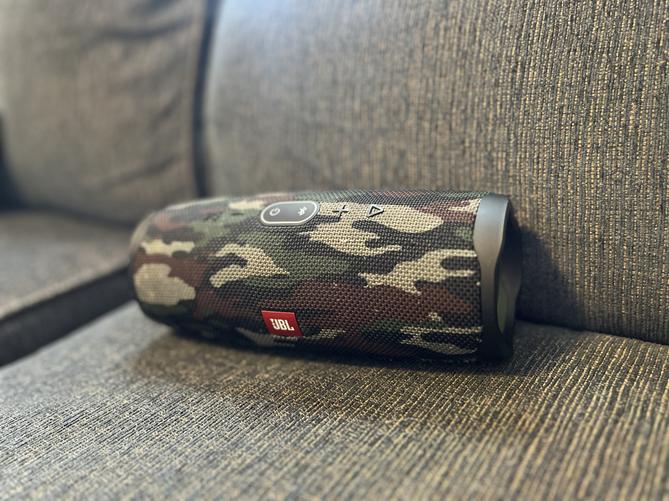
A week later, as the family listened to music, the police arrived again. This time, an officer issued Moreno a citation. Despite the encounter, Martinez and Moreno weren’t worried. It was such a small speaker. They were convinced the situation would resolve easily.
In late March, the couple walked into the courtroom with their evidence — the speaker — in hand. They hoped bringing the device in person would show the judge that the neighbor’s complaint was unreasonable. But the judge was not convinced. He found Moreno guilty and ordered him to pay a $277 fine. While it wasn’t the outcome they wanted, Martinez and Moreno thought they could pay and go home.
As the couple left the magisterial district court, two ICE agents approached Moreno and told him he was being detained.
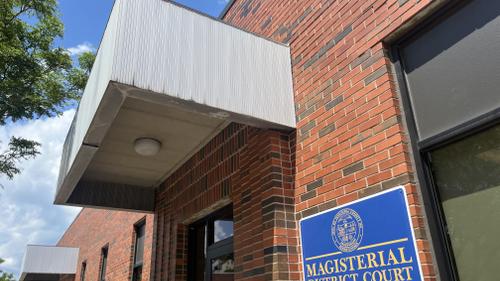
“They didn’t give any reason, any document,” Martinez said. “They simply showed the badge and took him. They put him in the car.”
The Schuylkill County Sheriff’s Office, which operates in courts throughout the county, has a 287(g) agreement with ICE that allows them to make arrests on the federal agency’s behalf. However, Schuylkill County Sheriff Shawn Butler told Spotlight PA that his staff was not involved in Moreno’s arrest.
The ICE agents took Moreno to a processing facility in York, and then to Moshannon Valley Processing Center, where he was detained briefly before being transferred to Cambria County Prison, roughly 200 miles away from his home in Pottsville.
Cambria County Prison is one of five jails in Pennsylvania that has worked with federal immigration enforcement agencies to hold people in their facilities, sometimes for months, in exchange for significant fees. Since October 2025, the county has made more than $1.5 million holding hundreds of people, including Moreno.
The other participating counties, Clinton, Erie, Franklin, and Pike, collectively charged more than $21 million for detention in 2024 and 2025, Spotlight PA previously reported. Erie County canceled its agreement in February of this year after significant pushback from community members.
These counties detain immigrants for the federal government through contracts with either the U.S. Marshals Service, which allows for the detention of federal prisoners, or with ICE directly.
Some of the agreements go back decades.
Cambria County’s longstanding agreement allowed them to periodically earn revenue for holding ICE detainees. Scott Hunt, a Cambria County commissioner, said the money earned from the original agreement with the U.S. Marshals “actually helped build our prison.”
But until recently, the jail held relatively few people for ICE, according to a federal inspection from June.
In September 2025, amid the Trump administration’s sweeping immigration crackdown, the county renewed the agreement to allow ICE agents to bring detained immigrants to the jail.
Local government officials in favor of the agreements told Spotlight PA that the revenue generated supports services such as the county jail or general fund expenses. Cambria County earns $103.50 per person each day detainees are held in the local jail.
“You’re always going to have pushback one way or another, but I would say we haven’t really experienced it to this point,” Hunt told Spotlight PA in early March. “This is a relationship that has gone back many years.”
He added: “So I realize that emotions are kind of flared now, but this is something we’ve been a part of for years, and I don’t see a reason why it wouldn’t continue.”
The facility can hold up to 490 people, according to 2024 capacity figures that the county reported to the state. In 2024, the average daily population was 366 people, including both state and federal detainees. Wolford, the jail’s warden, told Spotlight PA in August that Cambria held roughly 408 people, including 65 ICE detainees.
Moreno slept in a cell on a block with other immigrant men, separated from the people incarcerated there because they’ve been charged with a crime. Immigration proceedings are civil, meaning no crime has been committed.
Cambria County Prison follows federal detention standards established by the U.S. Marshals. The standards dictate that language translation services be provided to detainees who aren’t proficient in English, that detainees with disabilities be provided with the equipment they need for “self-care” and “personal hygiene,” and that all detainees have their healthcare needs met.
Wolford said his staff is in charge of overseeing the ICE detainees, though he added that ICE officials come up weekly to tour the jail and talk to detainees who need assistance.
He told Spotlight PA that Moreno had access to a telephone translation service for inmates who do not speak English. Moreno said otherwise.
“No, we don’t have any of that,” Moreno told Spotlight PA in a phone call from the jail.
Instead, Moreno said he typically brought another detainee with him to help translate when he met with county jail staff.
“When I have spoken to him, he usually brings up another guy with him that’s on the unit with him that translates,” Wolford confirmed.
“That’s what he likes to do.”
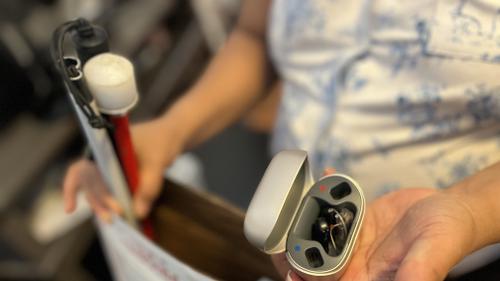
During most of his monthslong detention at Cambria, Moreno said he did not receive the medical equipment he needed. Because of his visual and hearing impairments, Moreno uses specialized glasses to see outside, a walking cane to get around, and hearing aids.
He did not have a battery charger for his hearing aids when he arrived in detention, forcing him to rely on prison guards to charge them for him. This is an arrangement that, as Moreno described, he had to “fight” for, because at the beginning his hearing aids would die out while he waited for the nurses to come by and help him.
Moreno said he asked different jail staff members and nurses for an update on his medical request, but the answer was always unclear.
“One passes it to the other, and that one passes it to another, and so on,” Moreno said. “In the end, none of them says, ‘Yes, we’re going to approve it.’”
Moreno said that, at one point, a fellow detainee made him some cardboard glasses and poked little holes in them so he could go outside and enjoy some fresh air. Due to his eye condition, sunlight causes him pain and can trigger headaches, which is why he sometimes skips outdoor recreation.
But a jail staff member confiscated his makeshift glasses, Moreno said.
“The captain came and broke them and threw them in the trash, as if that had done any harm to anyone,” Moreno said.
In May, when Martinez tried to send replacement hearing aids and a new walking cane, the package was returned marked in pen: “REFUSED — NOT ALLOWED!”
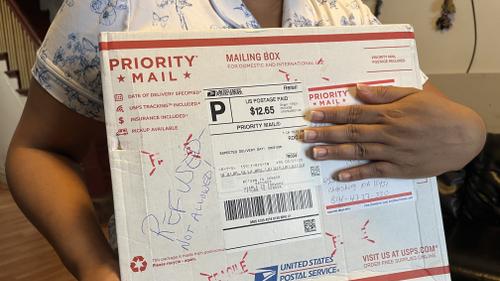
Chief Deputy Warden Megan Bursky told Spotlight PA the package was rejected because of “failed documentation.” The jail generally requires requests for medical devices to go through PrimeCare Medical, the jail’s contracted healthcare provider, and receive approval before security staff are told to expect a package.
Cassandra Nichols, a nurse and regional manager at PrimeCare Medical, said Moreno needed to first be seen by a provider to determine the medical necessity of his accommodation before an order could be issued for his request.
“I will speak with the patient again to ensure he understands this process, and where we are at with obtaining his devices,” Nichols said in a written statement to Spotlight PA in August.
About two days before Moreno was flown to Louisiana, more than five months after arriving at the Pennsylvania jail, he finally received a package with his needed medical aids.
Despite these discrepancies, Wolford insists the jail treats federal detainees fairly.
“You know, and as an example, we just recently started getting the ICE detainees to go to GED classes. That has never happened.”
He added that when ICE reviewed the county jail in June, which included an on-site inspection, it reported no deficiencies in any standards and gave the jail a “superior” rating.
“We’ve held ICE here for years. I mean, this isn’t something new,” Wolford said.
When Moreno lost his freedom, his family lost theirs.
Martinez worked for as long as she could after her husband’s arrest, but had to stop in the final months of her pregnancy. She did not have any health benefits or maternity leave through her Amazon warehouse job. She fell behind on her mortgage payments.
With no paycheck, she had to cancel prenatal appointments because she could not afford them. A roughly $1,500 emergency room bill from earlier in her pregnancy remains unpaid.
After she was discharged, Martinez took an Uber home with her new baby, who rode in an infant car seat donated by a local charity for moms. The charity also helped her secure baby clothes and diapers.
Martinez left the home less and less. She could not afford childcare and did not want to leave her other children with neighbors to go to appointments. And she didn’t visit her husband, fearing if she tried she would be detained as well.
Moreno’s absence has affected the children. Martinez asked their school if a psychologist or social worker could check in on them, “because it was a drastic change, not seeing their dad.” Their youngest daughter’s grades started slipping.
“It hit her hard,” she said. “She misses her dad.”
In the early morning, when she went into labor, she sent a message to Moreno.
Martinez gently bounced her fussy newborn while recounting the conversation she had with Moreno on the day of their son’s birth.
Her voice broke as she described Moreno’s call hours later.
The conversation was bittersweet, she said. Moreno was happy that his child was on the way, but sad he could not be there.
“He told me to be strong, and that he was sorry he could not be there with me,” Martinez said.
After giving birth, Martinez is focused on surviving and making sure her baby is safe and her children are fed.
Every 10 days, a nurse from a nonprofit goes to Martinez’s house to weigh the baby, and drop off diapers and formula — a routine check-in that will continue until Martinez’s son turns two.
Her newborn requires constant care, so she is not able to go back to work. She relies on mutual aid and dwindling funds from a GoFundMe campaign to pay her mortgage.
The couple have tried different legal avenues and spent most of their savings to try to stop Moreno’s deportation, but so far have been unsuccessful.
Shortly after the arrest, the family’s immigration attorney filed a habeas petition to contest Moreno’s detention. Across Pennsylvania, detained immigrants have filed hundreds of these petitions since 2025, which challenge the petitioner’s arrest and detention while their immigration case is pending.
Moreno was granted a bond hearing, where his attorney made the case that he was not a flight risk. But the immigration judge denied his release in April.
Two months later, the family faced another setback when a judge rejected Moreno’s asylum claim and issued an order to remove him from the country. The family had until July 1 to appeal that ruling.
Initially, Moreno had opted to accept deportation rather than appeal his removal, because he felt he would be a burden to his family if he remained in detention indefinitely.
But after massive earthquakes ravaged Venezuela in late June, he changed his mind. Moreno’s mother, who traveled to Venezuela in anticipation of her son’s deportation, told Martinez that Moreno’s childhood home in Caracas had been destroyed. If deported, Moreno worried he’d be returning to a country in turmoil.
Moreno ultimately decided to fight to stay — to see his family, to meet his son. But the conflicting instructions and deadlines of the immigration process created more hardships for his family, echoing their efforts to get him his medical equipment.
From the couple’s dwindling savings, Martinez paid a $1,030 fee to file a last-minute appeal of Moreno’s removal before the deadline. But Moreno learned afterward from an immigration official that his appeal did not go through in time.
Simultaneously, he received a letter from ICE that left him anxious, but hopeful. The agency said they would review Moreno’s detention at the end of August and consider releasing him from the county jail — though he would remain on a removal list.
Martinez scrambled, with the help of a Venezuelan attorney, to collect the proof that her husband was not a flight risk: letters from friends and family, employment confirmation from Amazon, their new baby’s birth certificate. In a letter to ICE and the Department of Homeland Security advocating for her husband’s release, Martinez pleaded with the government to allow Moreno to return home.
“I AM NOT ASKING ICE TO RELEASE CARLOS WITHOUT A PLAN,” Martinez wrote. “I will take him to medical appointments. I will take him to consular appointments. I will take him to appointments concerning passports or travel documents.”
“I AM ASKING FOR THE OPPORTUNITY TO CARE FOR MY HUSBAND AT HOME.”
But again, the Cambria County Prison returned the packet. Days after Moreno was moved to Louisiana, it arrived at the house in Pottsville unopened and marked in red ink “Released.”
Moreno is now farther than ever from his wife and children, indefinitely detained at Camp East Montana in El Paso as the federal government tries to send natives back to an earthquake-ravaged Venezuela.
He could be deported at any time.
This story was originally published by Spotlight PA and is republished by Gettysburg Connection with permission.
