
An existing project to promote closer relations and exchanges between organizations in Gettysburg and Bastogne, Belgium, took a big step forward with the recent visit of Mathieu Billa, manager of the Bastogne War Museum, to Gettysburg. While here, Billa visited Eisenhower National Historic Site and the Gettysburg National Military Park Visitor Center, viewed the graves of American soldiers who died during the Battle of the Bulge at Gettysburg National Cemetery, and visited the World War II American Experience museum.
The Gettysburg-Bastogne initiative was launched last month by the local Dwight D. Eisenhower chapter of the Battle of the Bulge Association (BOBA), which approved a resolution last month calling for “partnerships and cooperative efforts between municipal governments, educational, and community organizations in the two towns.” The resolution suggests such efforts might include “sharing of research results, joint scholarship efforts, publications, conferences, podcasts, etc.; joint museum exhibits and loans of exhibit materials; tourism promotions and exchanges; joint commemorative ceremonies; joint school programs; and other cooperative actions.” The local chapter cited the two towns’ efforts to remember the valor and sacrifices of the soldiers and civilians; the broader causes for which the Civil War and WWII were fought; and their shared appreciation of Dwight D. Eisenhower as areas of common purpose.
Billa took particular interest in the Visitor Center’s McKenna Foundation Resource Room, where volunteers help visitors research their Civil War ancestor. “We constantly have visitors who know their grandfather fought in the Battle of the Bulge but nothing else,” said Billa. “We don’t have the staff to research these requests, but we need to work with BOBA and other groups to find a way to help them.”
Billa agreed that a partnership between the two towns had great potential. He was impressed with Gettysburg’s Civil War story as well as its connections with World War II. Immediately before his visit to Gettysburg, he had spoken on “Inspiring the Next Generation of WWII Storytellers” in at event at the Belgian Consulate in New York City, and he saw the Gettysburg project as a prime way to inspire future generations. “We have many things in common,” he said. Joris DeQuae, head of Bastogne Rotary, said, “Both places are more than historical sites — they are symbols. Symbols of courage, of sacrifice, and above all, of the enduring struggle for freedom, equality, and human dignity. From the fields of Gettysburg during the American Civil War to the forests surrounding Bastogne during the Battle of the Bulge, generations of soldiers stood against forces that threatened these fundamental principles. The proposed coalition offers a powerful opportunity to ensure that these values are not only remembered, but actively transmitted to future generations. In a world where the meaning of freedom and equality can sometimes feel distant or abstract, initiatives like this bring history back to life — and make it relevant again.” He added, “we also see in this project a broader mission: contributing to a future where the sacrifices made in Gettysburg and Bastogne continue to inspire a world striving for peace, mutual respect, and unity among nations. If these historic grounds once bore witness to war, they can today serve as foundations for dialogue, cooperation, and lasting peace.”
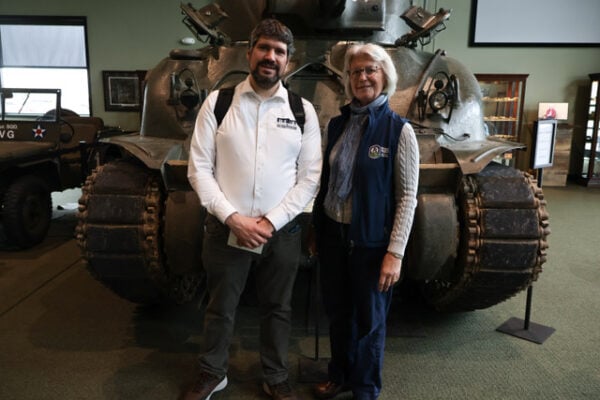
Loni Buck, chair of the WWII American Experience, and Billa agreed to share their museum’s promotional materials and social media posts as a first step toward developing a formal partnership, which could ultimately involve jointly sponsored research, conferences, and exhibits; youth programs; and a joint effort to preserve records and help people find their WWII ancestors.
Glenn Ivers, author and filmmaker from Syracuse, NY, author of Angels of Bastogne, also said, “I think it is a brilliant idea, seeking common ground between locations that are sacred ground for Americans, places where so many of our soldiers died in the defense of freedom.”
Featured image caption: Mathieu Billa, director of the Bastogne War Museum, and Loni Buck, CEO of WWII American Experience
