
The Gettysburg National Military Museum is an amazing place. Besides hundreds of exhibits about the battle, there are displays about the origins of the Civil War and its aftermath. It even has a huge picture of Thomas Jefferson at the entrance for some unexplained reason. What it doesn’t have is any mention of Thaddeus Stevens, even though he played a large role in the Gettysburg campaign.
Stevens, who was the most powerful congressman in 1863, suffered the largest civilian financial loss of the battle and owned the house where Confederate general Robert E. Lee set up his headquarters. Yet he does not get a mention at the museum.
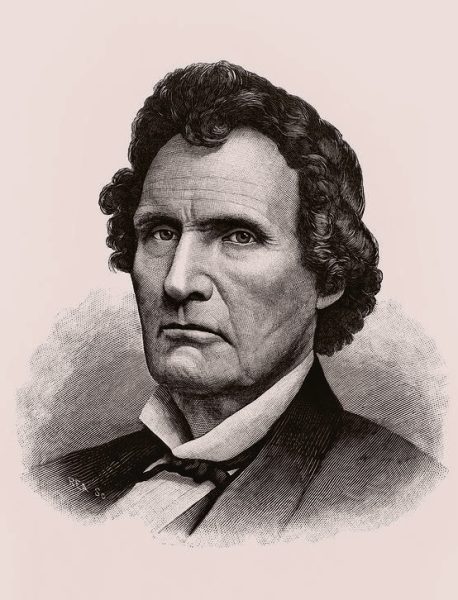
Stevens’s massive financial loss happened at his Caledonia iron furnace, now a state park near Chambersburg. On June 26, 1863, Confederate General Jubal Early burned the furnace complex to the ground in retaliation for Stevens’s hardline abolitionist policies. “Mr. Stevens is an enemy of the South. He is in favor of confiscating their property and arming the negroes,” Early said at the time. “His property must be destroyed.”
Stevens, who lived in Lancaster, PA at the time, was at the iron mill shortly before the raid, but fled, which was a good thing since Early said he would have murdered him. “I would hang him on the spot and divide his bones and send them to the several [Confederate] states as curiosities,” he told the mill’s foreman.
Besides burning the iron mill, the Confederates stole all of the mill’s horses, mules and harness, 4,000 pounds of bacon, $1,000 worth of corn and $4,000 worth of bar iron to use for shoeing horses. In all, Stevens lost more $75,000, which is over $2 million in current dollars.
The burning would not be the only effect the battle had on Stevens. When the Confederates got to Gettysburg, Lee set up his headquarters at the home of Mary Thompson at the top of Seminary Ridge. That house was owned by Stevens, who had bought the building at a sheriff’s sale in 1846 to prevent Thompson from being evicted. The is no mention of the house at the museum even though there is one about the headquarters of Union General George Meade.
With the theft from the Caledonia mill and the take over of the Thompson house, it could be said that Stevens partially supplied and housed the Confederate invasion of Gettysburg, unwillingly of course. Besides these direct connections to the Gettysburg battle, Stevens should also be included for his very important role in the legislative destruction of slavery. Yet none of this is at the Gettysburg National Military Park Museum.
The Thaddeus Stevens Society has on a number of occasions brought this to the attention of National Park Service, which operates the museum, and the Gettysburg Foundation, which owns the museum, but to no avail. Exhibits at the museum are changed from time to time and maybe an exhibit that at least mention’s Thaddeus Stevens might be considered. The Stevens Society stands ready to help if this ever happens.

Steven was and is a true American hero and should be remembered for his contribution to our union!
I don’t get this article…old journalism used to include the “5 Ws” – so, WHY is Thad missing? (my 2nd attempt to comment on this)
Has anyone asked the people who decide what’s included why they omitted the hometown boy, the man who supported the reason for the war. Oh, wait, by presidential decree, we never had slavery in this country so that could not have been the reason for the war.
NOT EVERYONE HAS THE SAME PROSPECTIVE OF THIS MAN, PEOPLE FROM THE SOUTH CONSIDERED HIM AN INDUSTRIALIST MAKING WEAPONS TO DESTROY THE SOUTH, HIS LOSS IS INSIGNIFICANT COMPARED TO THE DESTRUCTION THE SOUTH SUFFERED.
This is a very odd oversight. It would seem to be appropriate for the director of the GNMP to explain why this is so.
Key word in title of museum discussed is “MILITARY”. Mr Stevens is already featured in the newer museum just north of the Gettysburg College. In “military” museums, most of us expect to focus on military strategy, weaponry, uniforms and little biographies of key soldiers, officers, etc.
Thanks for printing the article on Thaddeus Stevens! Mr. Stevens is certainly one of the unsung heros from our historic past. There is room in our local historic narative for his inclusion. Perhaps his story is like the opposite of an Irish farewell and instead of quietly leaving the historic record he is actually quietly becoming a larger part of the story here.
He is included at the “Beyond the Battle” museum just north of Gettysburg College. I don’t see why Mr Stevens requires inclusion in a museum that focuses on “military” (soldiers, officers, strategy, weaponry, etc.). I know what I am coming to read and study when I visit a “military” museum or the “Beyond the Battle” museum, in other words. As a local, I really can live without Thaddeus in both museums.