
This time of year, we enjoy big blockbusters on screen, beach reads, and summer jams. The Majestic Theater gallery and Waldo’s and Company’s gallery have brought two refreshingly fun, yet challenging, painting exhibitions to our town known for a very different kind of summer tourism. (Have you noticed, by the way, that Gettysburg has been growing in our art and vintage shopping scenes? We’re becoming a destination for history buffs, quirky fashionistas, and arts lovers alike.)
Back to the art! Theo Morrow of Washington DC offers us Strange Landscapes, a series of seemingly simple but technically complex surreal desert-like landscapes at Waldo’s & Company through the end of June. Imagine Dr. Seuss eliminated the figures and outlines from his landscapes and added more gradients, gradual transitions from one color to another. Those Seussian colors and combinations of bubbly and sharper biomorphic shapes would remain, but the elimination of the outlines would create a more mature, dare I say “realer” image. These landscapes seem to illustrate more of inner world than an external landscape. I’ve never taken peyote (I still swear, Gettysburg PD) but if my memory of the episode of the Simpsons where Homer ingests an insanity pepper and goes on a spiritual desert hallucinatory trip serves, Morrow’s paintings may approximate the visual nature of that journey of self-inquiry in the safe and family friendly environment of Waldo’s.
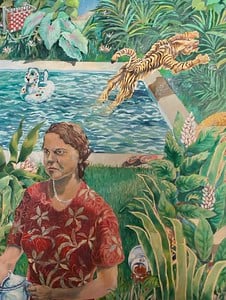
The Majestic is exhibiting a survey of 25 years of smart, funny, densely layered work by the late Dixon Brady of Gettysburg through mid-August. The artist’s experimentation was clearly inspired and motivated by many greats of late modernism and of contemporary art, among other influences. The painting Tiger of 1968 hangs in the spot of honor on the back wall. It features a tiger leaping out of a well-kept swimming pool onto a grassy lawn and a garden of tropical plants. In the foreground we see an irritated-looking woman in pearls walking with a teapot out of the composition. Across the scene we find an abandoned inflatable pool toy and flip flops, an overturned iced tea pitcher, and an overturned yard chair, suggesting a lack of domestic bliss in this upper-class scene. Shortly before in 1966 and 67, David Hockney (who just died this month) created the “splash” hit paintings in his Splash series, featuring, you guessed it, paintings of splashes resultant from unseen submerged figures’ dives into swimming pools. Hockney’s scenes are clean and tidy, nearly sterile scenes of domesticity, in comparison to Brady’s messy maximalist scene of a tiger (perhaps an escaped exotic pet ala Pandora’s box) wreaking havoc and leaping out of rather than into a pool.
The tiger and lush plants are reminiscent of Henri Rousseau, and had I never seen this painting I would have thought a Rousseau/Hockney mashup impossible. My favorite thing about this exhibition, as an art history nerd, is spotting the influences and their fascinating incorporations, which excitingly change significantly over time. Since this is a retrospective and Dixon Brady didn’t get caught in any time-period, we can see the way new influences continued to inspire him across the decades. Like those crazy summertime DJs who create dance mixes out of all kinds of diverse influences, Dixon Brady’s work is so clever and fun to attempt to deconstruct. I won’t ruin it for you by giving away all the bigtime artist influences and combos I found but I will point out that some of his later depictions of sorta’ nostalgic sorta’ cheeky paintings of people appear to use old photos as sources. They make me wonder if he was ever in conversation with another great Gettysburg artist, John Winship, who also referenced old photos, but in a decidedly more earnest mode. Might they have chatted about art the way I do with my fellow Gettysburg painters? I hope so!


Thanks, Sarah.