
Adams County’s America 250th celebrations wrapped up on Thursday with an expanded version of the traditional November 19 Dedication Day celebration. A weeklong series of activities preceded the Dedication Day celebration, which faithfully re-enacted Lincoln’s movements during his brief visit to Gettysburg.
The presidential events started the day before with the arrival of “President Lincoln” (actor Billy Campbell) at the old Gettysburg train station. A series of welcoming events took place on the square the night of the 18th. On the 19th, the almost perfect weather (mid-50s, almost identical to the weather at the original ceremony) drew huge crowds for the Dedication Day ceremony.
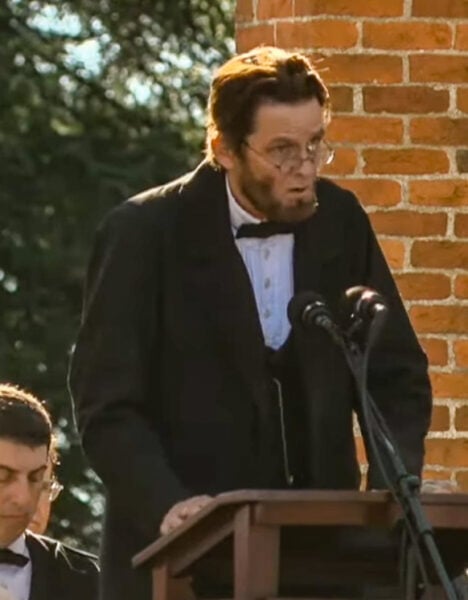
Dedication Day activities commenced with Campbell leading a procession from the Wills House, where he stayed the night before, to the Gettysburg National Cemetery. Campbell and members of his party rode on horseback, following an honor guard and band. He was accompanied and followed by a crowd of hundreds, many dressed in period garb.
Campbell was an amiable “Honest Abe,” bantering with the crowd along the parade route and chatting, shaking hands, receiving an invitation to visit Camp David, and posing for hundreds of photos before and after the ceremony at the cemetery.
As the ceremony was about to begin, Campbell walked quietly from the Rostrum to the Henry Bush Brown Lincoln sculpture and stood there reflectively for several minutes before rejoining the dignitaries. The Rostrum, which was not the site of Lincoln’s address, has been the site of six presidential addresses by: Rutherford B. Hayes, Theodore Roosevelt, Calvin Coolidge, Herbert Hoover, FDR, and Dwight D. Eisenhower. JFK was invited to speak during his 1963 visit but opted to travel to Dallas instead.
Wendy Allen, president of the Lincoln Fellowship of Pennsylvania, lead sponsor of the event, opened the ceremony with brief remarks. The rest of the program was an abridged re-enactment of the original 1863 event. Gettysburg Park Ranger Chris Gwinn, portraying the original event organizer, David Wills, acted as master of ceremonies. The invocation, musical performances, and benediction were from the original program, presented by individuals and groups portraying the Speaker of the House, Bergfield’s Band, the Marine Corps band, the Baltimore Glee Club, and the president of Pennsylvania College.
The main feature was a compressed version of the original 2+ hour address by Massachusetts politician Edward Everett who was one of the leading orators of the day. Portraying Everett was Princeton University professor and distinguished Civil War scholar Allen Guelzo, the first two-time winner of the Lincoln Prize. His compressed speech offered a master class in mid-19th century oratorical style. Even at 20 minutes, Guelzo captured the formidable spirit of Everett’s original oration, with a detailed account of the battle, fulsome praise for the fallen, and a lengthy essay on the wonders of the Constitution and the federal union and denunciation of secession, insurrection, and slavery.
After the original event, Everett praised Lincoln’s speech and lamented that he wished he had been able to capture the occasion as well in 2+ hours as Lincoln did in 2 minutes. And, indeed, the recitation as presented by Guelzo highlighted the magnificence of Lincoln’s speech.
Following that, Campbell delivered the “few appropriate remarks” that Wills had invited him to provide. Campbell’s presented a very emotional reading of Lincoln’s address.
The ceremony concluded with “music prepared for the occasion” by the Baltimore Glee Club and a funeral dirge, “Oh it is great for the country to die.”
The crowd was asked to stay in their seats while “the president and his party take leave,” accompanied by “Battle Hymn quickstep.” Campbell didn’t get very far, though, stopping for more handshakes and photos.
One necessary result of the re-enactment format was the omission of one of the nice traditions of a normal Dedication Day event, a citizenship ceremony for 16 new citizens (a number selected because Lincoln was the 16th president). While this is always a highlight of the ceremony, it quite obviously didn’t fit with the event’s re-enactment format.
After, President Lincoln and others, including Bo Brinkman playing Lincoln’s special guest, John Burns, went to Gettysburg Presbyterian Church, followed by Lincoln’s departure.
