

In two important speeches and three Constitutional amendments between 1863 and 1870, President Lincoln and Congress fundamentally redefined and re-imagined the purpose of the United States.
In a 3 minute speech delivered at Gettysburg in the midst of freshly buried bodies, Lincoln defined the Civil War as a crusade for the salvation of democracy; redefined the United States as an “is,” a nation made up of states, rather than an “are,” a confederation of states; promised “a new birth of freedom;” and prescribed that that nation was guided by a government “of the people, by the people, for the people.”
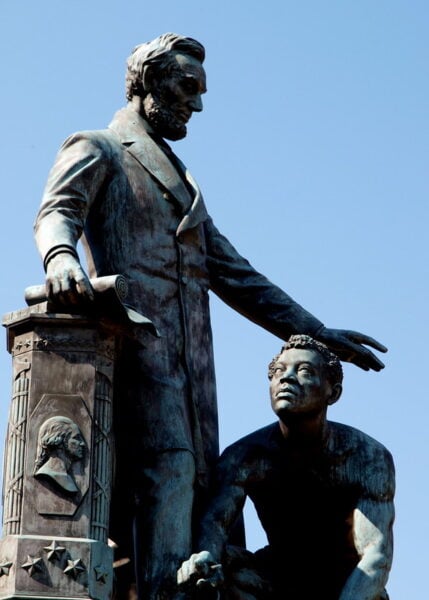
But just as Jefferson’s 1776 Vision statement needed the Constitution to create a workable mechanism, so too did Lincoln’s vision need a practical blueprint to bring meaning to those words: the 13th, 14th and 15th amendments. These amendments, ratified between 1865 and 1870, transformed the Constitution from a document that accommodated slavery to one that gave meaning to Lincoln’s “new birth of freedom” by providing national guarantees of equality and civil rights.
While the original Constitution didn’t mention the word “slavery,” various provisions –the three-fifths compromise, the Fugitive Slave Clause, and the mention of the slave trade —made it clear that slavery was legally permitted and gave disproportionate power to the slaveholding states, The Constitution made no mention of the Declaration’s promise of equality and at least permitted an interpretation (as Chief Justice Roger Taney ruled in the Dred Scott case) that black men had no rights and could never become citizens.
The 13th amendment settled the question of slavery. But almost immediately after the Civil War veterans returned home, many of the former Confederate States passed laws known as the “Black Codes,” which sharply limited the civil rights of the former slaves. Vagrancy laws in essence re-created slavery by allowing unemployed blacks to be arrested and auctioned off for labor. Black laborers were required to sign annual labor contracts, and blacks were prohibited from owning guns, serving on juries, or testifying against white people. In response, Congress passed and the states ratified arguably the most important Constitutional amendment after the Bill of Rights. The 14th amendment granted U.S. citizenship to everyone born on American soil, protected individual rights like free speech from state abuses, and guaranteed equal treatment under the laws to everyone.
Finally, the 15th Amendment, ratified in February 1870, prohibited racial discrimination in voting—and was the first of six Amendments that would help establish the right to vote as the most fundamental of all rights in our constitutional system.
The 13th amendment banned slavery
Under the 14th Amendment, everyone born on American soil was a U.S. citizen.
The 14th amendment also promised equal protection of the laws for all.
The 14th amendment ensured that states could not deny people the important rights enshrined in the Bill of Rights like free speech.
The 15th amendment guaranteed the right to vote free of racial discrimination.
Finally, the three Reconstruction amendments gave the national government the authority to protect the civil and political rights of all.
These amendments weren’t perfect. The 15th was meaningless verbiage for nearly 100 years until passage of the Voting Rights Act in 1965. Nevertheless, our Reconstruction founders made an important start.
Lincoln’s other important speech, his 2nd Inaugural Address, also played a key part in redefining the way forward. Dr. Jonathan White, Professor of American Studies at Christopher Newport University, reflected on Lincoln’s 2nd Inaugural at the 2025 Dedication Day ceremony here in Gettysburg. He reflected on the divided times we live in and commented, “It is almost unfathomable to us to consider the number of dead the Civil War wrought. Such staggering numbers almost defy comprehension.”
But through it all, Abraham Lincoln never wavered from his commitment to “representative government, government of the people, by the people. When he delivered his 2nd Inaugural address, he could have taken a victory lap. He could have celebrated, gloated, criticized the South or northern Democrats. But he didn’t do any of that. Instead, he offered a meditation on the meaning of the war. He did not cast aspersions in this moment. He concluded with this magnificent paragraph.
“With malice toward none; with charity for all; with firmness in the right, as God gives us to see the right, let us strive on to finish the work we are in; to bind up the nation’s wounds; to care for him who shall have borne the battle, and for his widow, and his orphan—to do all which may achieve and cherish a just and a lasting peace, among ourselves, and with all nations.”
White commented that Lincoln’s message has resonated throughout the world ever since and reflected on the experience of Nelson Mandela and the inspiration he drew from Lincoln.
White concluded, “We live in a culture that has lost track of the wisdom of Lincoln and Mandela. We live in a culture that is unforgiving. We refuse to give those we disagree with room for repentance or personal growth. If there was ever a person who was justified in not forgiving his enemies, it was Nelson Mandela, yet he took a different road. Let us follow their lead and strive to listen to the angels of our better nature.”
Black leader WEB duBois reflected on Lincoln. “Abraham Lincoln was perhaps the greatest figure of the 19th century. Certainly, of the five masters – Napoleon, Bismarck, Victoria, Browning, and Lincoln, Lincoln is to me the most human and lovable. And I love him not because he was perfect but because he was not and yet triumphed. The world is full of illegitimate children. The world is full of folk whose taste was educated in the gutter. The world is full of people born hating and despising their fellows. To these I love to say: ‘See this man. He was one of you and yet he became Abraham Lincoln.’”
