

In my lifetime, George Washington’s reputation has been transformed several times, from the pious jerk of the Parson Weems tales to the profiteer of Gore Vidal’s “An Evening With Richard Nixon” and “George Washington’s Expense Account” to a wooden figurehead who was neither a competent general nor an especially impressive president.
In fact, the standards of government and presidential behavior that for the most part lasted through 44 subsequent presidencies are largely the result of actions and decisions of George Washington. He repeatedly rejected opportunities for total power. He created the precedent of an energetic chief executive who appoints – and consults with – highly qualified advisors. He accepted the separation of powers and the advise and consent role of Congress. He set a standard of decorous public behavior. He served as president of the entire country, not just one faction or region. He rejected the role and trappings of Kingship. He set the standard that the presidency is not a lifetime position and the tradition of peaceful transition of power.
However, George Washington was not a god or a statue. To understand George Washington, it’s important to know that he always kept score, he never forgot, and he never did anything by accident.
Born into middling circumstances, inheriting some wealth (including Mount Vernon) from his half-brother Lawrence, and acquiring genuine wealth by marriage, he mastered the art of “being a gentleman” as thoroughly as anyone. He read every book of etiquette and protocol he could get his hands on. He even compiled one: “Rules of Civility and Decent Behavior in Company and Conversation.” He was one of the best horsemen in the colonies, and, although somewhat stiff and aloof, was an excellent dancer and conversationalist.
In May 1780, after a prolonged British siege, American General Benjamin Lincoln was forced to surrender the American garrison at Charleston, South Carolina. By the rules of 18th century warfare, Lincoln’s men had fought well and were entitled to “the honors of war:” marching out of the garrison freely, flying their own flag, and playing one of the adversary’s tunes as a sort of “well done, old boy; we’ll catch you next time” salute to the victor.
However, the British, still considering their foes to be rabble, denied Lincoln the honors of war: his men were forced to march out with their flags cased and playing an American tune. This amounted, in essence, to an accusation of cowardice. Eight hundred miles away, outside New York City, Washington took note of this humiliation – and remembered.
Almost a year and a half later, Washington saw his chance for victory – and payback. Learning that Lord Cornwallis, commander of British armies in the south, had bottled his army in Yorktown and, crucially, that the French fleet in the Caribbean would be available for a little while to cooperate with Washington’s army, Washington decided to push all his chips onto the table. Knowing the British army in New York City could travel by sea faster than he could by land – or head into the interior to maraud at will if they got wind that Washington was gone – Washington nevertheless decided to pull his army out of the trenches surrounding New York and make the 400 mile march to Yorktown. Bur first, he engaged in an elaborate ruse, including writing a set of orders that he made sure fell into British hands – to make the British think he was planning an attack on New York.
And Washington was right – the lethargic British commander dithered in New York just enough, and the French fleet arrived in the lower Chesapeake Bay on August 30, a few days before the tardy British fleet, which was chased off by the French after a battle on September 5, 1781.
Washington’s army arrived shortly afterwards and began the tedious job of strangling Cornwallis with entrenchments. In mid-October, surrounded and trapped, the British requested a parlay. And, to their horror, they learned that Washington had instructed his negotiators of one non-negotiable demand: the British would be denied the honors of war. To make the point abundantly clear, he insisted that, “same honors will be granted to the Surrendering Army as were granted to the Garrison of Charleston.” When the British negotiators protested, the Americans curtly replied: take it or leave it; we’re under orders to resume our bombardment if you don’t accept our terms.
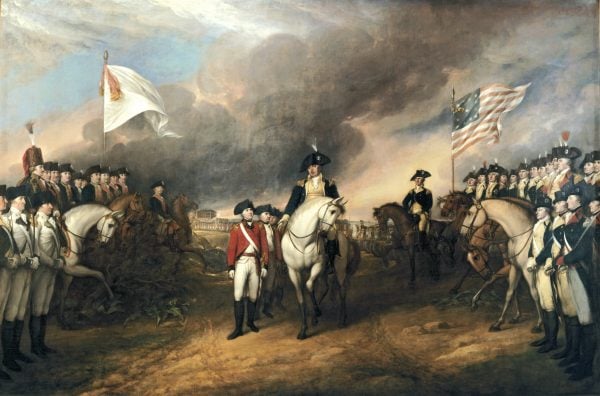
Humiliated, the British marched to Surrender Field, flags cased, playing a British tune (appropriately, “The World Turned Upside Down”). Cornwallis pled illness and left the surrender duties to his second-in-command, Brigadier General Charles O’Hara. In a ceremony full of subtexts, protocol, and messages, O’Hara first offered his sword to the French commander, Comte de Rochambeau, attempting to avoid acknowledging that the mightiest army in the world was surrendering to “rebel rabble.” Rochambeau politely informed O’Hara that his offer was misplaced and pointed to Washington. Upon being offered the sword, Washington dryly observed that the British commander seemed to be absent and directed O’Hara to give the sword to his second in command, the same Benjamin Lincoln who had been denied honors at Charleston the previous year. Washington knew his protocol – and he knew how to twist the knife. That evening, as was customary, Washington hosted a banquet for the defeated British and all was polite and collegial –but Washington made certain the British knew that he was the host – and the victorious general.
