

George Washington was the furthest thing from a “share the campfire with the boys” leader. Often traveling by carriage, he typically stayed in a comfortable farmhouse near the military encampment and usually dined with his aides or generals.
But after his Christmas-time 1776-1777 victories at Trenton and Princeton, his soldiers became extraordinarily devoted to their leader. Partly, this was because of his personal bravery. At Princeton, in particular, he earned the admiration of his troops when he rode out between the lines … and sat there on his horse as if daring the British to shoot at him. He wasn’t touched, which led some to say that the British were so awed at his bravery that they didn’t dare fire at him, while others said, No, he was protected by some magical force. Either way, it was the stuff of legends.
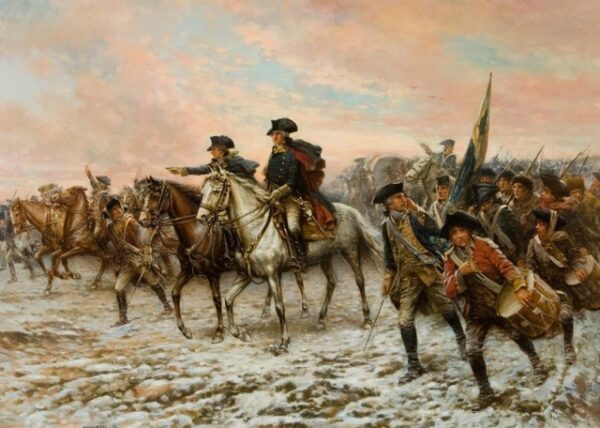
His military aggressiveness also earned him high marks. The attacks at Trenton and Princeton were truly bold moves. And his ability to escape from tight places – his retreat from Brooklyn the previous summer, his nighttime deception that allowed his army to march around the British main force and attack a rear-guard at Princeton, earned his soldiers’ gratitude and admiration.
In a time when pay and supplies were both hard to come by, Washington’s soldiers also appreciated his advocacy on their behalf.
Washington made many mistakes during his first year of command. After a surprisingly strong showing in the war’s opening months at Bunker Hill, Washington nearly lost his army several times when he tried to defend a place and dared the British to attack him. The more mobile British nearly surrounded and bagged Washington’s whole army in Brooklyn and captured much of his army and most of his cannon at Fort Washington.
But he learned from his mistakes. He came to believe that the army IS the rebellion. He understood that the key to success was to keep the army intact. He knew he couldn’t allow the army to get trapped or forced to fight a full-scale battle and that defending cities or forts was an unnecessary risk.
The key to American success was to try to match the whole army against part of the enemy and to use surprise, confusion, and deception.
He also came to believe that he could not rely on militia and must have a regular, trained army. The current practice of one-year enlistments was untenable; he needed longterm commitment for stability and training.
And the British were learning what it was like to fight an aroused population in that population’s home territory. You can march an army from place to place (or move by water) and you can capture and hold a city or build and hold a fort in the back country.
But any patrol going five miles from your city or fort will be attacked and any army leaving the coast for the interior can’t be resupplied. The British were trapped in their garrisons. Occupying a city was relatively easy but not worth much. The hearts and minds of the population proved elusive and British attempts to crack down, or Loyalist acts of revenge, proved counterproductive.

Thank you Leon for your insightful article. Very interesting as I get to know Washington better with your help. Al