
I’ve been re-reading Isaac Asimov’s sci-fi classic, The Foundation Trilogy. While we often read that the classics 1984 or Farenheit 451 or Brave New World forecast our future or present, I’m surprised I haven’t yet read anything that notes the eerie similarity between our present fix and Asimov’s “fiction.” Neither Orwell nor Bradbury nor Huxley forecast Donald Trump – but Isaac Asimov did.
To summarize quickly, a “psychohistorian” named Hari Seldon develops a form of mathematics that allows him with great accuracy to predict the future behavior of large populations of people. He calculates that the all-powerful Galactic Empire, seemingly at the height of its powers, will inevitably crumble, leading to a massive decline of civilization and a period of decay and anarchy that could last 30,000 years. He develops a Plan that, if followed faithfully, may cut this time to as little as 1000 years.
Since he won’t be around, Seldon appoints a Foundation to see that the Plan is followed. And he makes one rule vital to the Plan’s success: there will be periodic crises and the successful navigation of each – which will assure the Plan’s continuation – depends on doing nothing until the imminent crisis makes the solution obvious and self-evident.
Well, we have our own Seldon’s Plan – Madison’s Constitution, which attempted to anticipate and counter potential threats, particularly the appearance of a tyrant. And we certainly have a durable tradition of putting things off until the last possible minute. Whether Churchill actually said it or not, the quote often attributed to him that, “You can always count on the Americans to do the right thing, after they have exhausted all the other possibilities” reflects his view and that of many other mid-to-late 20th century leaders.
And we’ve certainly faced our Seldon Crises – and followed Seldon’s advice to put off anything until the last minute. Jefferson himself argued the evils of slavery – but said the problem’s solution would require people smarter than him. That finally took a Civil War – and another 100 years of Jim Crow.
Many of our crises were ended by the adoption of Constitutional amendments. The crisis of elections posed by the 1800 election was solved by the 12th amendment. The crisis of slavery was solved – on paper at least – by the 13th, 14th, and 15th.
Besides a variety of antitrust and labor laws, the economic and political abuses of the Gilded Age were partly addressed by the 16th (income tax) and 17th (direct election of senators) amendments. And besides court decisions like Brown vs. Board of Education and legislation like the Civil Rights and Voting Rights acts, the civil rights crisis was partly addressed by the 23rd (voting rights for citizens of the District of Columbia) and 24th (prohibition of poll taxes) amendments.
We didn’t need a Constitutional amendment to join the 20th century war against totalitarianism, but we certainly waited – as Seldon would have advised – until events – the Japanese attack on Pearl Harbor – removed any alternative. So, as of 2016, Asimov fans or fans of Madison’s Constitution could have looked at the U.S. with a sense of satisfaction that The Plan was on course.
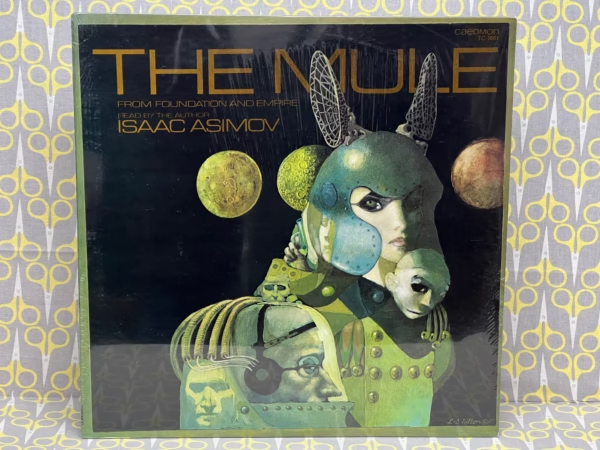
And Donald Trump appears in The Foundation trilogy. Midway through the second book, Seldon’s plan (Madison’s constitutional construct) is disrupted by the arrival of a mutant – The Mule – who, despite severe physical shortfalls, possesses enormous power to control human emotions and behavior. Unpredicted by Seldon, who can forecast human behavior but not the arrival or actions of a mutant, The Mule quickly shatters civilizations, the Foundation, and Seldon’s plan. His power sweeps quickly through the universe. And in the wake of the Mule’s period of rule, the Foundation struggles to reconstruct itself and reassemble the shattered elements of The Plan.
Donald Trump has been The American Mule. He has shattered most elements of the Constitutional construct, most notably the system of checks and balances that Madison said was the key to everything. The notion that there are three independent branches of government and that there are restraints on presidential behavior has been shattered. It could be argued that Madison and Hamilton anticipated the possibility of a Donald Trump, but they never forecast that the other two branches would surrender so meekly – as The Mul’s opponents also did.
And just like the post-Mule Foundation, we face a period of enormous uncertainty and instability after the departure of Donald Trump from the world stage. It is by no means certain – in fact all but impossible – that we will simply shift back to things as they were before.
