
I’ve been quiet from writing for a little while. It was a heavy winter and a full spring, and I’ve been practicing leaving space for breath, reflection and close listening. As I navigate serving as a space holder for holistic wellness practices and generally functioning as a 21st Century householder moving into the second half of a year that has somehow been both heartbreakingly tumultuous and breathtakingly beautiful all at once… there has been a lot to process. Others who I share space with seem to identify also with this sense of overwhelm, and need for pause and recalibration. In group yoga classes, sometimes we practice sending the softness of the exhale into places in our bodies, minds and hearts that feel strained, pained or unsettled. So I open here with an invitation to take a full breath in and out for all of us.
I write this also as an invitation to connection, curiosity and ongoing conversation. With plenty of pause for reflection and deep listening.
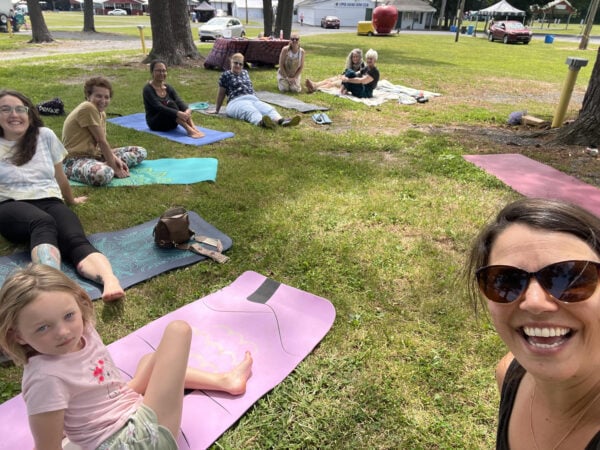
As a Yoga teacher and business owner, as a parent, partner and friend, and as a member of this community, I’ve been reflecting a lot on the importance of not just self-care, but rather– the power of collective care practices. Practices that nourish and sustain the bodies, minds and hearts of individuals and their communities. Practices that build a culture of compassion and resilience that ripples both inward and outward. Practices that center and hold the most vulnerable parts of ourselves, the most vulnerable people and places among us, and the parts of our shared history that have yet to be healed.
As an American citizen living in an historical center of our nation celebrating 250 years of independence, I’ve been reflecting on the spirit of collective liberation, especially at a time when many folks in our community and more broadly this nation, known lovingly as “the land of the free,” still do not identify with a real sense of freedom, and in many cases have been losing their liberties. I name this truth also as a person with relative proximity to power– a white, middle class, cisgender, educated, well-resourced, community-supported, business-owner. And from this position, I ask: How can we create braver spaces here in the heart of American history, and in doing so, continue to create and transcend our history? Spaces to gather, repair, heal and continue carrying forward our story in a way that illuminates all of us, and the land we call home? What would this look like? What would it feel like?
Let’s look to the story-tellers.
One space that felt deeply hopeful and inspiring to me this past year was the Gettysburg Film Festival. In April, documentarian Ken Burns, historian Rick Atkinson, broadway performer Christopher Jackson, and local filmmaker Jake Boritt gathered on stage to discuss the complexity and nuance of the birth of our nation– the deeply flawed and human story that has brought us remarkably to where we are today. It was a conversation that has been lingering on my mind and heart ever since. Christopher Jackson emotionally reflected on his approach to embodying the role of George Washington as a Black American and young parent. He shared that his first step to living this history was traveling to Washington’s home at Mount Vernon. He wanted to place his feet on the earth, the land that his ancestors had manicured, tended, and lived on, in enslaved bodies, co-existing in the same space that was inhabited by their oppressors. He wanted to be present to past, current, and future generations of Americans, from all walks of life, in all their inherently flawed human roles, who made contact with this land, and the stories and songs of healing and resilience that carried and will continue to carry this land forward. So that he might sound the chord of our history more authentically, from a place that felt connected to a shared truth. (These words are not directly quoted, but rather are relayed from my perspective as a listener who was deeply moved. I sincerely hope that I have accurately represented the intention of his message, as it was beautifully spoken.)
Jackson also spoke about how one of the greatest thrills and joys of his life was how the Hamilton production unexpectedly drew in such a cross section of the American population– how in a single audience there might be a prominent Republican politician and a left wing news anchor, a folk musician and a hip hop artist, a rural white retired school teacher and an urban African American high school student— all there to experience a re-telling of the story of our nation’s birth, and to reconsider and rediscover, or perhaps for many, to see for the first time, their place in it.
Later that weekend, sitting next to Jackson on stage, actress Phillipa Soo shared a backstage story in rehearsal of the closing scene in her role as Eliza Hamilton. In the final moment of the production, Eliza gasps, lifting her gaze and arms toward the heavens, toward future generations, toward those who came before, toward endless possibilities, toward what might become of her own story…the list of potential interpretations played over and over again night after night to thousands of human perspectives is wide open. But the director requested that regardless of how she played the scene or how it might be interpreted by her or the audience, that she must end the show on an inhale. Why? Because “he wanted the audience to have the exhale.” Phew! My whole body exhaled when I heard that. I think everyone in the audience exhaled together in fact, with a deep sense of knowing that they were seen and that all of us are an essential piece of the story.
We are all part of the story and the story is part of us.
We carry our stories and our history with us in our bodies and our nervous systems– generational trauma, global trauma, environmental trauma, personal lived experience and shared human experience. In “The Trauma of Caste: a Dalit Feminist meditation on survivorship, healing and abolition”, historian, singer/songwriter and Indian American Dalit activist, Thenmozhi Soundararajan describes how, as these human experiences live in our bodies, their release requires an embodied response. Not only so that we might heal and repair our own bodies, minds and hearts, and move toward a place of equanimity, but ultimately so that we might work to heal and repair our communities and work together toward a place of compassionate consciousness and collective liberation. As Buddhist peace activist Thich Nhat Hanh describes this concept, we must recognize our Interbeing, not just an interconnectedness with each other, but with past and future generations, and with the Earth itself. As Mother Teresa says, “If we have no peace, it is because we have forgotten that we belong to each other.”
It has occurred to me that this is one reason why I love this place we get to call home– a place of history, story-telling and learning, a place rooted in agriculture and an ancestral connection to the land, a place steeped in creative expression, a place where people from all over the world come to explore and learn from our shared human experiences, and a place where there are so many beautiful humans who genuinely care and show up for each other.
We come home to Interbeing.
Gettysburg is a place where people come home to their history, but it’s a place that we, Gettysburgians, are fortunate to call home and it’s a place that offers an abundance of authentic nourishing spaces of collective care. And for me personally, I speak not only of Adams County as home, but also the practice of Yoga (sometimes referred to as a practice of coming home to oneself and to each other). In my role in this community, this is where I see a daily opportunity for illuminating a spirit of Interbeing. On the Yoga mat, we are invited to bring a loving awareness into the cross-sections of our hearts, and welcome our whole selves, with compassion. We also welcome together with intention, and breathe in synchrony, along the cross-sections of our community. Where else can a retired college professor, a struggling elementary school teacher and a reenactor, a freelance musician, an Iraq War Veteran, and a farmer, a person with chronic illness, a marathon runner and a wheelchair user, a person quietly living through depression and a strained mental health therapist, a Buddhist-aligning Jewish meditation teacher and a Christian pastor, a grieving daughter, a single father, a nonbinary partner, an ally sister, an exhausted caregiver, a friend, a neighbor and a tourist …all come together to repair, heal, and regulate their nervous systems in community with a collective exhale? That’s right– for me, it’s Yoga. But only when the practice is truly inclusive, accessible and rooted in connection. In her historical recounting, Soundararajan reminds us that even the traditions of Yoga are inherently entangled with and have historically reinforced harmful systems of oppression and exclusion that we must, as space holders and practitioners, be working to intentionally dismantle. Just like Jackson and Soo, one way Soundararajan approaches this is through song. Because…
Music also lives in our bodies, minds and hearts.
Just as Jackson and Soo described their experience of retelling our nation’s story night after night to a different audience through the power of music as an act of collective healing, I’ve been thinking about all the places in our community where folks gather in the vibration of sound and music, and how this too, feels like a very real and meaningful collective exhale– a practice that nourishes and sustains, lifts spirits and sparks joy. Not only the actual resonance of musical instruments, voices in harmony or bodies joined in song and dance, but also pausing to notice the sounds of bird song or the breeze moving through orchard trees, the hum of a bee, the rhythm of our breath. Songs, sounds and movement that tell stories.
Making music together or in the solace of our own hearts is a form of soul-tending and collective care practice within both sacred and secular spaces that has been present in our human story from the beginning of time– whether through carrying forward oral histories, marching into battle, singing a hymn, chanting a mantra, lifting voices in songs of resistance, moving hips in unison at a benefit concert or joining in chorus to celebrate a life well-lived. Whether it’s a stressed out under-resourced mom singing Alanis Morisette at the top of her lungs out a car window rushing to her 2nd job after dropping off her children at school, a single immigrant father rocking and singing his child to sleep and his own heart to rest with the words “canta y no llores”, or teens singing the story of the birth of our nation to a Hamilton soundtrack in their southeast DC history class, for the first time feeling seen as part of the story– these are all songs of liberation.
These are embodied practices that free the soul and connect us deeply to each other.
And the vibrations ripple both inward and outward. In their poem, Say Yes, Poet Andrea Gibson articulates the power of this reverberation and connection through the following imagery.
“When two violins are placed in a room if a chord on one violin is struck
the other violin will sound the note
If this is your definition of hope
This is for you
The ones who know how powerful we are
Who know we can sound the music in the people around us
simply by playing our own strings
for the ones who sing life into broken wings
open their chests and offer their breath…”
I listened to an interview with Andrea in which they described their inspiration for this poem, learning that while this is true of stringed instruments, it’s also true of humans– that when two people embrace for long enough, the beating of their heart, the rhythm of their breath begins to naturally synchronize. As another beloved Yoga teacher of mine recently reminded me, in order to sound the strings in those around us, we must also continue to tune our own strings, and pause to listen. Self care is a part of collective care.
Song. Movement. Breath. Space for deep listening. Continued reflection…
I’ve been overwhelmed recently by the beauty and joy of these forms of collective care and co-regulation right here in Adams County over the past few weeks.
Communities in vibration. Communities in connection.
I’ve seen this at events like The Gettysburg Brass Festival, making music accessible by bringing free music into the streets, including the global rhythms of the West Philadelphia Symphony, at the “From Spirituals to Soul” Juneteenth Celebration of 250 years of Black Music, another free community concert at the Majestic Theater, in the Gettysburg Pride Festival with this year’s theme: A New Birth of Freedom, and in the recent Dig My Earth Music Festival in benefit of the Adams County Land Conservancy, an organization dedicated to preserving the beautiful land we call home. I hear it in the buzz and delight in anticipation of Black American stories finally being heard and honored at the new Hopkins House Museum (grab your ticket for a sneak peak on July 2 and the stage production of “Basil Biggs” at Kline Theater later that evening!), in the rhythms of our annual Salsa on the Square event in collaboration with Project Gettysburg Leon during Hispanic Heritage Month, in the voices of my own children as they prepare to perform with the Penguin Project, a theater group for children and adults with special needs and peer mentors, at the Gettysburg Community Theater later this year, in the open community music jam every Friday evening with our new neighbors Tonality Music Therapy, and in the quieter behind-the-scenes voices of the volunteer team at St. James Lutheran Church as they, along with other faith-based organizations, coordinate to provide a safe place for those who have no place to rest through the Gettysburg C.A.R.E.S. program.
This is just to name a few of the many amazing vibrations bringing people together to nourish, repair and sustain life right here in our midst. I am deeply grateful for all the folks who are sounding the music in the people around them simply by playing their own strings. These are people and spaces that inspire hope. But they are also places that we choose because they feel in harmony with the songs of our own hearts. And while I find that being in connection and care with other like-minded people is a beautiful and necessary thing, I believe creating braver spaces requires this and more. I wonder how we might be more intentional about rippling this collective care outward into the most vulnerable intersections of our shared spaces, and into the cross sections of our communities where there is discord.
We tune our own strings and then pause to listen…
The best musicians listen not only to the vibrations of their own instrument, not only to the other instruments in their section, but to the other sections of the orchestra— from the tubas to the piccolo. However the reality is that we choose what instruments we want to jam with. And that is a beautiful thing. But if we really want to learn and expand our chorus, we have to be willing to also listen to the voices outside of the music we are already making. That doesn’t mean dropping ourselves right into the middle of a space that feels discordant with our belief system. It doesn’t mean turning away from our own song. I think a pause for deep listening can be most meaningful, most powerful, when we open ourselves to one-on-one conversations, unexpected connections that expand our own personal perspectives and convictions. Perhaps places where we hear our shared stories retold to a different tune.
Over the past year I have come to know a local Civil War reenactor, who represents a space of gathering that I generally, even after living most of my life in Gettysburg, have zero connection to. If I’m being totally honest, I have intentionally tried to avoid it, as the sounds of gunfire and battle cries feel to me not celebratory but triggering in nature– in other words the vibrations of the reenactment feel discordant to me. But this individual who I now call friend, also happens to be a regular yogi at Rise and one of my regular mindful walking buddies. This past fall we met monthly, taking off our shoes, connecting to the land, and reflecting on the words of walking meditation teachers, including Thich Nhat Hanh, who invites us to “walk as though your feet kiss the Earth.” With this beautiful and heart-warming sentiment at the forefront, I confided during one of our walks this past Spring that I’ve never understood the practice of reenacting the most gruesome days of our history and asked how he handled reliving the battle over and over again. Without pause, he spoke about his years of dedicated connection with the battlefields that surround this place we call home, the presence of those who came before us, and what sounded like a strong influence from the indigenous heritage of his wife and their deep ancestral connection to the land. He shared that he walks in the steps of our ancestors to honor their lives, expressing a desire to place his feet on the land where those who came before us co-existed, in all of their inherently flawed, and messy forms of humanity– not north or south, enslaved or free, but for all of them, so that all might know that their spirits are carried forward, and that future generations might learn from our history. I paused for an inhale, a few minutes of quiet walking, and a then shared exhale. It didn’t come right away, but after a few moments (and months) of reflection I realized that– for him this was a space of Interbeing. An annual reminder of our interconnectedness with each other, with past and future generations, and with the land we all live on. A reminder that if we have no peace it is because we have forgotten that…
We belong to each other.
Where might there be opportunity and spaciousness to welcome in a pause, to breathe across a discord? To listen deeply, and to create space for care, curiosity and compassion to expand just a bit? What would it feel like to allow this to ripple both inward and outward? I certainly don’t have all the answers. And the reflection continues. But I think this is at the heart of collective care.
As we continue to celebrate Juneteenth, and Independence Day two weeks later, still right now deep in the heart of Pride month, and honoring Disability Pride month in July, and as we continue to move through America 250 celebrations this year— all of this co-existing in one of the most historically significant locations in our country, where folks from all over our nation will gather to celebrate, learn and remember. Could it also be a place where we collectively nourish, repair and heal? I invite us all to really pause and reflect, to appreciate the significance of this intersection, this moment in time and the power it holds. And to hold space for each other. To remember we are all part of the story. What does it look like to embody– individually and as a whole community– the notion of collective care and liberation?
With a full breath in, be reminded of the words of Civil Rights movement activist, Fannie Lou Hamer, and repeated by many other peacemakers and earthshakers, that “None of us are free until all of us are free.” And as you exhale, consider how you might land in this 251st year with a spirit of Interbeing, and carry forward an embodied intention of care for all of us. What spark of hope might exist within the next collective inhale?
This summer, as I continue to celebrate and reflect on my own connection to this community, to our shared history, to this precious Adams County landscape that we get to call home, and to my sweet daughters and the future we will give them, I close with the words and vision of indigenous author Robin Wall Kimmerrer, in her book Braiding Sweetgrass: Indigenous Wisdom, Scientific Knowledge and the Teachings of Plants. She says, “I want to stand by the river… I want to sing, strong and hard, and stomp my feet with a hundred others so that the waters hum with our happiness. I want to dance for the renewal of the world…”
I hope I see you on the dance floor this summer, friends.
As a contribution to Gettysburg’s America 250 Celebration at the Gettysburg Rec Park, Rise Yoga will be partnering with Soulshine by Shannon on the morning of July 4th for a free sound bath meditation at 8:30 am followed by a special offering of our regular weekly Yoga in the Park class, centered in the theme of Collective Liberation. We invite you to start your celebrations of independence by joining us in community for a collective, and reflective exhale. May the softness of this exhale create space for compassion, collective care and love that ripples inward, outward and into the Earth, this beautiful Adams County land that holds all of us.

Thanks for giving us a guide for what this community can be. ❤️