

At the beginning of the Revolution, the British occupied all of North America north of Spanish Florida out to the Mississippi River. The original 13 colonies were pushing settlement out to – and occasionally beyond – the Appalachian mountains. Some of the colonies, most notably Virginia but also Connecticut, Massachusetts, North Carolina, and Georgia, had claims based on their original Royal charters to lands west of the Appalachians. But as the British and the colonies had learned 20 years earlier when the French occupied the Forks of the Ohio, the only way to make a land claim real is to take possession. And, except for some scattered settlements in present-day Kentucky and Tennessee, the land west of the Appalachians unquestionably was possessed by the Crown and not by the rebelling colonies.
George Rogers Clark was born in Albemarle County, Virginia in 1752 and apprenticed as a surveyor. He traveled often to western Virginia and even across the Appalachians into Kentucky. When the American Revolution broke out, Clark knew that the frontier would be vulnerable to both attacks by the British at Fort Detroit and the Native Americans. And indeed, in 1777, the British in Detroit began encouraging Indians to raid white settlements in what is now Kentucky.
Clark sent scouts who reported that most of the British soldiers in the small outposts in the Illinois territory south of Detroit had been pulled out and that the population – mainly French speakers who had lived there before the British gained possession – had no love for their English occupiers. In December 1777, Clark met with Virginia governor Patrick Henry and proposed a mission to end British control of the “Illinois Territory,” the land north of the Ohio River that now makes up the states of Indiana and Illinois. He was commissioned a lieutenant colonel in the Virginia militia and was directed to take a small force to the west to evict the British from territories claimed by Virginia.
After drilling and training his men near present-day Louisville, KY, Clark’s men floated down the Ohio River in flatboats, then marched 120 miles cross-country to capture the British posts at Kaskaskia and Cahokia, near present-day St. Louis on the Mississippi River. His small army arrived in the evening on July 4, 1778, and captured the post without firing a single shot. Fort Sackville in Vincennes, IN, fell to Clark and his men the next month.
However, by December the British had retaken the Fort at Vincennes. Knowing that the British would attack Kaskaskia in the spring, Clark decided to strike first.
Clark and his men left Kaskaskia on their march to Vincennes on February 6, 1779. The weather was relatively warm but snow melt, constant rain, flooding made for a difficult journey. Clark’s army reached Vincennes on February 23 and surrounded the fort. Clark ordered the execution of 5 Native Americans during the siege and the intimidation worked: Lt. Gov. Henry Hamilton surrendered the fort.
During the campaign, Clark also was successful in negotiating tenuous peace agreements with many area tribes. Clark also conducted a retaliatory campaign against frontier Indians in 1780.
Clark is overshadowed in American history by his cousin, William Clark, co-leader of the Lewis and Clark Expedition. But his successful campaign was critically important to the new nation’s future. Together with successes against the British further south by Spanish governor Bernardo de Galvez, these conquests did much to undercut British land claims west of the Appalachians. When the Treaty of Paris granted the new United States all the land north of Spanish Florida and south of Canada to the Mississippi River, the stage was set for continental conquest.
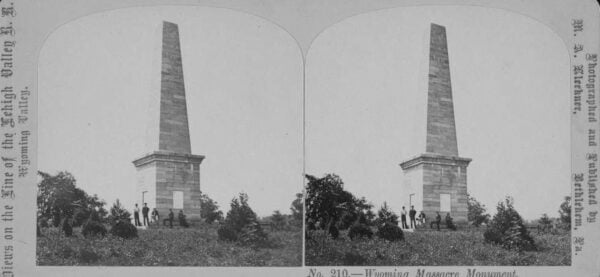
Featured image caption: Stereo view of Wyoming Valley massacre monument

at the southern tip of Illinois at the town of Metropolis, sits Fort Massac state park ,featuring a statue of George Rogers Clark ,overlooking the Ohio river.